
Question 241 markMCQAsked 2024Easy
A radioactive nucleus containing 128 nucleons emits a β – particle. After β – emission the number of nucleons present in the nucleus will be :
Confirming your payment
Sign up now and get 250 free tokens.
Previous Year Questions · Question 24 of 45
A radioactive nucleus containing 128 nucleons emits a β – particle. After β – emission the number of nucleons present in the nucleus will be :
(A) 128
(B) 129
(C) 124
(D) 127
Answer: (A) 128
Concept: The number of nucleons (protons + neutrons) is the mass number A. In β emission a neutron inside the nucleus changes into a proton and an electron, and the electron is thrown out. So A stays the same and Z rises by 1: a new element, one place forward in the periodic table.
Step 1 — See what happens to the nucleons.
In β emission one neutron inside the nucleus turns into a proton. One nucleon changes its type, but no nucleon leaves the nucleus.
Step 2 — Count the nucleons after.
The electron that is thrown out is not a nucleon, so the count does not change.
The nucleus now has one neutron fewer and one proton more.
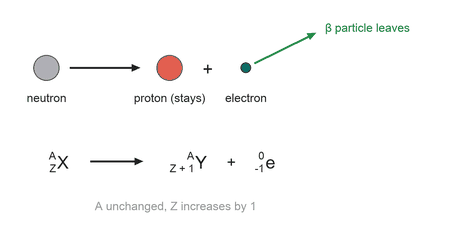
Watch out: The electron given out is created in the decay; it was never one of the 128 nucleons.
Why the other options are wrong:
Therefore, the nucleus still has 128 nucleons, option (A).