Solution:
Concept: Electric and magnetic fields push only on charged particles. In an electric field a positive charge is pulled towards the negative plate and a negative charge towards the positive plate; in a magnetic field the force on a moving charge is given by Fleming's left hand rule (forefinger along the field, central finger along the current, thumb gives the force). Uncharged γ radiation goes straight on. Thick, dense materials such as lead, steel and concrete absorb nuclear radiations.
(a)
Step 1 — Find the undeviated radiation.
γ radiation carries no charge, so the electric field exerts no force on it and it travels undeviated.

(b)
Step 2 — Stop the radiation escaping.
The reactor core is shielded by thick walls of lead and steel, and the whole reactor is housed in a strong, airtight building of thick concrete. These thick walls absorb the radiations so that they cannot escape into the surroundings.
(c)
Step 3 — Name an internal source.
Background radiation also comes from inside our own body. Radioactive potassium-40 is present in our body, along with traces of carbon-14 and radium.
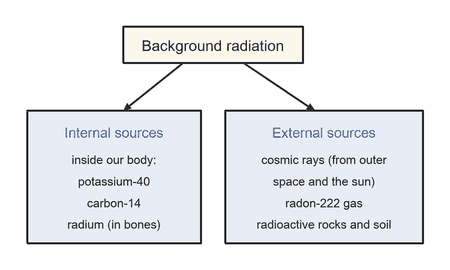
Watch out: An INTERNAL source is inside our body; cosmic rays and radon in the air are external sources.
Therefore, (a) γ radiation travels undeviated; (b) by shielding the reactor with thick lead and steel and housing it in a building with thick concrete walls; (c) radioactive potassium-40 inside our body.
