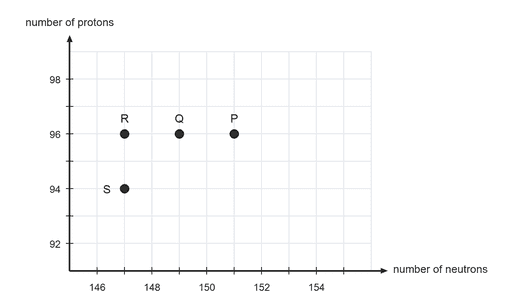
Solution:
Concept: On a graph of the number of protons Z against the number of neutrons N, every nucleus is one point, and its mass number is A = Z + N. α emission moves the point by Z − 2 and N − 2; β emission (a neutron turning into a proton) moves it by Z + 1 and N − 1; γ emission does not move it.
(a)
Step 1 — Find the point for Cm.
Curium-247 has 96 protons, and its neutrons are A − Z.
N=247−96=151
The point at 151 neutrons and 96 protons is P.
(b)
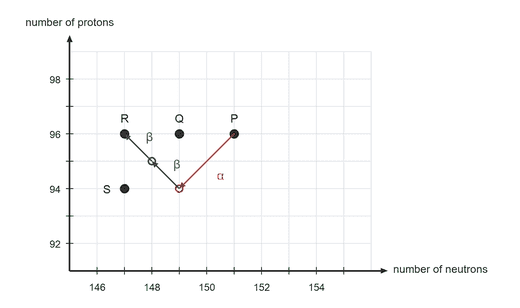
Step 2 — Apply the α emission.
α emission takes 2 protons and 2 neutrons away.
Z=96−2=94
N=151−2=149
Step 3 — Apply the two β emissions.
Each β emission turns one neutron into a proton.
Z=94+2=96
N=149−2=147
The point at 147 neutrons and 96 protons is R. Its atomic number is 96 again, so the daughter is another isotope of curium.
(c)
Step 4 — Find the mass number.
The mass number is the number of protons plus the number of neutrons.
A=96+147=243
Watch out: Read the axes the right way round: neutrons are along the horizontal axis and protons up the vertical axis.
Therefore, (a) P is the element Cm; (b) R is the daughter nucleus; (c) its mass number is 243.