
Question 323 marksAsked 2025Easy
Study the diagram given below and answer the questions that follow :
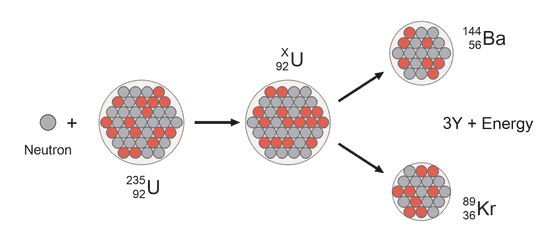
(a) Name the process depicted in the diagram.
(b) What is the value of X?
(c) Identify Y, the missing product of the reaction.
Confirming your payment
Sign up now and get 250 free tokens.
Previous Year Questions · Question 32 of 45
Study the diagram given below and answer the questions that follow :
(a) Name the process depicted in the diagram.
(b) What is the value of X?
(c) Identify Y, the missing product of the reaction.
Solution:
Concept: In nuclear fission a heavy nucleus such as , struck by a slow neutron, splits into two lighter nuclei of nearly equal size, giving out 2 or 3 neutrons and a large amount of energy (about 200 MeV per nucleus) because the products have slightly less mass. In every nuclear change the total mass number (A) and the total atomic number (Z) are the same on both sides of the equation. An α particle is , a β particle is , a neutron is and γ radiation has A = 0 and Z = 0.
(a)
Step 1 — Name the process.
A neutron strikes uranium-235, which becomes unstable and splits into two middle-sized nuclei, barium and krypton, with the release of energy. This is nuclear fission.
(b)
Step 2 — Find X.
The uranium-235 nucleus absorbs the neutron (mass number 1) and becomes ; the atomic number stays 92 because a neutron has no charge.
(c)
Step 3 — Balance the mass numbers.
Uranium-236 splits into barium-144, krypton-89 and three particles Y, so the three Y together carry the rest of the mass number.
Step 4 — Balance the atomic numbers.
The atomic numbers must also balance.
A particle with A = 1 and Z = 0 is a neutron.
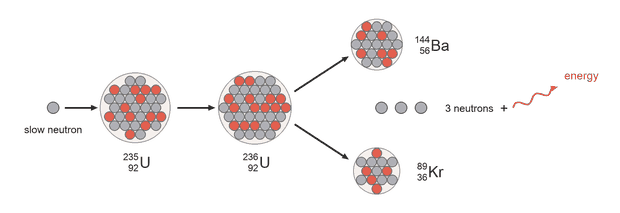
Watch out: The three neutrons released can go on to split more uranium nuclei: this is how a chain reaction starts.
Therefore, (a) the process is nuclear fission; (b) X = 236; (c) Y is a neutron, .