
Question 331 markMCQAsked 2025Easy
During β emission the parent and daughter nuclei will be:
Confirming your payment
Sign up now and get 250 free tokens.
Previous Year Questions · Question 33 of 45
During β emission the parent and daughter nuclei will be:
(A) isomers
(B) isotopes
(C) isotones
(D) isobars
Answer: (D) isobars
Concept: Isotopes have the same atomic number Z but different mass numbers A (same element, different numbers of neutrons). Isobars have the same A but different Z (different elements). Isotones have the same number of neutrons (A − Z) but different Z. In β emission a neutron inside the nucleus changes into a proton and an electron, and the electron is thrown out. So A stays the same and Z rises by 1: a new element, one place forward in the periodic table.
Step 1 — Compare the mass numbers.
In β emission the number of nucleons does not change, so the daughter has the same mass number as the parent.
Step 2 — Compare the atomic numbers.
The daughter has one more proton, so its atomic number is one more and it is a different element. Nuclei with the same mass number but different atomic numbers are isobars; for example, sodium-24 gives magnesium-24.
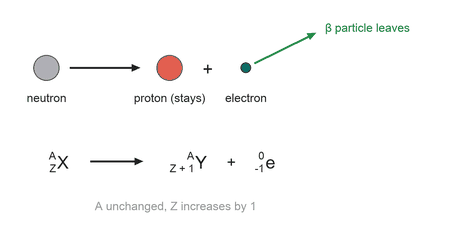
Watch out: Same A and different Z means isobars; same Z and different A means isotopes.
Why the other options are wrong:
Therefore, the parent and daughter nuclei in β emission are isobars, option (D).