Solution:
Concept: Dense materials made of heavy atoms, such as lead, absorb nuclear radiations strongly. Emitting an α particle lowers A by 4 and Z by 2; emitting a β particle keeps A and raises Z by 1 (a neutron turns into a proton); emitting γ radiation changes neither.
(a)
Step 1 — Name the element.
The special aprons (and gloves) worn by workers are lined with lead.
Step 2 — Say why lead is used.
Lead is a very dense metal with a high atomic number, so its atoms absorb radiation far more strongly than other common materials; even penetrating γ rays and X-rays are greatly reduced by it. A lead lining therefore keeps most of the radiation from reaching the worker's body.

(b)
Step 3 — Identify the radiation.
The radiation leaves the mass number unchanged, so it is either β or γ. It is deflected by a magnetic field, so it is charged; γ radiation has no charge. So it is β radiation.
Step 4 — Write the equation.
β emission keeps A = 24 and raises Z from 11 to 12, which is magnesium.
1124Na→1224Mg+−10e
Both sides balance: 24 = 24 + 0 and 11 = 12 + (−1).
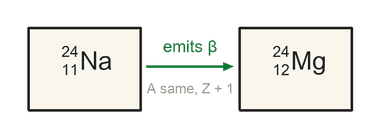
Watch out: γ radiation also leaves A unchanged, but it is NOT deflected by a magnetic field; the deflection rules it out.
Therefore, (a)(1) lead; (2) lead is very dense with a high atomic number, so it absorbs the radiations strongly; (b)(1) β radiation; (2) 1124Na→1224Mg+−10e.
