
Question 402 marksAsked 2026Easy
Give two differences between nuclear fission and nuclear fusion.
Confirming your payment
Sign up now and get 250 free tokens.
Previous Year Questions · Question 40 of 45
Give two differences between nuclear fission and nuclear fusion.
Solution:
Concept: Fission splits one heavy nucleus; fusion joins two light nuclei. Both release energy because the products have slightly less mass than the starting nuclei.
Step 1 — Compare what happens to the nuclei.
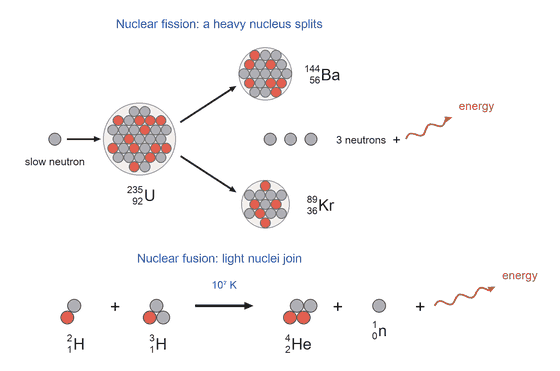
In nuclear fission a heavy nucleus (such as uranium-235), struck by a neutron, splits into two lighter nuclei of nearly equal size. In nuclear fusion two light nuclei (such as isotopes of hydrogen) combine to form a heavier nucleus.
Step 2 — Compare the conditions needed.
Fission takes place at ordinary temperature and pressure, because the neutron that starts it has no charge. Fusion takes place only at a very high temperature (about 10⁷ K) and very high pressure, because the positive nuclei repel each other.
Step 3 — Note further differences.
For the same mass of fuel, fusion releases about four times as much energy as fission. Fission products are strongly radioactive for a very long time, while fusion leaves far less radioactive waste.
Watch out: Fusion is not completely free of radioactivity: tritium is mildly radioactive and the fast neutrons make the reactor walls radioactive, but the waste is far smaller and shorter-lived.
Therefore, (1) fission splits a heavy nucleus into two lighter nuclei, while fusion joins two light nuclei into a heavier one; (2) fission takes place at ordinary temperature, while fusion needs a very high temperature (about 10⁷ K).