
Question 22 marksAsked 2016Easy
A radioactive substance is oxidized. Will there be any change in the nature of its radioactivity? Give a reason for your answer.
Confirming your payment
Sign up now and get 250 free tokens.
Previous Year Questions · Question 2 of 45
A radioactive substance is oxidized. Will there be any change in the nature of its radioactivity? Give a reason for your answer.
Solution:
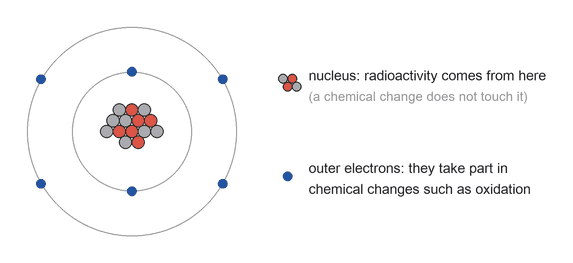
Concept: Radioactivity is a nuclear process: it comes from an unstable nucleus. A chemical change (such as oxidation) involves only the outer electrons of the atom, so it cannot change the nucleus, its radiation or its rate of decay.
Step 1 — Say what oxidation changes.
Oxidation is a chemical change: the atoms of the substance join with oxygen by sharing or transferring their outer electrons. Only these outer electrons take part.
Step 2 — Say where radioactivity comes from.
Radioactivity is the spontaneous break-up of an unstable nucleus. The nucleus lies deep inside the atom, and a chemical change does not reach it.
Step 3 — Draw the conclusion.
Because the nucleus is unchanged, it gives out the same kind of radiation (α, β or γ) at the same rate, whether the substance is free or combined as an oxide.
Watch out: The oxide is a new compound, but its radioactive nuclei are the same nuclei as before.
Therefore, no, there is no change in the nature of its radioactivity, because oxidation is a chemical change involving only the outer electrons, while radioactivity is a property of the nucleus.