Solution:
Concept: In nuclear fission a heavy nucleus such as 92235U, struck by a slow neutron, splits into two lighter nuclei of nearly equal size, giving out 2 or 3 neutrons and a large amount of energy (about 200 MeV per nucleus) because the products have slightly less mass. In α emission the nucleus throws out 2 protons and 2 neutrons together, so A falls by 4 and Z falls by 2: a new element, two places back in the periodic table.
(i)
Step 1 — Name the isotope.
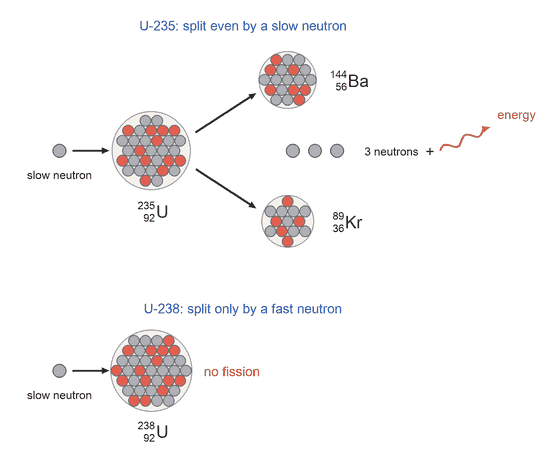
Of the two isotopes, uranium-235, 92235U, is the one that is easily fissionable.
(ii)
Step 2 — Give the reason.
A slow neutron is easily captured by a U-235 nucleus, and the nucleus then splits. A U-238 nucleus can be split only by a fast neutron; a slow neutron striking it is just absorbed without fission. In a natural ore the neutrons soon slow down, so U-235 is the one that keeps on splitting.
(iii)
Step 3 — Find the daughter nucleus.
An α particle carries away 4 from the mass number and 2 from the atomic number.
A=238−4=234
Z=92−2=90
Atomic number 90 is thorium.
Step 4 — Write the equation.
Both sides now balance: 238 = 234 + 4 and 92 = 90 + 2.
92238U→90234Th+24He
Watch out: U-238 is also fissionable, but only by FAST neutrons; the question is about which one splits easily.
Therefore, (i) uranium-235 is easily fissionable; (ii) it can be split even by slow neutrons, while U-238 needs fast neutrons; (iii) 92238U→90234Th+24He.
