Solution:
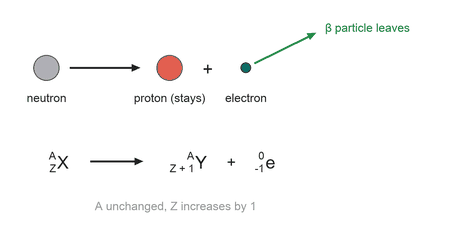
Concept: Einstein's mass–energy relation E = (Δm)c² says that a mass Δm that disappears in a nuclear change reappears as energy E, where c = 3 × 10⁸ m s⁻¹ is the speed of light. In atomic units, a mass of 1 a.m.u. is equivalent to 931 MeV. In β emission a neutron inside the nucleus changes into a proton and an electron, and the electron is thrown out. So A stays the same and Z rises by 1: a new element, one place forward in the periodic table.
(a)
Step 1 — Define nuclear energy.
Nuclear energy is the energy released from the nucleus of an atom in a nuclear reaction, fission or fusion. The products have slightly less mass than the reactants, and this lost mass Δm is changed into energy.
E=(Δm)c2
(b)
Step 2 — Identify the radiation.
A rise of 1 in the atomic number means one extra proton. This happens in β emission, when a neutron changes into a proton and an electron and the electron is thrown out. So the radiation is β radiation, −10e.
(c)
Step 3 — Write the nuclear reaction.
The mass number stays A and the atomic number rises from Z to Z + 1.
ZAX→Z+1AY+−10e
For example, sodium-24 changes into magnesium-24:
1124Na→1224Mg+−10e
(d)
Step 4 — Name the pair.
The parent and the daughter have the same mass number but different atomic numbers, so they are called isobars.
Watch out: In β emission the mass number does NOT change, so parent and daughter are isobars, not isotopes.
Therefore, (a) nuclear energy is the energy released from the nucleus in fission or fusion, from a loss of mass; (b) β radiation; (c) ZAX→Z+1AY+−10e; (d) isobars.
