
Question 171 markMCQAsked 2022Easy
To study the age of excavated material of archaeological significance we study the rate of decay of an isotope of :
Confirming your payment
Sign up now and get 250 free tokens.
Previous Year Questions · Question 17 of 45
To study the age of excavated material of archaeological significance we study the rate of decay of an isotope of :
(A) Uranium
(B) Cobalt
(C) Carbon
(D) Chlorine
Answer: (C) Carbon
Concept: The age of excavated remains of once-living things (wood, bone, cloth) is found by carbon dating, which measures how much radioactive carbon-14 is left in them.
Step 1 — See how carbon-14 gets into living things.
Every living plant or animal keeps taking in carbon (as carbon dioxide or food), and a small, fixed share of it is radioactive carbon-14.
Step 2 — See what happens after death.
After death no new carbon-14 is taken in, and the carbon-14 already present keeps decaying by β emission at a known rate. Measuring how much is left tells how long ago the plant or animal died.
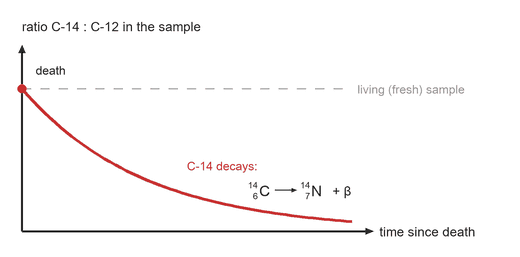
Watch out: The method works only for things that were once alive, because only they took in carbon-14.
Why the other options are wrong:
Therefore, the age of excavated material is found from the rate of decay of an isotope of carbon (carbon-14), option (C).