Solution:
Concept: Living things keep taking in carbon, a small fixed share of which is radioactive carbon-14. After death no new carbon is taken in, so the carbon-14 left keeps falling as it decays. In every nuclear change the total mass number (A) and the total atomic number (Z) are the same on both sides of the equation. An α particle is 24He, a β particle is −10e, a neutron is 01n and γ radiation has A = 0 and Z = 0.
(a)
Step 1 — Name the process.
Finding the age of a fossil from its share of carbon-14 is called carbon dating (radio-carbon dating).
(b)
Step 2 — Name the pair.
Carbon-14 and carbon-12 both have atomic number 6 but different mass numbers (8 and 6 neutrons), so they are isotopes of carbon.
(c)
Step 3 — Explain the fall in the ratio.
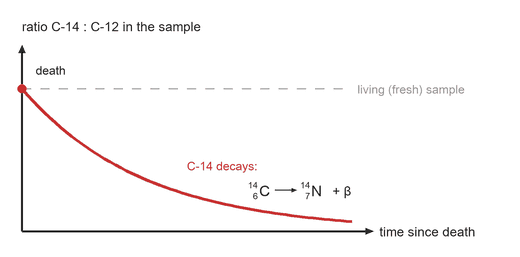
While the plant or animal was alive, it kept taking in carbon with a fixed share of carbon-14, so its ratio C-14 : C-12 was the same as in a fresh sample. After death no fresh carbon came in. Carbon-14 keeps decaying by β emission into nitrogen-14, while carbon-12 is stable.
614C→714N+−10e
So the carbon-14 falls while the carbon-12 stays the same, and the ratio decreases: the older the fossil, the smaller the ratio.
(d)
Step 4 — Balance the mass numbers.
The mass numbers on both sides must be equal; P here stands for a proton, 11H.
A+1=14+1
A=14
Step 5 — Balance the atomic numbers.
The atomic numbers must also be equal.
Z+0=6+1
Z=7
Atomic number 7 is nitrogen, so X is nitrogen-14.
714N+01n→614C+11P
This is how carbon-14 is formed in the atmosphere, when neutrons from cosmic rays strike nitrogen.
Watch out: Carbon-12 does not decay; only carbon-14 does, and that is why the ratio falls.
Therefore, (a) carbon dating; (b) isotopes; (c) after death the carbon-14 decays and is not replaced, while carbon-12 stays the same, so the ratio falls; (d) X is 714N.
