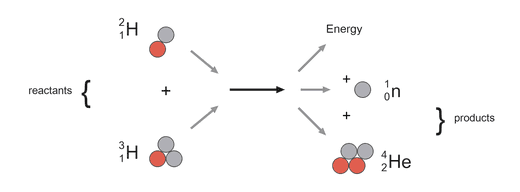
Solution:
Concept: In nuclear fusion two light nuclei (such as isotopes of hydrogen) join to form a heavier nucleus, giving out a large amount of energy because the product has slightly less mass. The nuclei are positively charged and repel each other, so fusion happens only at a very high temperature, about 10⁷ K. Einstein's mass–energy relation E = (Δm)c² says that a mass Δm that disappears in a nuclear change reappears as energy E, where c = 3 × 10⁸ m s⁻¹ is the speed of light. In atomic units, a mass of 1 a.m.u. is equivalent to 931 MeV.
(a)
Step 1 — Name the process.
Hydrogen-2 and hydrogen-3, two light nuclei, join to form helium-4 and a neutron, giving out energy. This is nuclear fusion.
12H+13H→24He+01n+Energy

(b)
Step 2 — Consider room temperature.
The two nuclei are positively charged and repel each other strongly. They can come close enough to fuse only when they move extremely fast, which needs a temperature of about 10⁷ K and a very high pressure. At room temperature they are far too slow, so the process is not possible there.
(c)
Step 3 — Compare the masses.
The energy given out comes from mass that disappears, so the products together have less mass than the reactants, by about 17.6 MeV worth of mass for each fusion.
E=(Δm)c2
Watch out: The energy comes FROM the lost mass, so the reactants must be the heavier side.
Therefore, (a) nuclear fusion; (b) no, fusion needs an extremely high temperature (about 10⁷ K); (c) mass of reactants > mass of the products.