
Question 52 marksAsked 2017Easy
When does the nucleus of an atom tend to be radioactive?
Confirming your payment
Sign up now and get 250 free tokens.
Previous Year Questions · Question 5 of 45
When does the nucleus of an atom tend to be radioactive?
Solution:
Concept: A light nucleus is stable when it has about as many neutrons as protons; heavier stable nuclei need a few more neutrons than protons (lead-208: 82 protons, 126 neutrons). A nucleus with too many neutrons for its protons, or one that is simply too big (every element with Z > 82), is unstable, and it gives out α or β particles until it becomes stable.
Step 1 — Compare neutrons with protons.
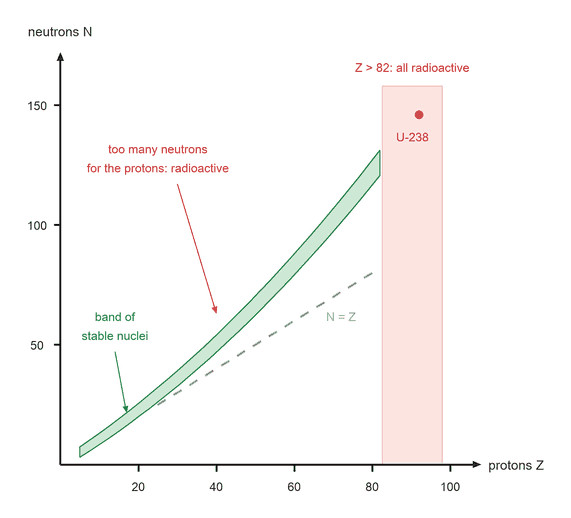
The protons in a nucleus repel each other, and the neutrons help to hold the nucleus together. A light stable nucleus has about as many neutrons as protons; a heavier stable nucleus needs a few more neutrons than protons.
Step 2 — Say when the balance fails.
When the number of neutrons is much more than the number of protons (the neutron–proton ratio is too high), the nucleus becomes unstable and gives out α or β particles until it becomes stable.
Step 3 — Give where this happens.
Every element with atomic number more than 82 (beyond lead), such as uranium, radium and polonium, is radioactive. Lighter elements have some radioactive isotopes too, such as carbon-14 (6 protons, 8 neutrons) and cobalt-60 (27 protons, 33 neutrons).
Watch out: A big nucleus is not radioactive just because it is big; it is the unbalanced neutron–proton ratio (and, beyond Z = 82, the sheer size) that makes it unstable.
Therefore, a nucleus tends to be radioactive when its number of neutrons is much more than its number of protons (a high neutron–proton ratio), as in all elements with atomic number more than 82.