
Question 123 marksAsked 2019Easy
(i) Define nuclear fission.
(ii) Rewrite and complete the following nuclear reaction by filling in the atomic number of Ba and mass number of Kr :
Confirming your payment
Sign up now and get 250 free tokens.
Previous Year Questions · Question 12 of 45
(i) Define nuclear fission.
(ii) Rewrite and complete the following nuclear reaction by filling in the atomic number of Ba and mass number of Kr :
Solution:
Concept: In nuclear fission a heavy nucleus such as , struck by a slow neutron, splits into two lighter nuclei of nearly equal size, giving out 2 or 3 neutrons and a large amount of energy (about 200 MeV per nucleus) because the products have slightly less mass. In every nuclear change the total mass number (A) and the total atomic number (Z) are the same on both sides of the equation. An α particle is , a β particle is , a neutron is and γ radiation has A = 0 and Z = 0.
(i)
Step 1 — Define fission.
Nuclear fission is the process in which a heavy nucleus, such as uranium-235, struck by a slow neutron, splits into two lighter nuclei of nearly equal size, giving out 2 or 3 neutrons and a large amount of energy (about 200 MeV per nucleus).
(ii)
Step 2 — Find the atomic number of Ba.
The atomic numbers on the left add up to 92 + 0. On the right they are Z (barium), 36 (krypton) and 0 for each neutron.
Step 3 — Find the mass number of Kr.
The mass numbers on the left add up to 235 + 1. On the right they are 144, A (krypton) and 1 for each of the 3 neutrons.
Step 4 — Rewrite the completed reaction.
Both totals now balance: 236 on each side for A and 92 for Z.
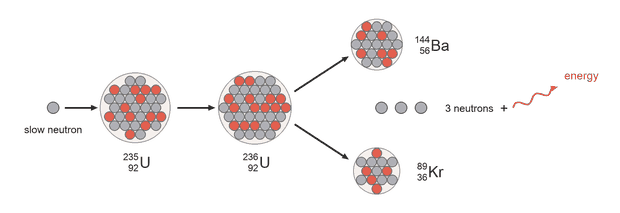
Watch out: Count all THREE neutrons on the right (3 × 1 = 3) and the incoming neutron on the left.
Therefore, (i) nuclear fission is the splitting of a heavy nucleus into two lighter nuclei of nearly equal size, with the release of neutrons and a large amount of energy; (ii) the atomic number of Ba is 56 and the mass number of Kr is 89.