
Question 143 marksAsked 2020Easy
(i) Differentiate between nuclear fusion and nuclear fission.
(ii) State one safety precaution in the disposal of nuclear waste.
Confirming your payment
Sign up now and get 250 free tokens.
Previous Year Questions · Question 14 of 45
(i) Differentiate between nuclear fusion and nuclear fission.
(ii) State one safety precaution in the disposal of nuclear waste.
Solution:
Concept: Fission splits one heavy nucleus; fusion joins two light nuclei. Both release energy because the products have slightly less mass than the starting nuclei. Spent fission fuel stays highly radioactive for thousands of years, so it must be kept away from people and the environment.
(i)
Step 1 — Compare the two processes.
The table compares them point by point.
| Nuclear fission | Nuclear fusion |
|---|---|
| A heavy nucleus splits into two lighter nuclei of nearly equal size when struck by a neutron. | Two light nuclei combine to form a heavier nucleus. |
| It takes place at ordinary temperature. | It needs a very high temperature (about 10⁷ K) and pressure. |
| For the same mass of fuel, less energy is released. | For the same mass of fuel, about four times as much energy is released. |
| Its products are strongly radioactive and stay so for a very long time. | It gives far less radioactive waste, and that waste is short-lived. |
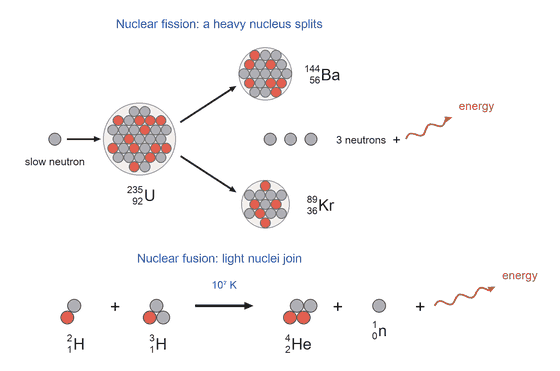
(ii)
Step 2 — State a safety precaution.
Nuclear waste should be sealed in thick, strong containers (for example of steel and concrete) and stored deep underground in specially built stores, far away from where people live, so that its radiation cannot reach water, soil or people.
Watch out: Fusion is not completely free of radioactivity: tritium is mildly radioactive and the fast neutrons make the reactor walls radioactive, but the waste is far smaller and much shorter-lived than fission waste.
Therefore, (i) fission is the splitting of a heavy nucleus at ordinary temperature, while fusion is the joining of light nuclei at about 10⁷ K and gives more energy per unit mass with far less radioactive waste; (ii) nuclear waste should be sealed in thick containers and buried deep underground, far from populated areas.