Solution:
Concept: An α particle takes away 2 protons and 2 neutrons. In β emission one neutron changes into a proton (the electron formed is thrown out). γ emission takes away only energy.
(i)
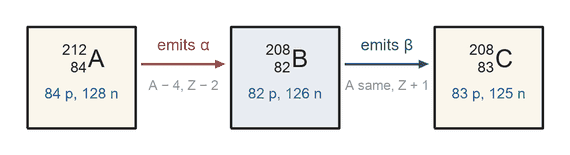
Step 1 — Find the composition of B.
The α particle takes 2 protons and 2 neutrons out of A.
protons=84−2=82
neutrons=128−2=126
So B has 82 protons and 126 neutrons (mass number 208).
(ii)
Step 2 — Find the composition of C.
One neutron of B changes into a proton.
protons=82+1=83
neutrons=126−1=125
So C has 83 protons and 125 neutrons (mass number still 208).
(iii)
Step 3 — Find the mass number of A.
The mass number is the total number of protons and neutrons.
A=84+128=212
(iv)
Step 4 — Consider γ emission.
γ radiation is an electromagnetic wave with no charge and no mass, so it carries away only energy; the numbers of protons and neutrons in C do not change.
Watch out: In β emission the number of nucleons stays the same: one neutron becomes one proton.
Therefore, (i) B has 82 protons and 126 neutrons; (ii) C has 83 protons and 125 neutrons; (iii) the mass number of A is 212; (iv) no, γ emission does not change the composition of C.
