
Question 903 marksEasy
(a) Write one nuclear fusion reaction.
(b) State the approximate value of energy released in the reaction mentioned in part (a).
(c) Give reason for the release of energy stated in part (b).
Confirming your payment
Sign up now and get 250 free tokens.
Radioactivity · Question 90 of 95
(a) Write one nuclear fusion reaction.
(b) State the approximate value of energy released in the reaction mentioned in part (a).
(c) Give reason for the release of energy stated in part (b).
Solution:
Concept: In nuclear fusion two light nuclei (such as isotopes of hydrogen) join to form a heavier nucleus, giving out a large amount of energy because the product has slightly less mass. The nuclei are positively charged and repel each other, so fusion happens only at a very high temperature, about 10⁷ K.
(a)
Step 1 — Write a fusion reaction.
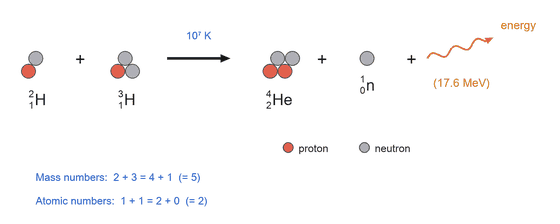
Deuterium and tritium fuse to form helium-4 and a neutron.
Both totals balance: 2 + 3 = 4 + 1 in mass number and 1 + 1 = 2 + 0 in atomic number.
(b)
Step 2 — Give the energy.
About 17.6 MeV is released in each such fusion.
(c)
Step 3 — Give the reason.
The helium nucleus and the neutron together are lighter than the deuterium and tritium nuclei by about 0.0189 u. This lost mass is converted into energy.
Therefore, (a) , (b) about 17.6 MeV is released, and (c) it comes from the loss of about 0.0189 u of mass, converted into energy by E = (Δm)c².