
Question 913 marksEasy
(a) State one similiarity in the process of nuclear fission and fusion.
(b) State two differences between the process of nuclear fission and fusion.
Confirming your payment
Sign up now and get 250 free tokens.
Radioactivity · Question 91 of 95
(a) State one similiarity in the process of nuclear fission and fusion.
(b) State two differences between the process of nuclear fission and fusion.
Solution:
Concept: Fission splits a heavy nucleus; fusion joins light nuclei. Both get their energy in the same way.
(a)
Step 1 — Similarity.
In both processes the products are lighter than the reactants, and this loss of mass is converted into a large amount of energy according to E = Δm c².
(b)
Step 2 — Differences.
The table sets out the main differences.
| Nuclear fission | Nuclear fusion |
|---|---|
| A heavy nucleus splits into two lighter nuclei. | Two light nuclei combine into a heavier nucleus. |
| It takes place at ordinary temperature, started by a slow neutron. | It needs an extremely high temperature (about 10⁷ K). |
| It gives less energy per unit mass of fuel. | It gives more energy per unit mass of fuel. |
| It can be controlled in a reactor, and it leaves radioactive waste. | No fusion power station has yet been built, and it leaves very little radioactive waste. |
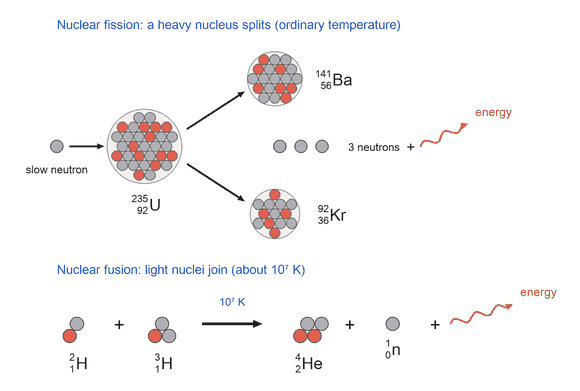
Therefore, (a) in both, a loss of mass is converted into energy, and (b) fission splits a heavy nucleus at ordinary temperature, while fusion joins light nuclei and needs about 10⁷ K (any two rows of the table are enough).