
Question 403 marksEasy
What changes occur in the nucleus of a radioactive element when it emits (a) an alpha particle, (b) a beta particle, (c) gamma radiation ? Give one example, in each case (a) and (b) in support of your answer.
Confirming your payment
Sign up now and get 250 free tokens.
Radioactivity · Question 40 of 95
What changes occur in the nucleus of a radioactive element when it emits (a) an alpha particle, (b) a beta particle, (c) gamma radiation ? Give one example, in each case (a) and (b) in support of your answer.
Solution:
Concept: In every nuclear change the total mass number (A) and the total atomic number (Z) are the same on both sides of the equation. An α particle is , a β particle is , a neutron is and γ radiation has A = 0 and Z = 0.
(a)
Step 1 — Alpha particle.
The nucleus throws out 2 protons and 2 neutrons together, so its mass number decreases by 4 and its atomic number by 2: a new element is formed. For example:
The totals balance on both sides.
(b)
Step 2 — Beta particle.
A neutron inside the nucleus changes into a proton and an electron, and the electron is emitted. The atomic number increases by 1 and the mass number stays the same. For example:
The totals balance on both sides.
(c)
Step 3 — Gamma radiation.
The nucleus passes from an excited state to a lower energy state and gives out the extra energy as γ radiation. Its atomic number and mass number do not change.
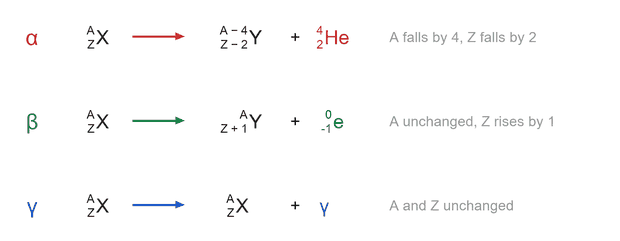
Watch out: After α or β emission the element changes; after γ emission it does not.
Therefore, (a) α emission lowers A by 4 and Z by 2, (b) β emission keeps A and raises Z by 1 (a neutron becomes a proton), and (c) γ emission changes neither, only the energy of the nucleus.