
Question 393 marksEasy
What happens to the position of an element in the periodic table when its nucleus emits (a) an α-particle, (b) a β-particle and (c) γ radiation ? Give reason for your answer.
Confirming your payment
Sign up now and get 250 free tokens.
Radioactivity · Question 39 of 95
What happens to the position of an element in the periodic table when its nucleus emits (a) an α-particle, (b) a β-particle and (c) γ radiation ? Give reason for your answer.
Solution:
Concept: The position of an element in the periodic table is fixed by its atomic number Z. So follow what each emission does to Z.
(a)
Step 1 — α particle.
An α particle takes away 2 protons, so Z decreases by 2 and the element moves two places back. For example, uranium-238 becomes thorium-234.
(b)
Step 2 — β particle.
A neutron changes into a proton, so Z increases by 1 and the element moves one place forward. For example, thorium-234 becomes protactinium-234.
(c)
Step 3 — γ radiation.
γ radiation has no charge, so Z does not change and the element keeps its place; only the energy of the nucleus falls.
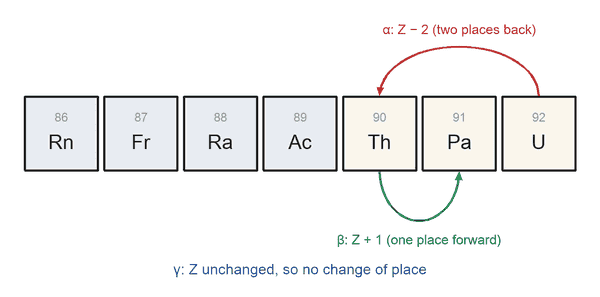
Watch out: β emission moves the element FORWARD (Z rises), even though a negative particle leaves.
Therefore, (a) α emission moves the element two places back, (b) β emission one place forward, and (c) γ emission causes no change of place.