
Question 212 marksEasy
State whether the following nuclear disintegrations are allowed or not (star indicates an excited state). Give reason if it is not allowed.
(a)
(b)
Confirming your payment
Sign up now and get 250 free tokens.
Radioactivity · Question 21 of 95
State whether the following nuclear disintegrations are allowed or not (star indicates an excited state). Give reason if it is not allowed.
(a)
(b)
Solution:
Concept: In every nuclear change the total mass number (A) and the total atomic number (Z) are the same on both sides of the equation. An α particle is , a β particle is , a neutron is and γ radiation has A = 0 and Z = 0. A change is allowed only if both totals balance and each symbol has one atomic number.
(a)
Step 1 — Check the γ emission.
On the left the excited nucleus has mass number A and atomic number Z. On the right the nucleus has A and Z, and γ radiation adds 0 to each, so both totals balance and the element stays X. The nucleus simply gives out its extra energy.
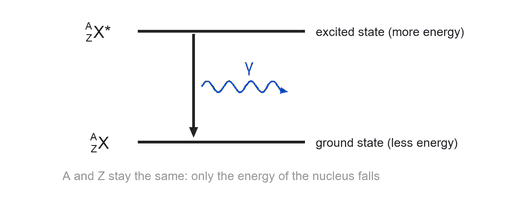
So this disintegration is allowed.
(b)
Step 2 — Check the mass numbers.
The left side has mass number A, but the right side has A from the nucleus plus 4 from the helium nucleus.
Step 3 — Check the symbol.
The product is written as X with atomic number Z − 2, but an element's atomic number is fixed: a nucleus with Z − 2 protons is a different element, not X.
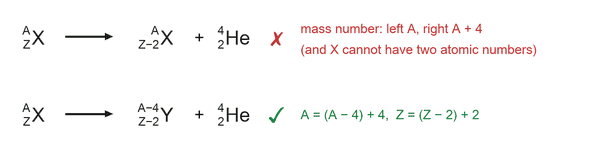
So this disintegration is not allowed. The correct α decay is:
Watch out: After α emission both A and Z must fall, A by 4 and Z by 2, and the element must change.
Therefore, (a) is allowed, and (b) is not allowed because the mass number is not conserved (A on the left, A + 4 on the right) and a nucleus with atomic number Z − 2 cannot still be X.