
Question 202 marksEasy
What happens to the (i) atomic number, (ii) mass number of the nucleus of an element when (a) an α-particle, (b) a β-particle, and (c) γ radiation, is emitted ?
Confirming your payment
Sign up now and get 250 free tokens.
Radioactivity · Question 20 of 95
What happens to the (i) atomic number, (ii) mass number of the nucleus of an element when (a) an α-particle, (b) a β-particle, and (c) γ radiation, is emitted ?
Solution:
Concept: Look at what each emission takes out of the nucleus: an α particle carries away 2 protons and 2 neutrons; in β emission a neutron inside the nucleus turns into a proton and an electron, and the electron leaves; γ radiation carries away only energy.
Step 1 — α particle.
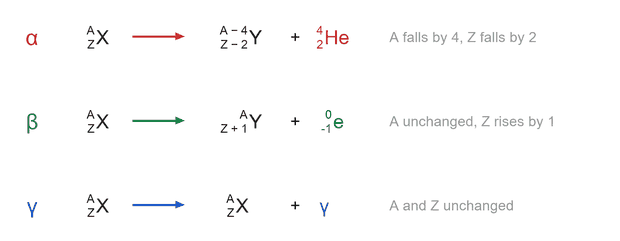
The α particle carries away 2 protons and 2 neutrons, so the atomic number falls by 2 and the mass number falls by 4.
Step 2 — β particle.
A neutron becomes a proton, so the atomic number rises by 1, while the number of nucleons, and so the mass number, stays the same.
Step 3 — γ radiation.
Only energy leaves, so neither number changes.
Step 4 — Collect the results.
The table puts the three cases side by side.
| Emission | (i) Atomic number | (ii) Mass number |
|---|---|---|
| (a) α-particle | decreases by 2 | decreases by 4 |
| (b) β-particle | increases by 1 | no change |
| (c) γ radiation | no change | no change |
Watch out: In β emission the atomic number INCREASES, although a negative particle leaves.
Therefore, (a) α emission: Z decreases by 2 and A by 4; (b) β emission: Z increases by 1 and A is unchanged; (c) γ emission: neither Z nor A changes.