
Question 952 marksEasy
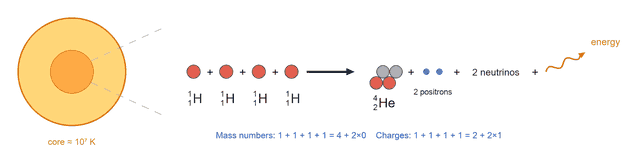
When four hydrogen nuclei combine to form a helium nucleus in the interior of sun, the loss in mass is 0.0265 a.m.u. How much energy is released ?
Confirming your payment
Sign up now and get 250 free tokens.
Radioactivity · Question 95 of 95
When four hydrogen nuclei combine to form a helium nucleus in the interior of sun, the loss in mass is 0.0265 a.m.u. How much energy is released ?
Solution:
Concept: Einstein's mass–energy relation E = (Δm)c² says that a mass Δm that disappears in a nuclear change reappears as energy E, where c = 3 × 10⁸ m s⁻¹ is the speed of light. In atomic units, a mass of 1 a.m.u. is equivalent to 931 MeV. So the energy in MeV is the loss in mass in a.m.u. multiplied by 931.
Given: loss in mass Δm = 0.0265 a.m.u. when four hydrogen nuclei form one helium nucleus; 1 a.m.u. ≡ 931 MeV.
Step 1 — Write the relation.
Since 1 a.m.u. of mass is equivalent to 931 MeV, the energy released is the mass lost (in a.m.u.) times 931 MeV.
Step 2 — Put in the value.
The loss in mass when four hydrogen nuclei form one helium nucleus is 0.0265 a.m.u.
Step 3 — See what it means.
Each helium nucleus formed in the sun gives out about 24.7 MeV (about 4 × 10⁻¹² J). This fusion, repeated an enormous number of times every second, is the source of the sun's energy.
Watch out: The 0.0265 a.m.u. is the mass LOST, not the mass of the helium nucleus.
Therefore, the energy released is about 24.7 MeV (24.67 MeV).