
Question 942 marksEasy
In fission of one uranium-235 nucleus, the loss in mass is 0.2 a.m.u. Calculate the energy released.
Confirming your payment
Sign up now and get 250 free tokens.
Radioactivity · Question 94 of 95
In fission of one uranium-235 nucleus, the loss in mass is 0.2 a.m.u. Calculate the energy released.
Solution:
Concept: Einstein's mass–energy relation E = (Δm)c² says that a mass Δm that disappears in a nuclear change reappears as energy E, where c = 3 × 10⁸ m s⁻¹ is the speed of light. In atomic units, a mass of 1 a.m.u. is equivalent to 931 MeV. So the energy in MeV is the loss in mass in a.m.u. multiplied by 931.
Given: loss in mass Δm = 0.2 a.m.u. in the fission of one uranium-235 nucleus; 1 a.m.u. ≡ 931 MeV.
Step 1 — Write the relation.
Since 1 a.m.u. of mass is equivalent to 931 MeV, the energy released is the mass lost (in a.m.u.) times 931 MeV.
Step 2 — Put in the value.
The loss in mass is 0.2 a.m.u.
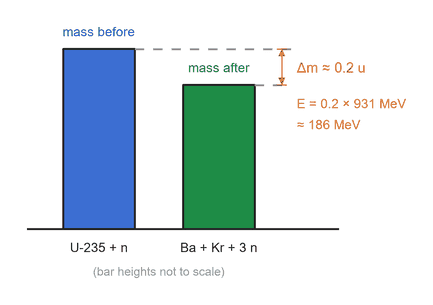
Step 3 — See what it means.
In joule this is about 3 × 10⁻¹¹ J (186.2 × 1.6 × 10⁻¹³ J) from a single nucleus, millions of times more than a chemical reaction gives per atom.
Watch out: Multiply by 931 only when Δm is in a.m.u.; with Δm in kg use E = (Δm)c² and get joule.
Therefore, the energy released is 186.2 MeV.