Solution:
Concept: α particles are helium nuclei 24He (charge +2e, about 4 times the mass of a proton); β particles are fast electrons −10e (charge −e); γ radiation is an electromagnetic wave with no charge and no mass. α ionises the most and penetrates the least; γ ionises the least and penetrates the most.
(a)
Step 1 — Zero mass.
γ radiation, an electromagnetic wave, has zero mass.
(b)
Step 2 — Lowest ionising power.
γ radiation, which has no charge, has the lowest ionising power.
(c)
Step 3 — Lowest penetrating power.
α radiation has the lowest penetrating power: a sheet of paper stops it.
(d)
Step 4 — Charge and mass of an α particle.
An α particle is a helium nucleus of 2 protons and 2 neutrons. Its charge is that of 2 protons, and its mass is about 4 times that of a proton.
q=2e=2×1.6×10−19 C=3.2×10⁻¹⁹ C
m≈4×1.67×10−27 kg=6.68×10⁻²⁷ kg
(e)
Step 5 — The rare gas.
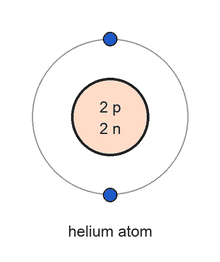
An α particle that picks up 2 electrons becomes a neutral helium atom, so the rare gas is helium. Its model has a nucleus of 2 protons and 2 neutrons, with 2 electrons in the K shell.
(f)
Step 6 — Where they come from.
All three radiations come from the nucleus of the atom.
Watch out: (c) asks about penetrating power, which is lowest for α, even though α ionises the most.
Therefore, (a) γ, (b) γ, (c) α, (d) charge +2e = +3.2 × 10⁻¹⁹ C and mass about 4 proton masses ≈ 6.68 × 10⁻²⁷ kg, (e) helium, (f) the nucleus.
