
Question 363 marksEasy
(a) What is the composition of α, β and γ radiations? (b) Can a hydrogen () nucleus emit an alpha particle ? Give a reason for your answer. (c) Which one α, β or γ radiation has the least penetrating power?
Confirming your payment
Sign up now and get 250 free tokens.
Radioactivity · Question 36 of 95
(a) What is the composition of α, β and γ radiations? (b) Can a hydrogen () nucleus emit an alpha particle ? Give a reason for your answer. (c) Which one α, β or γ radiation has the least penetrating power?
Solution:
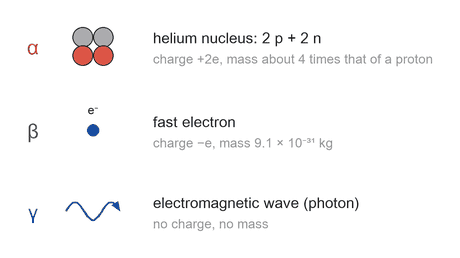
Concept: α particles are helium nuclei (charge +2e, about 4 times the mass of a proton); β particles are fast electrons (charge −e); γ radiation is an electromagnetic wave with no charge and no mass. α ionises the most and penetrates the least; γ ionises the least and penetrates the most.
(a)
Step 1 — α radiation.
It is a stream of α particles, each a helium nucleus of 2 protons and 2 neutrons, , with charge +2e.
Step 2 — β radiation.
It is a stream of fast electrons, , with charge −e, thrown out of the nucleus.
Step 3 — γ radiation.
It is a stream of photons: electromagnetic waves of very short wavelength, with no charge and no mass.
(b)
Step 4 — Check what hydrogen has.
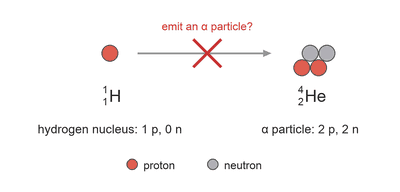
To emit an α particle a nucleus must give up 2 protons and 2 neutrons. The hydrogen nucleus has only one proton and no neutron, so it cannot.
(c)
Step 5 — Least penetrating.
α radiation has the least penetrating power: a sheet of paper stops it.
Watch out: β particles are electrons from the NUCLEUS, not from the electron shells.
Therefore, (a) α = helium nuclei (2 p + 2 n), β = fast electrons, γ = electromagnetic waves (photons); (b) no, because a hydrogen nucleus has only 1 proton and no neutrons, while an α particle needs 2 protons and 2 neutrons; (c) α radiation.