
Question 372 marksEasy
An α-particle captures (i) one electron, (ii) two electrons. In each case, what does it change to ?
Confirming your payment
Sign up now and get 250 free tokens.
Radioactivity · Question 37 of 95
An α-particle captures (i) one electron, (ii) two electrons. In each case, what does it change to ?
Solution:
Concept: An α particle is a helium nucleus with no electrons, , of charge +2e. Each electron it captures cancels one unit of this charge.
(i)
Step 1 — One electron.
With one electron its charge becomes +2e − e = +e, so it is a singly ionised helium ion, He⁺.
(ii)
Step 2 — Two electrons.
With two electrons its charge becomes zero, so it is a neutral helium atom, He.
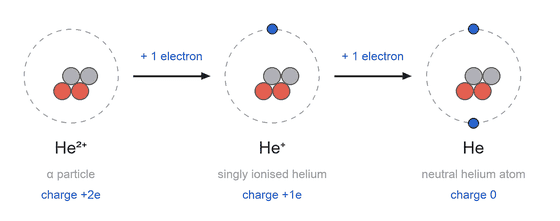
Watch out: One electron is not enough to make it neutral; it needs two.
Therefore, (i) with one electron it becomes a singly charged helium ion, He⁺, and (ii) with two electrons it becomes a neutral helium atom, He.