
Question 842 marksEasy
Write the approximate value of the energy released in the fission of one nucleus of . What is the reason for it ?
Confirming your payment
Sign up now and get 250 free tokens.
Radioactivity · Question 84 of 95
Write the approximate value of the energy released in the fission of one nucleus of . What is the reason for it ?
Solution:
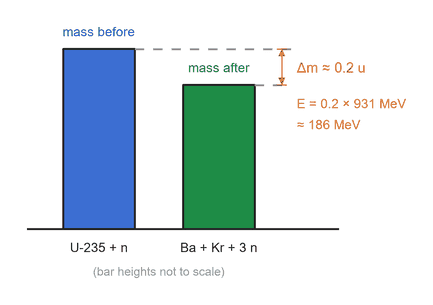
Concept: Einstein's mass–energy relation E = (Δm)c² says that a mass Δm that disappears in a nuclear change reappears as energy E, where c = 3 × 10⁸ m s⁻¹ is the speed of light. In atomic units, a mass of 1 a.m.u. is equivalent to 931 MeV.
Step 1 — Give the energy.
The fission of one uranium-235 nucleus releases about 200 MeV of energy.
Step 2 — Give the reason.
The products of the fission (the two fragments and the neutrons) are together lighter than the uranium-235 nucleus and the neutron that struck it, by about 0.2 u. This lost mass is converted into energy.
This is close to 200 MeV; the exact value depends on which two fragments are formed.
Step 3 — Say where the energy goes.
Most of it appears as the kinetic energy of the fragments; the rest is carried by the neutrons and γ radiation, and it ends up as heat.
Watch out: The energy comes from the loss of MASS, not from the uranium 'burning'.
Therefore, about 200 MeV is released in the fission of one nucleus, because about 0.2 u of mass is lost and converted into energy by E = (Δm)c².