
Question 853 marksEasy
What do you mean by the chain reaction in nuclear fission ? How is it controlled ?
Confirming your payment
Sign up now and get 250 free tokens.
Radioactivity · Question 85 of 95
What do you mean by the chain reaction in nuclear fission ? How is it controlled ?
Solution:
Concept: Each fission uses one neutron but gives out two or three new neutrons. Whether the reaction runs away or stays steady depends on how many of these cause another fission.
Step 1 — Explain the chain reaction.
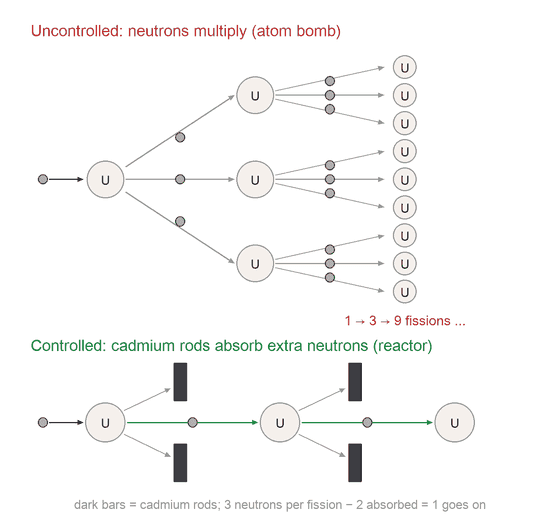
When one uranium-235 nucleus splits, it releases 2 or 3 neutrons. Each of these can split another uranium-235 nucleus, which releases more neutrons, and so on. Once started, the reaction keeps itself going, and the number of fissions multiplies rapidly (1 → 3 → 9 → 27 …).
Step 2 — See what happens if it is not controlled.
An uncontrolled chain reaction releases an enormous amount of energy in a very short time, as in an atom bomb.
Step 3 — Explain how it is controlled.
In a nuclear reactor, cadmium (or boron) control rods absorb the extra neutrons, so that on average only one neutron from each fission causes a further fission. The rate then stays steady. Pushing the rods in slows the reaction; pulling them out speeds it up.
Step 4 — Mention the moderator.
A moderator such as graphite or heavy water slows the fast neutrons, so that they can split uranium-235.
Watch out: The moderator slows neutrons; the control rods absorb them.
Therefore, a chain reaction is a self-sustaining series of fissions in which the neutrons from one fission cause further fissions; it is controlled by cadmium rods that absorb the extra neutrons, leaving one neutron per fission to carry on.