
Question 872 marksEasy
Give two differences between the radioactive decay and nuclear fission.
Confirming your payment
Sign up now and get 250 free tokens.
Radioactivity · Question 87 of 95
Give two differences between the radioactive decay and nuclear fission.
Solution:
Concept: In both a nucleus changes, but radioactive decay happens on its own and throws out a small particle, while fission must be started by a neutron and splits the nucleus into two nearly equal parts.
Step 1 — Compare the two processes.
The table sets out the differences.
| Radioactive decay | Nuclear fission |
|---|---|
| It is spontaneous: it happens on its own. | It happens only when the nucleus is bombarded with a neutron. |
| The nucleus emits α or β particles (with γ radiation) and becomes a slightly lighter nucleus. | The nucleus splits into two nearly equal lighter nuclei and releases neutrons. |
| The energy per nucleus is small (a few MeV). | The energy per nucleus is large (about 200 MeV). |
| It cannot be controlled. | It can be controlled (in a reactor). |
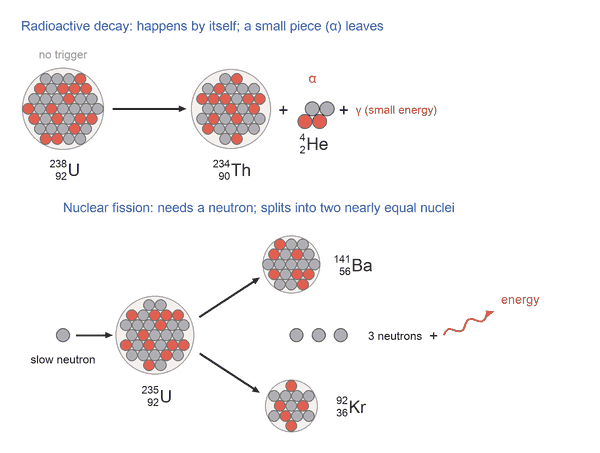
Step 2 — Give an example of each.
α decay of uranium-238 and fission of uranium-235:
Therefore, radioactive decay is spontaneous and emits a small α or β particle, while fission needs a neutron to start it and splits the nucleus into two nearly equal parts (any two rows of the table are enough).