
Question 71 markMCQEasy
and are :
Confirming your payment
Sign up now and get 250 free tokens.
Radioactivity · Question 7 of 95
and are :
(A) Isotopes
(B) Isobars
(C) Radioactive substances
(D) Isotones
Answer: (D) Isotones
Concept: Isotopes have the same atomic number Z but different mass numbers A (same element, different numbers of neutrons). Isobars have the same A but different Z (different elements). Isotones have the same number of neutrons (A − Z) but different Z.
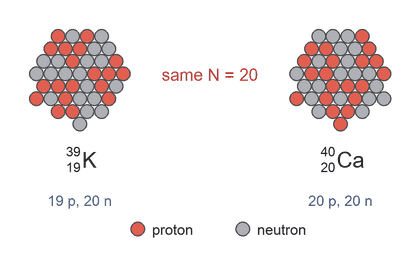
Step 1 — Find the neutrons in potassium-39.
Potassium has A = 39 and Z = 19, so its number of neutrons is A − Z.
Step 2 — Find the neutrons in calcium-40.
Calcium has A = 40 and Z = 20, so its number of neutrons is A − Z.
Step 3 — Compare.
Both nuclei have 20 neutrons, but their atomic numbers (19 and 20) and their mass numbers (39 and 40) differ. Nuclei with the same number of neutrons are isotones.
Watch out: Compare A − Z, not A or Z, to spot isotones.
Why the other options are wrong:
Therefore, potassium-39 and calcium-40 are isotones, option (D).