
Question 61 markMCQEasy
Out of the following, which element has the largest number of isotopes ?
Confirming your payment
Sign up now and get 250 free tokens.
Radioactivity · Question 6 of 95
Out of the following, which element has the largest number of isotopes ?
(A) Hydrogen
(B) Carbon
(C) Chlorine
(D) Tin
Answer: (D) Tin
Concept: Isotopes have the same atomic number Z but different mass numbers A (same element, different numbers of neutrons). Isobars have the same A but different Z (different elements). Isotones have the same number of neutrons (A − Z) but different Z. A stable isotope does not decay; the others are radioactive.
Step 1 — Count the stable isotopes of each element.
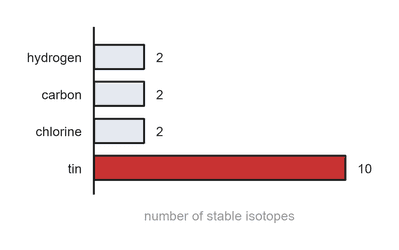
Hydrogen has 2 stable isotopes (protium and deuterium) and one well-known radioactive one, tritium. Carbon has 2 stable isotopes (carbon-12 and carbon-13) and the radioactive carbon-14. Chlorine has 2 stable isotopes, chlorine-35 and chlorine-37.
Step 2 — Compare with tin.
Tin has 10 stable isotopes, more than any other element in the periodic table.
Step 3 — Choose the largest.
Even if the radioactive isotopes of hydrogen and carbon are counted, they have only 3 each, far fewer than tin.
Watch out: Count the same kind of isotopes for every element; tin has the most stable isotopes of all the elements.
Why the other options are wrong:
Therefore, tin has the largest number of isotopes, option (D).