
Question 11 markMCQEasy
The total number of protons in a neutral atom is equal to :
Confirming your payment
Sign up now and get 250 free tokens.
Radioactivity · Question 1 of 95
The total number of protons in a neutral atom is equal to :
(A) atomic number
(B) neutrons
(C) electrons
(D) both (a) and (c)
Answer: (D) both (a) and (c)
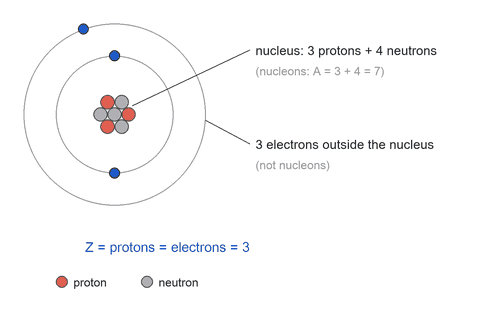
Concept: An atom has a tiny nucleus of protons and neutrons (together called nucleons) with electrons outside it. The atomic number Z is the number of protons; the mass number A is the number of nucleons (protons + neutrons). So the number of neutrons is A − Z, and a neutral atom has Z electrons.
Step 1 — Count the protons from the atomic number.
The atomic number Z of an element is defined as the number of protons in the nucleus of its atom, so the number of protons is always equal to the atomic number.
Step 2 — Use the word 'neutral'.
Each proton carries a charge +e and each electron a charge −e. For the atom to have no net charge, the negative charge of the electrons must cancel the positive charge of the protons exactly, so there are as many electrons as protons.
Step 3 — Put the two facts together.
So the total number of protons equals the atomic number AND the number of electrons. Lithium-7 in the figure shows this: Z = 3, with 3 protons and 3 electrons.
Watch out: The word 'neutral' matters; in an ion the number of electrons is no longer equal to the number of protons.
Why the other options are wrong:
Therefore, the number of protons in a neutral atom equals both the atomic number and the number of electrons, option (D).