Solution:
Concept: A charged particle moving across a magnetic field feels a force at right angles to both the field and its motion, given by Fleming's left hand rule. Opposite charges are pushed opposite ways, and a lighter particle is deflected more.
(a)
Step 1 — Draw the paths.
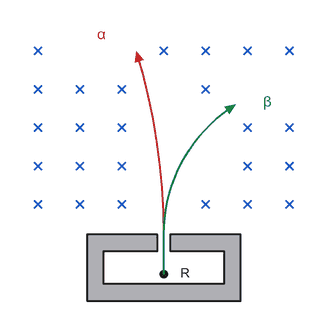
The α particles (positive) bend slightly to the left, because they are heavy; the β particles (negative) bend sharply to the right, because they are very light. Both paths are curved (arcs of circles), because the magnetic force always acts at right angles to the motion.
(b)
Step 2 — Name the law.
The law used is Fleming's left hand rule.
Step 3 — Apply it to α.
The forefinger points along the field (into the page) and the central finger along the current, which for the positive α particles is upwards, the way they move. The thumb then points to the left, so α bends left.
Step 4 — Apply it to β.
For the negative β particles the current is opposite to their motion, that is downwards, so the thumb points to the right and β bends right.

Watch out: The β path bends more sharply than the α path; do not draw them as mirror images.
Therefore, (a) α particles are deflected slightly to the left and β particles sharply to the right, and (b) the law used is Fleming's left hand rule.

