
Question 263 marksEasy
Name the three constituents of an atom and state mass and charge of each. How are they distributed in an atom ?
Confirming your payment
Sign up now and get 250 free tokens.
Radioactivity · Question 26 of 95
Name the three constituents of an atom and state mass and charge of each. How are they distributed in an atom ?
Solution:
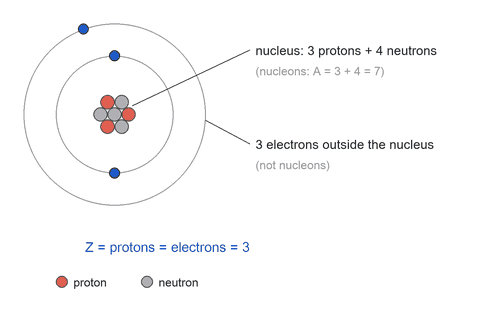
Concept: An atom has a tiny, heavy, positively charged nucleus at its centre, made of protons and neutrons, with light, negatively charged electrons moving around it.
Step 1 — Name the constituents and give their mass and charge.
The three particles that make up an atom are the proton, the neutron and the electron. The table gives the book's values.
| Particle | Mass | Charge |
|---|---|---|
| Proton | kg (about 1 u) | C (+e) |
| Neutron | kg (about 1 u) | zero |
| Electron | kg (about 1/1840 of a proton) | C (−e) |
Step 2 — Describe the nucleus.
The protons and neutrons are packed together in the nucleus at the centre. Almost the whole mass of the atom is there, and the nucleus is positively charged because of its protons.
Step 3 — Describe the electrons.
The electrons revolve around the nucleus in definite orbits (shells K, L, M, …). In a neutral atom their number equals the number of protons.
Step 4 — Note the empty space.
The nucleus is about 10⁴ to 10⁵ times smaller than the atom, so most of the atom is empty space.
Watch out: The neutron has almost the same mass as the proton but NO charge; the electron is far lighter than either.
Therefore, an atom is made of protons (about 1.67 × 10⁻²⁷ kg, +e) and neutrons (about 1.67 × 10⁻²⁷ kg, no charge) in the central nucleus, and electrons (9.1 × 10⁻³¹ kg, −e) revolving around it in orbits.