
Question 252 marksEasy
Which of the following is the radio isotope in each pair (a), (b) and (c) ?
(a) , (b) , (c) ,
Give reason for your answer.
Confirming your payment
Sign up now and get 250 free tokens.
Radioactivity · Question 25 of 95
Which of the following is the radio isotope in each pair (a), (b) and (c) ?
(a) , (b) , (c) ,
Give reason for your answer.
Solution:
Concept: A nucleus is stable only when its numbers of neutrons and protons are suitably balanced. A radio isotope is an isotope whose nucleus is unstable, most often because it has more neutrons than the stable isotope of that element.
Step 1 — Count the neutrons in each pair.
The number of neutrons is A − Z.
| Pair | lighter isotope | heavier isotope |
|---|---|---|
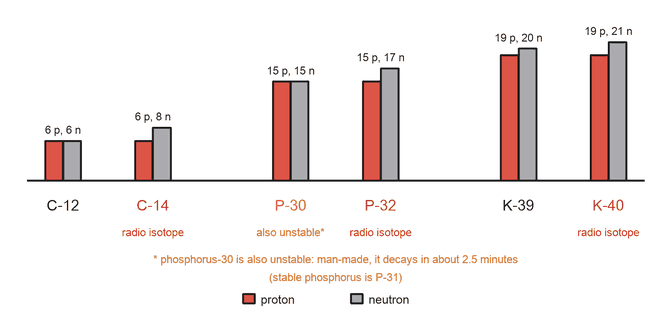
| (a) carbon | C-12: 6 p, 6 n | C-14: 6 p, 8 n |
| (b) phosphorus | P-30: 15 p, 15 n | P-32: 15 p, 17 n |
| (c) potassium | K-39: 19 p, 20 n | K-40: 19 p, 21 n |
Step 2 — Pick the radio isotope in each pair.
In each pair the heavier isotope has more neutrons than the stable isotope of the element (C-12, P-31 and K-39 are stable), so its nucleus is unstable and it decays by emitting β particles.
Step 3 — State the radio isotopes.
So the radio isotopes are carbon-14, phosphorus-32 and potassium-40.
Watch out: Compare with the STABLE isotope of the same element; a radio isotope has the wrong neutron count for its protons.
Note: Strictly, phosphorus-30 is also radioactive: it is a man-made isotope (with too FEW neutrons) that decays in a few minutes, while stable phosphorus is P-31. The book's intended answer for (b), phosphorus-32, the familiar radio isotope used as a tracer, is kept.
Therefore, the radio isotopes are (a) , (b) and (c) , because each has extra neutrons that make its nucleus unstable.