
Question 272 marksEasy
Define the following terms :
(a) atomic number, and (b) mass number.
Confirming your payment
Sign up now and get 250 free tokens.
Radioactivity · Question 27 of 95
Define the following terms :
(a) atomic number, and (b) mass number.
Solution:
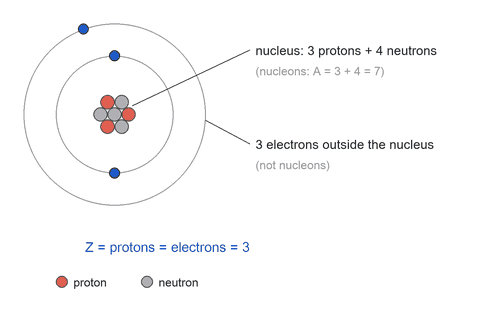
Concept: Both numbers count particles in the nucleus: the atomic number counts only the protons, while the mass number counts all the nucleons (protons + neutrons).
(a)
Step 1 — Define the atomic number.
The atomic number Z of an element is the number of protons in the nucleus of its atom. In a neutral atom it also equals the number of electrons. For example, sodium has 11 protons, so its atomic number is 11.
(b)
Step 2 — Define the mass number.
The mass number A of an atom is the total number of protons and neutrons (nucleons) in its nucleus. For example, sodium has 11 protons and 12 neutrons, so its mass number is 23.
Watch out: Electrons are not counted in the mass number; they are outside the nucleus.
Therefore, (a) the atomic number is the number of protons in the nucleus of an atom, and (b) the mass number is the total number of protons and neutrons in its nucleus.