
Question 594 marksEasy
State following four properties each of α, β and γ radiations : (a) nature, (b) charge, (c) mass, and (d) effect of electric field.
Confirming your payment
Sign up now and get 250 free tokens.
Radioactivity · Question 59 of 95
State following four properties each of α, β and γ radiations : (a) nature, (b) charge, (c) mass, and (d) effect of electric field.
Solution:
Concept: All four properties follow from what each radiation is: a helium nucleus (α), an electron (β) or an electromagnetic wave (γ).
Step 1 — Collect the properties.
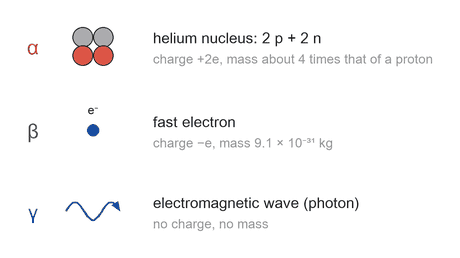
The table lists the four properties for each radiation.
| Property | α radiation | β radiation | γ radiation |
|---|---|---|---|
| (a) Nature | stream of helium nuclei, | stream of fast electrons from the nucleus | electromagnetic waves (photons) |
| (b) Charge | +2e ( C) | −e ( C) | no charge |
| (c) Mass | about 4 times the mass of a proton, kg | mass of an electron, kg | zero |
| (d) Effect of electric field | deflected slightly, towards the negative plate | deflected more, towards the positive plate | not deflected |
Step 2 — See why the field acts as it does.
The field pushes positive α towards the negative plate and negative β towards the positive plate; uncharged γ goes straight. The very light β particle is deflected the most.

Watch out: The charge of an α particle is +2e, not +e: it has two protons.
Therefore, α: helium nuclei, +2e, about 4 proton masses, deflected slightly to the − plate; β: fast electrons, −e, 9.1 × 10⁻³¹ kg, deflected more to the + plate; γ: electromagnetic waves, no charge, no mass, not deflected.