
Opening your dashboard
Class 10 Physics Chapter 12 Radioactivity: Practice Questions
42 questions on Chapter 12, each worked through on its own page with the AI tutor. Class 10 Physics, ICSE 2026-27.
42 questions
1–5 marks · Mixed difficulty
- 11 mark
Question 1
Bloom's level: Remember
The protons and neutrons in the nucleus of an atom are held together by :
- 21 mark
Question 2
Bloom's level: Remember
Workers in an X-ray room or a nuclear power plant wear a small film badge (dosimeter) on their clothes. It is used to :
- 31 mark
Question 3
Bloom's level: Apply
A student has to sort four pairs of nuclei. In which pair do the two nuclei have equal numbers of neutrons, i.e. form isotones ?
- 41 mark
Question 4
Bloom's level: Apply
The nucleus emits a β-particle. The daughter nucleus is :
- 51 mark
Question 5
Bloom's level: Understand
Which statement is true for all three radiations, α, β and γ ?
- 61 mark
Question 6
Bloom's level: Understand
Scientists want to find out how much of a phosphate fertiliser is taken up by a crop. They add a small amount of a radio isotope to the fertiliser and later detect its radiation in the leaves. The isotope best suited is :
- 71 mark
Question 7
Bloom's level: Apply
In one fission reaction, . The value of is :
- 81 mark
Question 8
Bloom's level: Evaluate
Ravi says, "Fusion is not used in power stations today because it gives much less energy than fission." Which is the best judgement of his statement ?
- 91 mark
Question 9
Bloom's level: Apply
In a nuclear reaction, the total mass of the products is less than the total mass of the reactants by 0.03 a.m.u. The energy released is about (1 a.m.u. = 931 MeV) :
- 101 mark
Question 10
Bloom's level: Understand
Read the Assertion (A) and the Reason (R) and choose the correct option.
Assertion (A): Heating a radioactive sample, or making it take part in a chemical reaction, does not change the rate at which it gives out radiation.
Reason (R): Radioactivity is a property of the nucleus, while heating and chemical reactions affect only the electrons outside the nucleus.
- 111 mark
Question 11
Bloom's level: Understand
Read the Assertion (A) and the Reason (R) and choose the correct option.
Assertion (A): In the same magnetic field, α-particles are deflected much less than β-particles.
Reason (R): An α-particle carries a larger charge than a β-particle.
- 121 mark
Question 12
Bloom's level: Understand
Read the Assertion (A) and the Reason (R) and choose the correct option.
Assertion (A): All the isotopes of an element have the same chemical properties.
Reason (R): Isotopes of an element have the same number of neutrons in their nuclei.
- 132 marks
Question 13
Bloom's level: Remember
(a) Who discovered radioactivity, and what did he observe ?
(b) Name two radioactive elements discovered by Marie and Pierre Curie.
- 142 marks
Question 14
Bloom's level: Apply
From the nuclei , , , , , pick out :
(a) two pairs of isotopes,
(b) a set of isobars,
(c) two pairs of isotones.
- 152 marks
Question 15
Bloom's level: Apply
changes into the stable nucleus through a series of α and β emissions. Find how many α-particles and how many β-particles are emitted in all.
- 162 marks
Question 16
Bloom's level: Understand
Explain why (a) the mass of an atom in a.m.u. is nearly equal to its mass number, and (b) the chemical properties of an element depend on its atomic number and not on its mass number.
- 172 marks
Question 17
Bloom's level: Understand
Packed plastic syringes and stored food grains are often exposed to γ-rays from cobalt-60. Explain why γ-rays are used for this, and why the syringes can be treated after packing.
- 182 marks
Question 18
Bloom's level: Analyse
An α-source kept outside the body is fairly harmless, but radon gas (an α-emitter) breathed into the lungs is very harmful. Explain this difference.
- 192 marks
Question 19
Bloom's level: Apply
(a) Using , find the energy equivalent of 1 g of matter ( m s).
(b) For how long could this energy run a 1000 MW power station ?
- 202 marks
Question 20
Bloom's level: Analyse
Suppose each fission of U-235 releases 3 neutrons, and each of these causes one more fission.
(a) Starting from one fission, how many fissions take place in the 5th generation, and how many in all up to the 5th generation ?
(b) What must the control rods do so that the reaction goes on at a steady rate ?
- 212 marks
Question 21
Bloom's level: Remember
What is meant by (a) radioactivity, (b) the parent nucleus and the daughter nucleus in a radioactive decay ?
- 222 marks
Question 22
Bloom's level: Evaluate
Kiran's revision notes on this chapter contain these four statements. Judge whether each is correct, and correct the wrong ones.
- In β-emission the mass number of the nucleus increases by 1.
- Isobars have the same mass number.
- Nuclear fusion can take place at ordinary room temperature.
- γ-rays have neither charge nor mass.
- 234 marks
Question 23
Bloom's level: Analyse
A detector placed near a radioactive source gives these readings, with different absorbers between the source and the detector :
Absorber none sheet of paper 3 mm aluminium 10 cm lead Count rate (per minute) 930 630 150 30 With the source removed, the detector reads 30 per minute.
(a) Which radiations does the source give out ? Give a reason for each.
(b) Find the count rate due to each radiation.
(c) Why does the reading never fall below 30 per minute ?
- 244 marks
Question 24
Bloom's level: Apply
Case study: In a hospital, a patient with an overactive thyroid gland is given a drink containing a small amount of radio-iodine (I-131). Another patient with a deep tumour is treated with a beam of γ-rays from a cobalt-60 source in a thick lead housing.
(a) Why does the radio-iodine collect in the thyroid gland, and how does it help treat the gland ?
(b) Why are γ-rays, and not α-particles, used for the deep tumour ?
(c) State two precautions the hospital staff must take while working with these sources.
- 254 marks
Question 25
Bloom's level: Analyse
Case study: A nuclear power station uses uranium-235 as fuel, heavy water as moderator, cadmium rods to control the reaction, and water pumped through the core to carry the heat to a boiler.
(a) Why must the neutrons be slowed down by a moderator ?
(b) What would happen if the cadmium rods were pulled out completely ? What happens when they are pushed further in ?
(c) Trace the energy changes from the fuel to the electricity supplied.
(d) State one serious problem of producing electricity this way.
- 264 marks
Question 26
Bloom's level: Apply
About 200 MeV of energy is released in the fission of one U-235 nucleus. Take 1 MeV J.
(a) Express the energy per fission in joule.
(b) How many fissions per second are needed to produce 320 MW of heat ?
(c) 1 g of U-235 contains about nuclei. Find the energy released if all of them undergo fission, and the mass of coal that gives the same energy (burning 1 kg of coal gives about J).
- 275 marks
Question 27
Bloom's level: Create
Your school has received a small sealed γ-source for a demonstration. Draw up a safety plan for storing it, using it in class, and finally getting rid of it. Your plan should cover :
(a) storage and labelling,
(b) handling during the demonstration (use the ideas of shielding, distance and time),
(c) protecting students and checking the dose,
(d) what to do if it is lost or when it is no longer needed.
- 284 marks
Question 28
Bloom's level: Create
The nucleus changes into by a few α and β emissions.
(a) Work out how many α and how many β emissions are needed.
(b) Construct two different orders of these emissions that lead from Pb-214 to Pb-210. For each, write the nuclear equations, naming each intermediate nucleus by its and (you may call them X, Y, …).
(c) Make a table showing , and the number of neutrons at each step of one of your routes.
- 294 marks
Question 29
Bloom's level: Evaluate
"Nuclear fusion will be a better source of energy than nuclear fission in the future." Evaluate this statement. Give at least two points in favour, at least two difficulties, and your conclusion.
- 305 marks
Question 30
Bloom's level: Analyse
Case study: Many home smoke detectors contain a tiny amount of americium, , an α-emitter. Its α-particles ionise the air between two plates, so a small current flows. When smoke enters, it absorbs the α-particles, the current drops and the alarm sounds.
(a) State the number of protons, neutrons and electrons in one neutral atom of Am-241.
(b) Write the equation for its α-decay. Neptunium has atomic number 93; identify the daughter nucleus.
(c) Why is an α-emitter chosen rather than a γ-emitter for this device ? Give two reasons.
(d) Is a closed smoke detector a danger to people in the room ? Why must it not be broken open or thrown with ordinary waste ?
- 311 mark
Question 31
The nucleus of an atom of zinc is represented by . This nucleus contains :
- 321 mark
Question 32
Which of the following lists the three nuclear radiations in the order of decreasing ionising power ?
- 331 mark
Question 33
Assertion (A): When a nucleus emits a β-particle, its atomic number increases by 1 but its mass number does not change.
Reason (R): In β-emission, a neutron in the nucleus changes into a proton and an electron, and the electron is emitted.
- 342 marks
Question 34
Four nuclei are given below.
, , ,
(i) From these, select a pair of isotopes and a pair of isobars.
(ii) Which two of these nuclei are isotones ? State the number of neutrons in each of them.
- 352 marks
Question 35
(i) Name the nuclear radiation used in the treatment of cancer and one radio isotope that provides it. State the property of this radiation which makes it suitable for the purpose.
(ii) Name the radio isotope used to estimate the age of old remains of plants and animals, and name this method.
- 362 marks
Question 36
A uranium nucleus emits three α-particles and two β-particles, one after the other, and changes into a nucleus Y.
(i) Find the mass number and the atomic number of Y.
(ii) By how much does the number of neutrons in the nucleus change in the whole process ?
- 372 marks
Question 37
(i) What are background radiations ? Name one source of these radiations.
(ii) State two safety precautions that a person must take while handling a radioactive source in a laboratory.
- 384 marks
Question 38
A radioactive source S is kept inside a thick lead block with a narrow opening. The radiations coming out of the opening pass between two metal plates, the upper plate being negatively charged and the lower plate positively charged. The radiations are found to travel along three tracks P, Q and R as shown in the diagram.
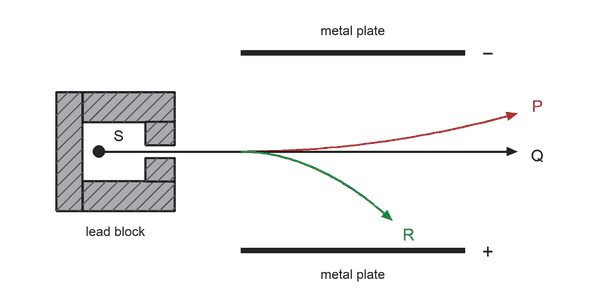
(i) Identify the radiations that travel along the tracks P, Q and R.
(ii) Why is the radiation along Q not deflected ? Why is the radiation along R deflected more than the radiation along P ?
(iii) A thick sheet of paper is now placed in front of the opening of the lead block. Which of the three tracks will no longer be seen ? Give a reason.
- 394 marks
Question 39
A uranium-235 nucleus absorbs a slow neutron and splits as shown :
(i) Name this nuclear reaction and find the value of .
(ii) About 200 MeV of energy is released in the reaction of one uranium-235 nucleus. Calculate, in joule, the energy released when such nuclei react. (Take 1 MeV J.)
(iii) What is meant by a chain reaction ? State how it is kept under control in a nuclear reactor.
- 403 marks
Question 40
In a fusion reaction, a nucleus of deuterium combines with a nucleus of tritium :
The total mass of the two nuclei before the reaction is 5.0301 a.m.u. and the total mass of the products is 5.0113 a.m.u.
(i) Why can nuclear fusion take place only at a very high temperature ?
(ii) Find the mass number and the atomic number of X, and name it.
(iii) Calculate the energy released in this reaction in MeV. (Take 1 a.m.u. = 931 MeV.)
- 412 marks
Question 41
When do α-emission and β-emission take place from the nucleus of an atom ?
- 422 marks
Question 42
Why do stable nuclei never have more protons than neutrons ?