
Question 534 marksEasy
What is nucleus of an atom ? Compare its size with that of the atom. Name its constitutents. How is the number of these constituents determined by the atomic number and mass number of the atom ?
Confirming your payment
Sign up now and get 250 free tokens.
Radioactivity · Question 53 of 95
What is nucleus of an atom ? Compare its size with that of the atom. Name its constitutents. How is the number of these constituents determined by the atomic number and mass number of the atom ?
Solution:
Concept: Almost all the mass of an atom is in its tiny central nucleus, made of protons and neutrons; the electrons move in the large, mostly empty space around it.
Step 1 — Say what the nucleus is.
The nucleus is the tiny, dense, positively charged central part of an atom, in which nearly the whole mass of the atom is concentrated.
Step 2 — Compare its size with the atom.
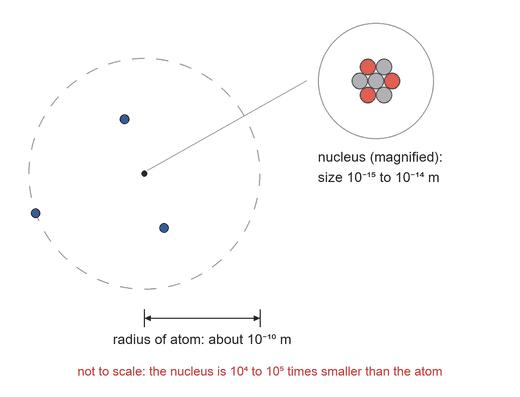
The nucleus is of the order of 10⁻¹⁵ m to 10⁻¹⁴ m across, while the atom is of the order of 10⁻¹⁰ m. Dividing the two sizes shows how many times smaller the nucleus is.
So the nucleus is about 10⁴ to 10⁵ times smaller than the atom, and most of the atom is empty space.
Step 3 — Name its constituents.
The nucleus is made of protons (positive) and neutrons (no charge), together called nucleons.
Step 4 — Find their numbers from Z and A.
For an atom , the atomic number gives the protons and the mass number gives all the nucleons, so the neutrons are the difference.
For example, has 11 protons and 23 − 11 = 12 neutrons.
Watch out: The mass number is not the number of neutrons; subtract Z from it.
Therefore, the nucleus is the tiny, dense, positive centre of the atom, about 10⁴ to 10⁵ times smaller than the atom; it is made of protons and neutrons, with protons = Z and neutrons = A − Z.