
Opening your dashboard
Class 10 Physics Chapter 12 Radioactivity: Competency-Based Questions (CBQ)
40 questions on Chapter 12, each worked through on its own page with the AI tutor. Class 10 Physics, ICSE 2026-27.
40 questions
1–5 marks · Mixed difficulty
- 11 mark
Question 1
Competency: Evaluation
Which of the following equations are correctly balanced?
A.
B.
C.
D.
- 21 mark
Question 2
Competency: Understanding & Analysis
Which of the following combinations correctly shows the charges on the particles.?
C C C (A) proton neutron alpha particle (B) alpha particle electron neutron (C) proton electron alpha particle (D) electron Proton alpha particle - 34 marks
Question 3
Competency: Evaluation & Application
The graph illustrates the correlation between the number of protons (x-axis) and the number of neutrons (y-axis) for element C in the periodic table. The element is denoted by letters rather than their conventional symbols. When element C, depicted in the graph, undergoes radioactive decay, it releases radioactive rays.

(a) Write the chemical symbol along with the mass number and atomic number for the element denoted as ‘C’.
(b) Plot on the graph,
i. The daughter element after the emission of beta radiation by the element ‘C’.
ii. The daughter element, as indicated in the previous answer, if it undergoes alpha decay.
- 44 marks
Question 4
Competency: Understanding & Application
An element emits one α-particle and then two β-particles consecutively to form an element Q.
(a) Show all the transformations by means of equations only.
(b) What are P and Q called?
- 51 mark
Question 5
Competency: Analysis
A research note lists four nuclei by the letters W, X, Y and Z (these are not their chemical symbols).
Nucleus Number of protons Number of neutrons W 17 18 X 17 20 Y 18 19 Z 19 20 Which option classifies the pairs correctly ?
- 61 mark
Question 6
Competency: Analysis
A detector is moved away from a small radioactive source in air, and the count rate is noted at each distance. The graph shows the readings. With the source taken out of the room, the detector reads 20 counts per minute.

Which radiation does the source give out ?
- 71 mark
Question 7
Competency: Understanding
Assertion (A): A photographic plate wrapped in thick black paper is kept in a dark drawer with a uranium salt lying on it. When the plate is developed, it is found to be fogged.
Reason (R): A uranium salt gives out radiations only after it has been exposed to sunlight.
- 81 mark
Question 8
Competency: Understanding & Analysis
Assertion (A): Nuclear fusion is also called a thermonuclear reaction.
Reason (R): The energy released per unit mass of fuel is greater in nuclear fusion than in nuclear fission.
- 92 marks
Question 9
Competency: Application & Analysis
For a science exhibition, a student makes a scale model of an atom. A pea of radius 0.5 cm stands for the nucleus. Take the radius of the nucleus as m and the radius of the atom as m.
(a) On the same scale, what should be the radius of the sphere that stands for the whole atom ?
(b) A visitor says, "Then most of the mass of the atom must be spread through that big sphere, outside the pea." Is the visitor right ? Give a reason.
- 102 marks
Question 10
Competency: Evaluation
A water pipe buried 50 cm below the ground is leaking somewhere along a long road. Engineers plan to mix a small amount of a radio isotope with the water and then walk along the road with a detector held near the ground. Three isotopes are available.
Isotope Radiation it gives out X α-particles Y β-particles Z γ-radiation Which isotope should the engineers choose ? Justify the choice by judging each of the three.
- 112 marks
Question 11
Competency: Application & Analysis
A student places a detector on a laboratory table when no radioactive source has been brought into the room. She counts for one minute, three times, and gets 24, 28 and 26 counts. She then places a weak source in front of the detector and gets 146 counts in one minute.
(a) Why does the detector record counts even when there is no source in the room ? Name one origin of these counts.
(b) Find the count rate that is due to the source alone.
- 122 marks
Question 12
Competency: Application
In an experimental fusion machine, two deuterium nuclei combine as shown :
The masses are : = 2.0141 a.m.u., = 3.0160 a.m.u. and = 1.0087 a.m.u. Take 1 a.m.u. = 931 MeV.
(a) Find the loss in mass in this reaction.
(b) Find the energy released, in MeV.
- 134 marks
Question 13
Competency: Analysis & Evaluation
Case study: In a paper mill, the thickness of the paper sheet is checked all the time by the gauge shown below. A β-source is fixed below the moving sheet and a detector above it. The counter is joined to the control of the rollers that press the sheet. For a sheet of the correct thickness the count rate is 400 counts per second.

One morning the counter shows these readings.
Time 10:00 10:05 10:10 10:15 10:20 Count rate (counts per second) 400 402 398 430 460 (a) Why is a β-source used in this gauge, and not an α-source or a γ-source ?
(b) What is happening to the sheet after 10:10 ? By what percentage is the count rate at 10:20 above the correct value, and what should the control do to the gap between the rollers ?
(c) The mill owner wants to use the same gauge to check steel plates 2 cm thick. Judge whether it will work, and suggest the change needed.
- 144 marks
Question 14
Competency: Application & Analysis
Case study: In a nuclear reactor, cadmium rods are moved in or out of the core to control the chain reaction of uranium-235. Each fission releases 3 neutrons. The table shows the number of fissions in four successive steps of the chain, for three positions P, Q and R of the rods.
Rod position Step 1 Step 2 Step 3 Step 4 P 1000 1000 1000 1000 Q 1000 1500 2250 3375 R 1000 800 640 512 (a) For each rod position, find how many of the 3 neutrons from one fission go on, on average, to cause another fission. State what happens to the rate of release of energy in each case.
(b) Which position is used when the reactor is to give a steady output ? In which position are the rods pushed deepest into the core ? Give a reason.
(c) In position P there are fissions every second, and each fission releases 200 MeV. Find the power of the reactor in MW. (1 MeV = J)
- 154 marks
Question 15
Competency: Application & Creation
Case study: A school laboratory has an old sealed radioactive source whose label has faded, so nobody knows which radiations it gives out. The teacher has a detector joined to a counter, a stop-watch, a sheet of thin paper, an aluminium plate 5 mm thick, a thick block of lead, a stand to hold the source, and a pair of long tongs.
(a) Plan an experiment with this apparatus to find out which of the α, β and γ radiations the source gives out. List the steps and say how the readings will be used to decide.
(b) Draw the table in which the readings would be recorded. Describe the readings you would expect if the source gives out β-particles and γ-radiation but no α-particles.
(c) State two precautions the teacher must take in this experiment, with the reason for each.
- 161 mark
Question 16
Competency: Understanding
Four changes are listed below.
- P: a piece of coal burns in air.
- Q: a radium nucleus gives out an α-particle.
- R: sugar dissolves in tea.
- S: a uranium-235 nucleus splits after it absorbs a neutron.
Which option names the changes that take place inside the nucleus, and gives the usual order of the energy released for each atom or nucleus involved in them?
- 171 mark
Question 17
Competency: Application
A data sheet describes the nucleus of an atom in this way: its total charge is C and its mass is about 55 times the mass of a proton. The charge on one proton is C, and a neutron has nearly the same mass as a proton.
How many neutrons are there in this nucleus?
- 181 mark
Question 18
Competency: Analysis
Tritium, , is a radioactive isotope of hydrogen. Its nucleus changes into a nucleus Y by emitting a β-particle.
Which statement about tritium and the nucleus Y is correct?
- 191 mark
Question 19
Competency: Understanding
A student writes four statements about radioactivity.
- P: A radioactive nucleus disintegrates on its own, without any outside push such as heating or pressing.
- Q: The radioactivity of uranium in uranium oxide is different from that of uranium in uranium chloride.
- R: Some nuclei of light elements, such as carbon-14, are also radioactive.
- S: Radioactivity is caused by electrons leaving the outer shells of the atom.
Which statements are correct?
- 201 mark
Question 20
Competency: Analysis
A source gives out α-particles, β-particles and γ-radiation. A detector is held in air 1.5 m from the source. A sheet of aluminium 5 mm thick is then placed between them, as shown. In air, the range of α-particles is 3 cm to 8 cm, that of β-particles is a few metres, and that of γ-radiation is hundreds of metres. A sheet of aluminium 5 mm thick stops β-particles.

Which radiations reach the detector (i) without the sheet, and (ii) with the sheet in place?
- 211 mark
Question 21
Competency: Application
A radioactive nucleus X emits an α-particle, then a γ-ray photon, and finally a β-particle. The last nucleus formed is polonium-214, .
How many neutrons were there in the original nucleus X?
- 221 mark
Question 22
Competency: Evaluation
An engineer checks a welded steel plate 3 cm thick with γ-rays from a cobalt-60 source held above it. A photographic film is placed below the plate. After exposure, the developed film shows a small dark patch below one point of the weld, and the rest of the film is only lightly shaded, as shown. The film becomes darker where more γ-radiation reaches it.
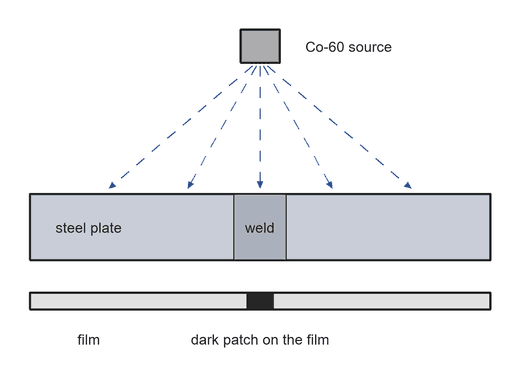
Which conclusion should the engineer draw?
- 231 mark
Question 23
Competency: Application
A 1 kW electric heater is switched on for one hour, so it supplies J (1 kWh) of energy. Suppose the same amount of energy were obtained entirely from the loss of mass in a nuclear reaction. Take m s.
The loss of mass needed would be :
- 241 mark
Question 24
Competency: Understanding
Assertion (A): Nuclear waste from a reactor is sealed in thick containers of steel and concrete and stored deep underground.
Reason (R): The radiations from nuclear waste are harmful, and they keep coming out for a very long time.
- 251 mark
Question 25
Competency: Understanding
Assertion (A): When a nucleus emits a γ-ray photon, its atomic number decreases by one.
Reason (R): A γ-ray photon carries energy but has no charge and no mass.
- 262 marks
Question 26
Competency: Analysis
A student compares the two ways of getting nuclear energy. In the fission of one uranium-235 nucleus about 200 MeV of energy is released. In the fusion of four hydrogen nuclei into one helium nucleus about 26.7 MeV is released.
(a) Find the energy released per nucleon in each process.
(b) Which process releases more energy from the same mass of fuel, and about how many times more? (All nucleons have nearly the same mass.)
- 272 marks
Question 27
Competency: Analysis
A school club uses the same detector at four places. No artificial source is kept near it at any place. The readings are given below. (Hypothetical data.)
Place Count rate (counts per minute) Beach at sea level 18 Hill station, 3000 m above sea level 31 Granite quarry at sea level 44 Room with thick lead walls at sea level 4 (a) Name a natural source of radiation that explains the higher reading at the hill station, and another that explains the higher reading at the quarry.
(b) Why is the reading lowest in the lead-walled room?
- 282 marks
Question 28
Competency: Application
Hydrogen has two isotopes, protium and deuterium (written D). Water made from protium is ordinary water, . Water made from deuterium is called heavy water, . The oxygen atom is in both.
(a) Find the number of neutrons in one molecule of each kind of water.
(b) Find the total number of nucleons in each molecule. Do the two kinds of water have the same chemical properties? Give a reason.
- 292 marks
Question 29
Competency: Application
When a uranium-235 nucleus undergoes fission, one of the possible fragments is barium-144, . Such fragments have too many neutrons and are unstable. They give out β-particles, one after another, until a stable nucleus is formed.
(a) Barium-144 emits one β-particle and forms lanthanum (La, atomic number 57). This nucleus then emits another β-particle and forms cerium (Ce). Write the two nuclear equations.
(b) Is the cerium nucleus an isotope of barium-144? Give a reason.
- 302 marks
Question 30
Competency: Application
A γ-ray photon and a β-particle leave a source at the same instant and travel 3 m through a vacuum chamber towards a detector. The γ-ray travels at m s. The β-particle travels at 90% of this speed.
(a) Find the time taken by each to reach the detector.
(b) Which one arrives first, and by how much time?
- 312 marks
Question 31
Competency: Understanding
An atom of aluminium has 13 protons, 14 neutrons and 13 electrons. Its mass is nearly 27 a.m.u. The mass of one electron is about 0.00055 a.m.u.
(a) Find the total mass of the electrons in this atom.
(b) What percentage of the mass of the atom is this? What does your answer show about where the mass of an atom is found?
- 323 marks
Question 32
Competency: Evaluation
A student reads the nuclear reaction below and says, "Matter has been destroyed in this fission, so the law of conservation of mass is wrong."
Masses (in a.m.u.): = 235.0439, neutron = 1.0087, = 89.9077, = 142.9535. (Hypothetical data.) Take 1 a.m.u. = 931 MeV.
(a) Show that the mass number and the atomic number are conserved in the reaction.
(b) Find the loss of mass and the energy released.
(c) Judge the student's statement.
- 333 marks
Question 33
Competency: Understanding
Cobalt-60, , is widely used as a source of γ-rays, though its nucleus first emits a β-particle and forms an excited nickel nucleus (the star shows an excited state). The excited nucleus then gives out γ-radiation and settles into the stable nucleus .
(a) Write the two nuclear equations.
(b) Show that the mass number and the atomic number are conserved in each equation.
(c) The cobalt-60 source is sealed in a steel capsule. Why do only γ-rays come out of the capsule, and not the β-particles?
- 343 marks
Question 34
Competency: Creativity
For Science Day you must build a working classroom model of a nuclear chain reaction using only cheap, safe things: small spring-loaded toy flippers (or mousetraps kept in a covered tray), table-tennis balls and cardboard strips.
Describe your model so that a classmate can build it.
(a) What stands for a uranium nucleus, for a neutron and for the energy released?
(b) How will your model show that the reaction can grow rapidly and go out of control?
(c) How will you add something that stands for the control rods, so that the reaction goes on at a steady rate?
- 353 marks
Question 35
Competency: Application
Radium-226 is a radioactive nucleus. It disintegrates by giving out an α-particle.
The masses are : = 226.0254 a.m.u., = 222.0176 a.m.u. and = 4.0026 a.m.u. Take 1 a.m.u. = 931 MeV.
(a) Show that the equation is balanced for mass number and atomic number.
(b) Find the loss of mass in the disintegration.
(c) Find the energy released in MeV, and say in what form most of this energy appears.
- 363 marks
Question 36
Competency: Application
In a hospital, a cobalt-60 machine treats a tumour deep inside a patient. Instead of firing the γ-ray beam from one side only, the source is moved round the patient to 9 equally spaced positions, always aimed at the tumour. Each beam position gives 5 units of radiation dose to every point on its path inside the body. Assume that the skin at any one entry point lies on the path of only one beam. (Hypothetical data.)
(a) Find the dose received by the tumour and by the skin at one entry point.
(b) Find how many times the dose at the tumour is that at the skin, and say what advantage this gives.
(c) Why do the hospital staff operate the machine from a separate control room?
- 375 marks
Question 37
Competency: Analysis
Case study: In a demonstration, a teacher keeps a source S, which gives out α-particles, β-particles and γ-radiation, at the bottom of a thick lead block with a narrow opening. The radiations come out of the opening and pass through a region where a magnetic field acts out of the page (shown by dots). The class sees three tracks P, Q and R, as shown. The teacher reminds the class that Fleming's left-hand rule gives the direction of the force on a moving charged particle, with the current taken in the direction of motion of a positive charge, and that a lighter particle is turned aside more easily.

(a) Name the radiation along each of the tracks P, Q and R, and give a reason for each.
(b) Explain why track P bends more sharply than track R.
(c) A sheet of aluminium 5 mm thick is placed across the opening of the lead block. Which tracks will still be seen? If, instead, the sheet is removed and the field is reversed, towards which side will the α-particle track bend?
- 385 marks
Question 38
Competency: Application & Evaluation
Case study: A water company wants to find how fast water flows in a buried steel pipe of diameter 0.60 m without digging it up. A small amount of a radio isotope is injected into the water at a point A. Two detectors, D1 and D2, are clamped to the outside of the pipe, 100 m and 400 m from A along the pipe. Each detector records the count rate as the radioactive water passes it. The readings are given below. (Hypothetical data.)
D1 (100 m from A): time after injection (s) 30 40 50 60 70 Count rate (counts per second) 120 480 900 470 130 D2 (400 m from A): time after injection (s) 180 190 200 210 220 Count rate (counts per second) 95 300 620 310 100 (a) At what time does each detector show its highest count rate? Use these times to find the speed of the water in the pipe.
(b) Find the volume of water that flows through the pipe in one second. Take .
(c) Which radiation must the isotope give out for the detectors outside the steel pipe to record it? Give a reason. State one more precaution in choosing the isotope, because the water is for drinking.
- 394 marks
Question 39
Competency: Analysis
Case study: Thorium-232, , is found in the sand of some beaches. It does not become stable at once, because its nucleus goes through a series of disintegrations. In one part of the series the nucleus emits five particles one after another, and the last nucleus formed is radon-220. The table lists the emissions, and the symbols of the elements formed are Ra (atomic number 88), Ac (89), Th (90) and Rn (86).
Step Particle emitted Nucleus formed 1 α Ra 2 β Ac 3 β Th 4 α Ra 5 α Rn (a) Find the mass number and the atomic number of the nucleus formed at each step.
(b) Name two pairs of nuclei in the series that are isotopes of each other, and give a reason.
(c) Name three nuclei in the series that are isobars of one another. Explain, using what happens inside the nucleus, why every β-emission produces an isobar of the nucleus that emits it.
- 404 marks
Question 40
Competency: Evaluation
Case study: The Sun gives out light and heat because hydrogen nuclei join together to form helium nuclei in its core, where the temperature is about K. In this fusion a small part of the mass of the hydrogen nuclei is changed into energy, which then reaches the Earth as sunlight. Some data about the Sun are given in the table. Take m s.
Quantity Value Energy given out by the Sun every second J Mass of the Sun kg Number of seconds in one year s (a) Find the mass changed into energy in the Sun every second.
(b) Find the mass changed into energy in one year, and the fraction of the Sun's mass that this is.
(c) A student says, "The Sun loses more than four billion kilograms every second, so it will soon be used up." Use your answers to judge this statement.