
Opening your dashboard
Class 10 Chemistry Chapter 6: Electrolysis Solutions
76 textbook questions with step-by-step answers, free to read, for ICSE 2026-27.
Get talked through Ch 6, not just shown the answer
Reading a finished solution is not the same as being able to do it. The AI tutor takes one question at a time and works it with you, in your own words, until you can.
- Ask it out loud, in your own words
- It gives you the next step, not the answer
- Stuck on part (ii)? Start there
76 questions with solutions
1–5 marks · Mixed difficulty
The first 67 solutions are on this page. This chapter is a long one, so the rest open on their own page to keep this one quick to load.
- 15 marks
Question 1
Fill in the blanks.
(a) Powdered sodium chloride (common salt) does not conduct an electric current, but it does so when .............. or when .............. .
(b) Molten lead bromide conducts electricity. It is called an .............. It is composed of lead .............. and bromide .............. . The lead ions are .............. charged and are called .............. The bromide .............. are .............. charged and are called ..............
(c) Substances which conduct electricity in the solid state are generally..............
(d) The electron releasing tendency of zinc is .............. than that of copper.
(e) A solution of HCl gas in water conducts electricity because .............., but a solution of HCl gas in toluene does not conduct an electric current because ..............
(f) Pure water consists entirely of .............. (ions/molecules).
(g) We can expect that pure water .............. (will/will not) normally conduct electricity.
(h) Electrolysis is the passage of .............. (electricity/electrons) through a liquid or a solution accompanied by a .............. (physical/chemical) change.
Solve with AIWritten solution
Solution:
Concept: A substance conducts electricity only if it has charged particles that are free to move. Metals (and graphite) have free electrons; an electrolyte has free ions, but only when it is molten (fused) or dissolved in water. Electrolysis is the chemical change that the current then brings about at the electrodes.
Step 1 — (a) When does common salt conduct.
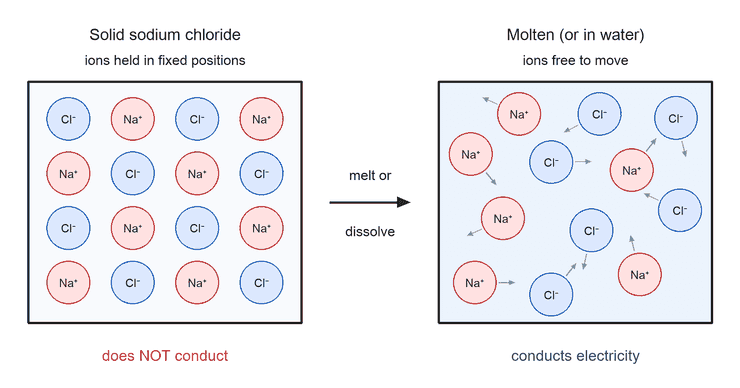
Solid sodium chloride does not conduct, because its and ions are held in fixed positions in the crystal. Melting it, or dissolving it in water, sets the ions free, and the moving ions carry the current.
So the blanks are: it conducts when dissolved in water or when melted (fused).
Step 2 — (b) Molten lead bromide.
Molten lead bromide conducts and is decomposed by the current, so it is an electrolyte. It is made of lead ions and bromide ions:
The lead ions are positively charged and are called cations. The bromide ions are negatively charged and are called anions.
Step 3 — (c) Conductors in the solid state.
Substances that conduct while solid must already have free charged particles. These are generally metals (and graphite), which conduct by free electrons, so they need not be melted or dissolved.
Step 4 — (d) Zinc and copper.
Zinc lies above copper in the electrochemical series, so a zinc atom gives up its electrons more easily:
The electron-releasing tendency of zinc is therefore greater than that of copper.
Step 5 — (e) HCl in water and in toluene.
Hydrogen chloride is a polar covalent compound. In water it ionises, so the solution has free ions:
Toluene is a non-polar solvent, so in toluene HCl does not ionise and stays as molecules; there are no ions to carry the current.
Step 6 — (f) What pure water is made of.
Pure water is ionised only to a very tiny extent, so it consists almost entirely of molecules.
Step 7 — (g) Does pure water conduct.
With almost no ions, pure water is a very poor conductor, so it will not normally conduct electricity.
Step 8 — (h) Definition of electrolysis.
In electrolysis the current (a flow of electricity) passes through the liquid, and the liquid is decomposed at the electrodes, which is a chemical change.
Watch out: In (h) the answer is 'electricity', not 'electrons': inside the liquid the current is carried by ions, not by a stream of electrons.
Therefore, the blanks are: (a) dissolved in water, melted (fused); (b) electrolyte, ions, ions, positively, cations, ions, negatively, anions; (c) metals; (d) greater; (e) it ionises (forms free ions), it does not ionise (stays as molecules); (f) molecules; (g) will not; (h) electricity, chemical.
- 25 marks
Question 2
Define the following terms :
(a) Electrolysis,
(b) Non-electrolyte,
(c) Cation and anion,
(d) Weak electrolytes.
Solve with AIWritten solution
Solution:
Concept: Every definition in this chapter turns on ions: whether a substance has free ions, and what happens to the ions at the electrodes when a current passes.
Step 1 — (a) Electrolysis.
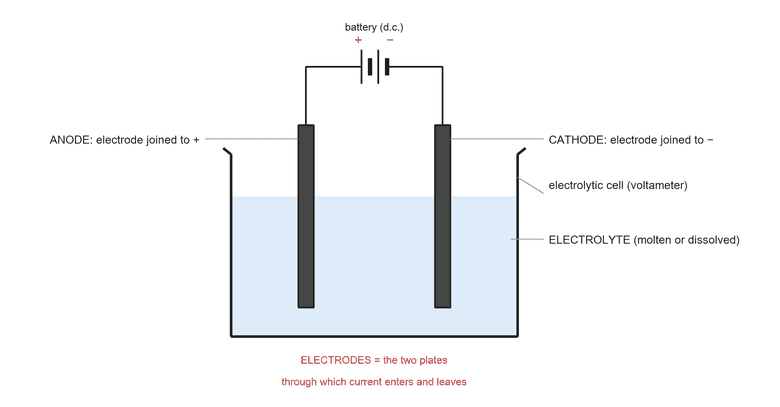
Electrolysis is the process of decomposition of a chemical compound in the aqueous or molten (fused) state by the passage of an electric current, with a chemical change at the electrodes.
For example, molten lead bromide is decomposed into lead at the cathode and bromine at the anode.
Step 2 — (b) Non-electrolyte.
A non-electrolyte is a compound which does not conduct electricity in the molten or aqueous state, because it contains only molecules and no ions.
Examples are sugar solution, alcohol and carbon tetrachloride.
Step 3 — (c) Cation and anion.
A cation is a positively charged ion, such as or . During electrolysis it moves to the cathode.
An anion is a negatively charged ion, such as or . During electrolysis it moves to the anode.
Step 4 — (d) Weak electrolytes.
Weak electrolytes are electrolytes which are only partially dissociated (ionised) in the fused or aqueous state. Their solutions contain ions as well as un-ionised molecules, so they conduct electricity only feebly.
Examples are acetic acid, ammonium hydroxide and carbonic acid.
Watch out: A cation goes to the cathode and an anion to the anode; the names match their first letters, which helps to remember them.
Therefore, electrolysis is decomposition of a molten or dissolved compound by an electric current; a non-electrolyte has no ions and does not conduct; cations are positive ions and anions negative ions; weak electrolytes are only partly ionised and conduct feebly.
- 35 marks
Question 3
What is the difference between :
(a) Modern explanation and Arrhenius explanation for the theory of electrolysis,
(b) Electrolytic dissociation and ionisation,
(c) A cation and an anion,
(d) Electrolytic dissociation and thermal dissociation.
(e) Strong electrolyte and weak electrolyte.
Solve with AIWritten solution
Solution:
Concept: Ionic (electrovalent) compounds already contain ions and only set them free on melting or dissolving; polar covalent compounds form ions only when they react with water.
Step 1 — (a) Arrhenius and modern explanations.
Arrhenius said that an electrolyte, when dissolved in water, dissociates into free, mobile ions, which carry the current. He thought that water produces the ions.
The modern explanation says that an electrovalent compound is ionic even in the solid state. There the ions are held in fixed positions by strong electrostatic forces, so they cannot move. Water (or melting) only breaks these forces and makes the existing ions mobile; it does not create the ions.
Step 2 — (b) Electrolytic dissociation and ionisation.
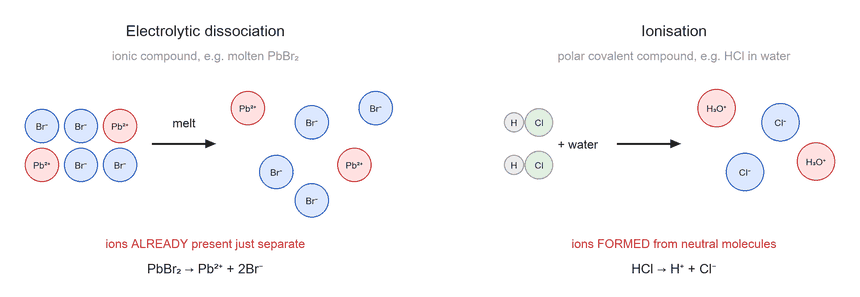
Electrolytic dissociation is the separation of ions already present in an electrovalent compound when it is melted or dissolved in water:
Ionisation is the formation of ions from a polar covalent compound, which has no ions of its own, when it is dissolved in water:
Step 3 — (c) Cation and anion.
A cation is positively charged and is formed by loss of electrons. It moves to the cathode and gains electrons there (reduction):
An anion is negatively charged and is formed by gain of electrons. It moves to the anode and loses electrons there (oxidation):
Step 4 — (d) Electrolytic and thermal dissociation.
In electrolytic dissociation an electrolyte breaks up into ions when it is melted or dissolved in water; no heat is needed to make the ions.
In thermal dissociation a compound breaks up reversibly into simpler molecules on heating. The products are neutral molecules, not ions, and they recombine on cooling:
Step 5 — (e) Strong and weak electrolytes.
A strong electrolyte is almost completely dissociated. Its solution contains (almost) only ions, so it is a good conductor, e.g. sodium chloride solution and dilute hydrochloric acid.
A weak electrolyte is only partially dissociated. Its solution contains ions and molecules, so it is a poor conductor, e.g. acetic acid and ammonium hydroxide.
Watch out: Ionisation and dissociation both give free ions, but only dissociation starts from a compound that is already made of ions.
Therefore, the modern theory says the ions already exist in the solid; dissociation separates existing ions while ionisation forms new ones; a cation is positive and goes to the cathode, an anion is negative and goes to the anode; electrolytic dissociation gives ions while thermal dissociation gives molecules on heating; a strong electrolyte is almost fully dissociated and a weak one only partly.
- 45 marks
Question 4
Name :
(a) a salt which is a weak electrolyte,
(b) a base which is a weak electrolyte,
(c) an inert electrode and an active electrode,
(d) a positively charged non-metallic ion,
(e) the electrode at which reduction occurs,
(f) a non-metallic element which is a conductor of electricity.
Solve with AIWritten solution
Solution:
Concept: Weak electrolytes are only partly ionised, inert electrodes do not take part in the electrode reaction, and reduction (gain of electrons) takes place at the cathode.
Step 1 — (a) A salt that is a weak electrolyte.
Lead acetate, , is such a salt (ammonium carbonate is another). It ionises only partly in water.
Step 2 — (b) A base that is a weak electrolyte.
Ammonium hydroxide, , is a weak alkali and is only partly ionised:
Step 3 — (c) Inert and active electrodes.
An inert electrode does not take part in the electrode reaction; platinum (or graphite) is an example.
An active electrode takes part in the reaction; copper (or silver, nickel) is an example, since as an anode it dissolves.
Step 4 — (d) A positive non-metallic ion.
The hydrogen ion, , is one (the ammonium ion, , is another). Hydrogen is a non-metal but forms a positive ion, which is why it is placed among the metals in the electrochemical series.
Step 5 — (e) Electrode where reduction occurs.
Reduction is gain of electrons, and cations gain electrons at the cathode:
Step 6 — (f) A non-metal that conducts.
Graphite (a form of carbon) has free electrons, so it conducts electricity although it is a non-metal.
Watch out: Graphite is the usual exception asked for: a non-metal that conducts. Diamond, the other form of carbon, does not conduct.
Therefore, (a) lead acetate, (b) ammonium hydroxide, (c) platinum (inert) and copper (active), (d) the hydrogen ion H⁺, (e) the cathode, (f) graphite.
- 52 marks
Question 5
Electrolysis is a redox process. Explain.
Solve with AIWritten solution
Solution:
Concept: Reduction is gain of electrons and oxidation is loss of electrons. A reaction in which both take place together is a redox reaction.
Step 1 — Look at the cathode.
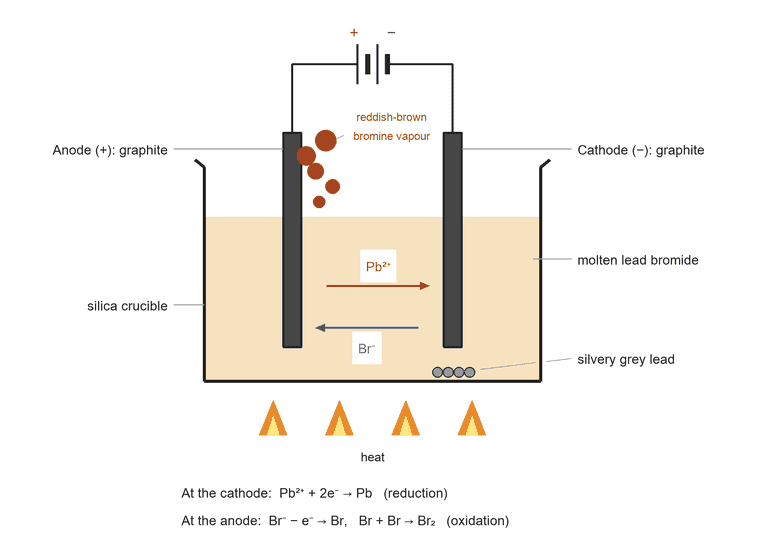
At the cathode the cations gain electrons, which is reduction. In molten lead bromide the lead ions are reduced:
Step 2 — Look at the anode.
At the anode the anions lose electrons, which is oxidation. The bromide ions are oxidised:
Step 3 — Put the two together.
The electrons given up at the anode flow through the outer circuit to the cathode, so the electrons lost at one electrode equal the electrons gained at the other. Oxidation and reduction therefore happen at the same time.
Watch out: Do not mix up the two electrodes: oxidation always takes place at the anode and reduction at the cathode.
Therefore, electrolysis is a redox process: reduction at the cathode and oxidation at the anode take place simultaneously.
- 63 marks
Question 6
Classify the following substances under three headings:
(a) strong electrolytes (b) weak electrolytes
(c) non-electrolytes.
Acetic acid, ammonium chloride, ammonium hydroxide, carbon tetrachloride, dilute hydrochloric acid, sodium acetate, dilute sulphuric acid.
Solve with AIWritten solution
Solution:
Concept: Ask how far each substance breaks into ions in water. Salts and mineral acids dissociate almost fully (strong); acetic acid and ammonium hydroxide only partly (weak); a covalent liquid such as not at all (non-electrolyte).
Step 1 — Strong electrolytes.
Ammonium chloride, dilute hydrochloric acid, sodium acetate and dilute sulphuric acid are strong electrolytes. The two salts are ionic, and the two mineral acids ionise almost completely, for example:
Step 2 — Weak electrolytes.
Acetic acid and ammonium hydroxide are weak electrolytes. Their solutions hold ions and un-ionised molecules, for example:
Step 3 — Non-electrolytes.
Carbon tetrachloride is a non-electrolyte. It is made only of molecules and forms no ions.
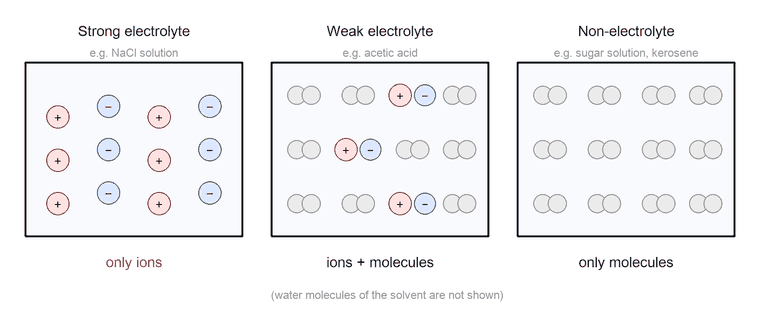
Watch out: Sodium acetate and ammonium chloride are salts of a weak acid or a weak base, but the salts themselves are ionic and therefore strong electrolytes.
Therefore, (a) strong: ammonium chloride, dilute hydrochloric acid, sodium acetate, dilute sulphuric acid; (b) weak: acetic acid, ammonium hydroxide; (c) non-electrolyte: carbon tetrachloride.
- 74 marks
Question 7
Explain why ;
(a) Cu, though a good conductor of electricity is a non electrolyte,
(b) Solid sodium chloride does not allow electricity to pass through ?
Solve with AIWritten solution
Solution:
Concept: An electrolyte conducts by ions and is decomposed by the current. A metal conducts by free electrons and is not decomposed.
Step 1 — (a) Why copper is a non-electrolyte.
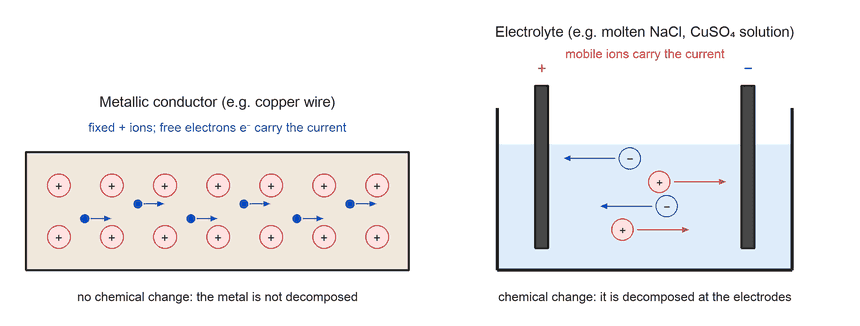
Copper conducts by the flow of its free (mobile) electrons. It has no moving ions, and it undergoes no chemical change when the current passes: after the current is switched off it is still the same copper.
An electrolyte must be decomposed by the current, so copper, though a good conductor, is a non-electrolyte (a metallic conductor).
Step 2 — (b) Why solid sodium chloride does not conduct.
In solid sodium chloride the and ions are held firmly in fixed positions in the crystal lattice by strong electrostatic forces. They are not free to move, so they cannot carry the current.
When the salt is melted or dissolved in water these forces are broken, the ions become mobile, and sodium chloride conducts.
Watch out: Solid sodium chloride does contain ions; it fails to conduct because the ions cannot move, not because there are no ions.
Therefore, (a) copper conducts by electrons without being decomposed, so it is a non-electrolyte; (b) in solid sodium chloride the ions are fixed in the lattice and cannot move, so it does not conduct.
- 81 mark
Question 8
Choose A, B, C or D to match the descriptions (i) to (v) below. Some alphabets may be repeated.
A. non-electrolyte B. strong electrolyte
C. weak electrolyte D. metallic conductor
(i) Molten ionic compound,
Solve with AIAnswer
(A) non-electrolyte
- Correct
(B) strong electrolyte
(C) weak electrolyte
(D) metallic conductor
Answer: (B) strong electrolyte
Concept: A non-electrolyte has only molecules; a strong electrolyte is (almost) fully dissociated, so it has only ions; a weak electrolyte has ions and molecules; a metallic conductor conducts by free electrons and is not decomposed.
Step 1 — Picture the molten compound.
Melting an ionic compound breaks the forces that held the ions in the crystal, so every particle in the melt is a free, mobile ion; no molecules are left.
Step 2 — Match the description.
A liquid made entirely of free ions is a good conductor that is decomposed by the current, which is the mark of a strong electrolyte (e.g. molten lead bromide, molten sodium chloride).
Watch out: A molten ionic compound is not a metallic conductor even though it conducts well: it conducts by ions and is decomposed.
Why the other options are wrong:
- (A) non-electrolyte: A non-electrolyte has no ions at all, only molecules, while the melt is made entirely of ions.
- (C) weak electrolyte: A weak electrolyte has ions and molecules together, while a molten ionic compound has no molecules.
- (D) metallic conductor: A metallic conductor conducts by electrons and is not decomposed, while the melt conducts by ions and is decomposed.
Therefore, a molten ionic compound is a strong electrolyte, option (B).
- 91 mark
Question 9
Choose A, B, C or D to match the descriptions (i) to (v) below. Some alphabets may be repeated.
A. non-electrolyte B. strong electrolyte
C. weak electrolyte D. metallic conductor
(ii) Carbon tetrachloride,
Solve with AIAnswer
- Correct
(A) non-electrolyte
(B) strong electrolyte
(C) weak electrolyte
(D) metallic conductor
Answer: (A) non-electrolyte
Concept: A non-electrolyte has only molecules; a strong electrolyte is (almost) fully dissociated, so it has only ions; a weak electrolyte has ions and molecules; a metallic conductor conducts by free electrons and is not decomposed.
Step 1 — Look at the particles.
Carbon tetrachloride, , is a non-polar covalent liquid made only of molecules. It neither dissociates nor ionises, so it has no ions.
Step 2 — Match the description.
A liquid that does not conduct because it has only molecules is a non-electrolyte.
Why the other options are wrong:
- (B) strong electrolyte: A strong electrolyte is full of ions, and carbon tetrachloride has none.
- (C) weak electrolyte: A weak electrolyte has at least some ions, and carbon tetrachloride has none.
- (D) metallic conductor: Carbon tetrachloride has no free electrons either, so it is not a metallic conductor.
Therefore, carbon tetrachloride is a non-electrolyte, option (A).
- 101 mark
Question 10
Choose A, B, C or D to match the descriptions (i) to (v) below. Some alphabets may be repeated.
A. non-electrolyte B. strong electrolyte
C. weak electrolyte D. metallic conductor
(iii) An aluminium wire,
Solve with AIAnswer
(A) non-electrolyte
(B) strong electrolyte
(C) weak electrolyte
- Correct
(D) metallic conductor
Answer: (D) metallic conductor
Concept: A non-electrolyte has only molecules; a strong electrolyte is (almost) fully dissociated, so it has only ions; a weak electrolyte has ions and molecules; a metallic conductor conducts by free electrons and is not decomposed.
Step 1 — Look at how the wire conducts.
Aluminium is a metal. In the wire the aluminium ions stay fixed and only the free electrons drift along, carrying the current.
Step 2 — Match the description.
No chemical change takes place in the wire, so it is a metallic conductor, not an electrolyte.
Why the other options are wrong:
- (A) non-electrolyte: A non-electrolyte does not conduct at all, while the aluminium wire conducts well.
- (B) strong electrolyte: A strong electrolyte conducts by ions and is decomposed; a metal wire does neither.
- (C) weak electrolyte: A weak electrolyte conducts by a few ions and is decomposed; a metal wire does neither.
Therefore, an aluminium wire is a metallic conductor, option (D).
- 111 mark
Question 11
Choose A, B, C or D to match the descriptions (i) to (v) below. Some alphabets may be repeated.
A. non-electrolyte B. strong electrolyte
C. weak electrolyte D. metallic conductor
(iv) A solution containing solvent molecules, solute molecules and ions formed by the dissociation of solute molecules.
Solve with AIAnswer
(A) non-electrolyte
(B) strong electrolyte
- Correct
(C) weak electrolyte
(D) metallic conductor
Answer: (C) weak electrolyte
Concept: A non-electrolyte has only molecules; a strong electrolyte is (almost) fully dissociated, so it has only ions; a weak electrolyte has ions and molecules; a metallic conductor conducts by free electrons and is not decomposed.
Step 1 — Read the description.
The solution holds ions formed from the solute and also solute molecules that have not dissociated, so the solute is only partly dissociated.
Step 2 — Match the description.
Partial dissociation is the mark of a weak electrolyte, such as acetic acid:
Watch out: The solvent (water) molecules are present in every solution; it is the leftover SOLUTE molecules that show the electrolyte is weak.
Why the other options are wrong:
- (A) non-electrolyte: A non-electrolyte solution has no ions, but this solution has ions.
- (B) strong electrolyte: A strong electrolyte is almost fully dissociated, so practically no solute molecules remain.
- (D) metallic conductor: A metallic conductor is a metal, not a solution of ions and molecules.
Therefore, the solution is that of a weak electrolyte, option (C).
- 121 mark
Question 12
Choose A, B, C or D to match the descriptions (i) to (v) below. Some alphabets may be repeated.
A. non-electrolyte B. strong electrolyte
C. weak electrolyte D. metallic conductor
(v) A sugar solution with sugar molecules and water molecules.
Solve with AIAnswer
- Correct
(A) non-electrolyte
(B) strong electrolyte
(C) weak electrolyte
(D) metallic conductor
Answer: (A) non-electrolyte
Concept: A non-electrolyte has only molecules; a strong electrolyte is (almost) fully dissociated, so it has only ions; a weak electrolyte has ions and molecules; a metallic conductor conducts by free electrons and is not decomposed.
Step 1 — Look at the particles.
Sugar is a covalent compound that does not dissociate in water, so the solution has only sugar molecules and water molecules, and no ions.
Step 2 — Match the description.
Without ions there is nothing to carry the current, so the solution does not conduct; sugar is a non-electrolyte.
Why the other options are wrong:
- (B) strong electrolyte: A strong electrolyte gives many ions in solution, and sugar gives none.
- (C) weak electrolyte: A weak electrolyte gives at least a few ions in solution, and sugar gives none.
- (D) metallic conductor: The solution has no free electrons, so it is not a metallic conductor.
Therefore, a sugar solution is a non-electrolyte, option (A).
- 131 mark
Question 13
An electrolyte which completely dissociates into ions is:
Solve with AIAnswer
(A) Alcohol
(B) Carbonic acid
(C) Sucrose
- Correct
(D) Sodium hydroxide
Answer: (D) Sodium hydroxide
Concept: An electrolyte that dissociates completely into ions is a strong electrolyte. Ionic compounds, strong acids and strong alkalis behave like this.
Step 1 — Pick the ionic compound.
Sodium hydroxide is an ionic compound and a strong alkali. In water it breaks up fully:
Step 2 — Check the result.
Its solution contains only and ions (besides water), so it is a good conductor and a strong electrolyte.
Watch out: Carbonic acid is an acid, but a weak one; being an acid does not make a substance a strong electrolyte.
Why the other options are wrong:
- (A) Alcohol: Alcohol is a covalent liquid and a non-electrolyte; it forms no ions.
- (B) Carbonic acid: Carbonic acid is a weak acid; it is only partly ionised, so its solution holds molecules as well as ions.
- (C) Sucrose: Sucrose (cane sugar) is a non-electrolyte; its solution has only molecules.
Therefore, sodium hydroxide dissociates completely into ions, option (D).
- 143 marks
Question 14
Name two substances in each case :
(a) Contain only molecules,
(b) Contain only ions,
(c) Contain ions as well as molecules.
Solve with AIWritten solution
Solution:
Concept: Only molecules means a non-electrolyte; only ions means a strong electrolyte (molten, or fully dissociated in water); ions and molecules together mean a weak electrolyte.
Step 1 — (a) Only molecules.
Sugar solution and carbon tetrachloride contain only molecules (alcohol, kerosene and distilled water are other examples). They are covalent and do not form ions.
Step 2 — (b) Only ions.
Molten sodium chloride and molten lead bromide contain only ions. In the melt every particle is an ion, for example:
Solutions of strong electrolytes, such as sodium chloride or sodium hydroxide solution, also contain only ions apart from the water molecules.
Step 3 — (c) Ions as well as molecules.
Acetic acid solution and ammonium hydroxide solution contain both (carbonic acid is another). They ionise only partly, for example:
Watch out: In a solution the water molecules are always present; the question is about the particles of the dissolved substance.
Therefore, (a) sugar solution and carbon tetrachloride; (b) molten sodium chloride and molten lead bromide; (c) acetic acid and ammonium hydroxide.
- 152 marks
Question 15
Select the ion in each case, that would get selectively discharged from the aqeuous mixture of the ions listed below :
(a) , and
(b) , and
Solve with AIWritten solution
Solution:
Concept: When several ions of the same charge sign reach an electrode, the ion lower in the electrochemical series is discharged in preference (selective discharge).
Step 1 — (a) Place the anions in the series.
The anion series is , , , , , , and the ease of discharge at the anode increases downwards. Of the three ions given, is the lowest, so it is discharged:
Step 2 — (b) Place the cations in the series.
In the cation series the order is … … , … , with the ease of discharge at the cathode increasing downwards. Of the three ions given, is the lowest, so it gains electrons most readily:
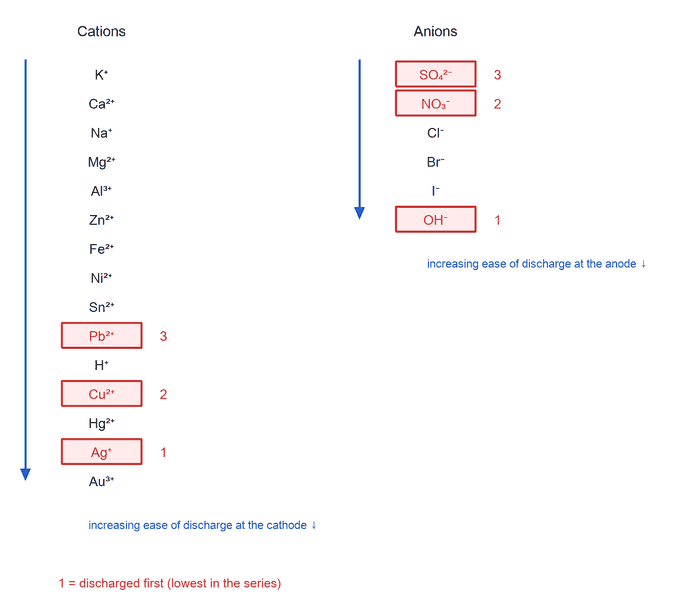
Watch out: The ion discharged first is the one LOWEST in the series, not the one at the top.
Therefore, (a) OH⁻ is discharged and (b) Ag⁺ is discharged.
- 164 marks
Question 16
(a) Among Zn and Cu, which would occur more readily in nature as metal and which as ion?
(b) Why we cannot store solution in a copper vessel ?
(c) Out of Cu and Ag, which is more active ?
Solve with AIWritten solution
Solution:
Concept: The higher a metal is in the electrochemical (activity) series, the more easily it loses electrons and the more it prefers to exist as ions. The order here is Zn > Cu > Ag.
Step 1 — (a) Zinc and copper in nature.
Copper is low in the series and does not lose electrons easily, so copper occurs more readily as the metal.
Zinc is higher and loses electrons easily, so zinc occurs more readily as ions:
Step 2 — (b) Silver nitrate in a copper vessel.
Copper lies above silver in the series, so copper is more reactive and displaces silver from silver nitrate solution:
The copper vessel would be eaten away, silver would be deposited, and the solution would turn blue (copper nitrate). So silver nitrate cannot be stored in a copper vessel.

Step 3 — (c) Copper or silver.
Copper is more active than silver, which is exactly why copper displaces silver in part (b).
Watch out: 'more active' means higher in the series and more ready to lose electrons, not 'more valuable'.
Therefore, (a) copper occurs as the metal and zinc as ions; (b) copper displaces silver from silver nitrate, so the vessel would be corroded; (c) copper is more active than silver.
- 174 marks
Question 17
(a) How would you change a metal like Cu into its ions?
(b) How would you change ion to Cu ?
Solve with AIWritten solution
Solution:
Concept: Changing a metal into its ion is oxidation (loss of electrons); changing the ion back into the metal is reduction (gain of electrons).
Step 1 — (a) Copper to copper ions.
Copper must be made to lose two electrons. One way is to make copper the anode in the electrolysis of copper sulphate solution: the copper atoms give up electrons to the anode and pass into the solution as ions.
Copper also forms ions when it displaces a less active metal, for example silver from silver nitrate.
Step 2 — (b) Copper ions to copper.
The ion must be made to gain two electrons. This happens at the cathode in the electrolysis of copper sulphate solution:
Adding a more active metal such as zinc does the same job:
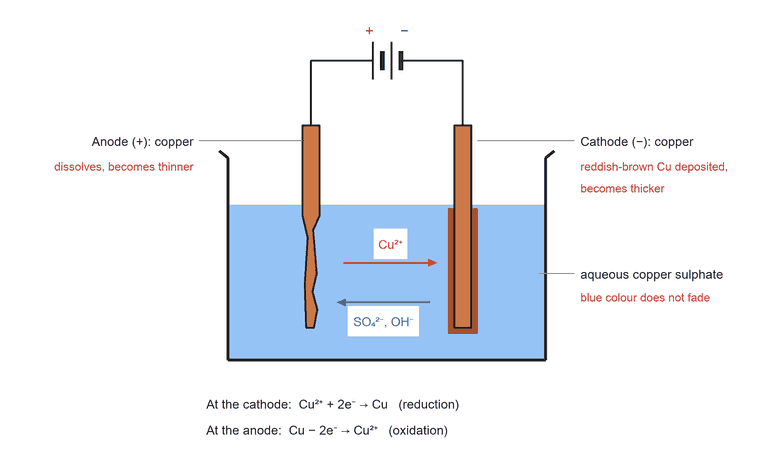
Watch out: The anode takes electrons away (oxidation) and the cathode supplies them (reduction); do not swap the two.
Therefore, (a) copper is changed into Cu²⁺ by making it lose two electrons, e.g. as the anode in copper sulphate solution; (b) Cu²⁺ is changed into copper by making it gain two electrons, e.g. at the cathode.
- 182 marks
Question 18
A solution of caustic soda (NaOH) in water or when fused, conducts an electric current. What is the similarity in these two cases ?
Solve with AIWritten solution
Solution:
Concept: An electrolyte conducts only through free, mobile ions.
Step 1 — Look at solid sodium hydroxide.
Sodium hydroxide is an ionic compound. In the solid its and ions are held in fixed positions and cannot move, so the solid does not conduct.
Step 2 — Melt it or dissolve it.
Melting or dissolving breaks the forces between the ions, so the same ions become free to move:
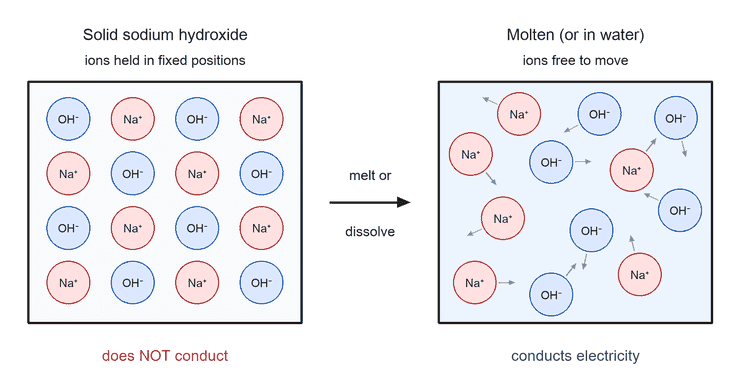
Step 3 — Compare the two cases.
In both the melt and the solution the current is carried by the same free ions, moving to the cathode and moving to the anode.
Watch out: Water does not create the ions here; they were already in the solid and are only set free.
Therefore, the similarity is that in both cases the current is carried by the same free, mobile Na⁺ and OH⁻ ions.
- 195 marks
Question 19
During electrolysis of an aqueous solution of sulphuric acid between platinum electrodes, two types of anions migrate towards the anode but only one of them is discharged :
(a) Name the two anions,
(b) Name the main product of the discharge of anion at the anode and write the anode reaction,
(c) Name the product at the cathode and write the reaction.
(d) Do you notice any change in colour. State why?
(e) Why this electrolysis, is considered as an example of catalysis ?
Solve with AIWritten solution
Solution:
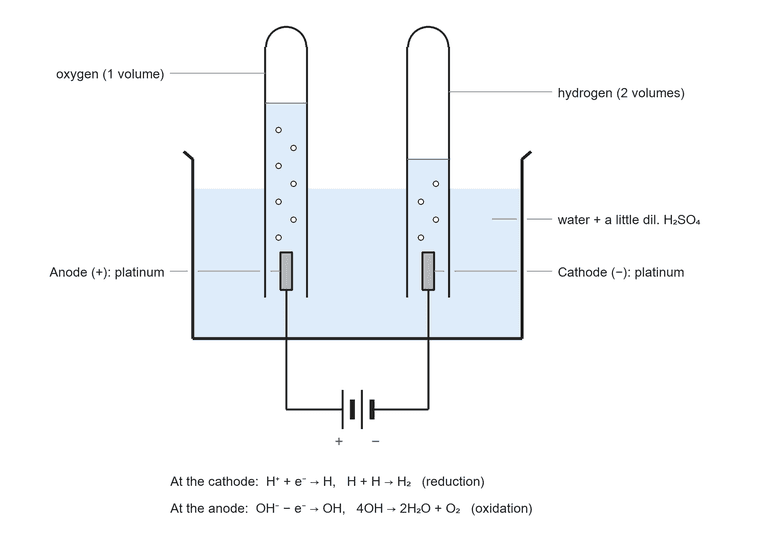
Concept: Acidified water contains , and ions. At an inert platinum anode the anion lower in the series () is discharged; at the cathode is discharged.
Step 1 — (a) Name the two anions.
The anions are sulphate ions, , from the acid, and hydroxyl ions, , from water:
Step 2 — (b) Product at the anode.
The ion lies below in the series, so it is discharged. Each hydroxyl ion loses an electron, and the OH groups then combine to give oxygen:
Step 3 — (c) Product at the cathode.
The ions gain electrons and the atoms pair up to give hydrogen:
For every four electrons, two molecules of hydrogen form at the cathode but only one molecule of oxygen at the anode, so the gases form in the ratio 2 : 1 by volume.
Step 4 — (d) Any colour change.
There is no change in colour. All the ions present (, , ) are colourless, and the products, hydrogen and oxygen, are colourless gases.
Step 5 — (e) Why it is called catalysis.
Pure water contains very few ions, so it hardly conducts electricity. The dilute sulphuric acid supplies plenty of ions ( and ), so the solution conducts and the water is decomposed into hydrogen and oxygen.
The acid itself is not used up: the same amount is left at the end. A substance that helps a reaction without being consumed acts as a catalyst, so this electrolysis is treated as an example of catalysis.
Note: The acid does not make the water itself ionise more; it only provides the ions that carry the current.
Watch out: The sulphate ion reaches the anode but is not discharged; the oxygen comes from the hydroxyl ions of water.
Therefore, (a) SO₄²⁻ and OH⁻; (b) oxygen, 4OH⁻ − 4e⁻ → 2H₂O + O₂; (c) hydrogen, 2H⁺ + 2e⁻ → H₂; (d) no colour change, as all ions and products are colourless; (e) the acid supplies the ions that carry the current but is not used up, like a catalyst.
- 202 marks
Question 20
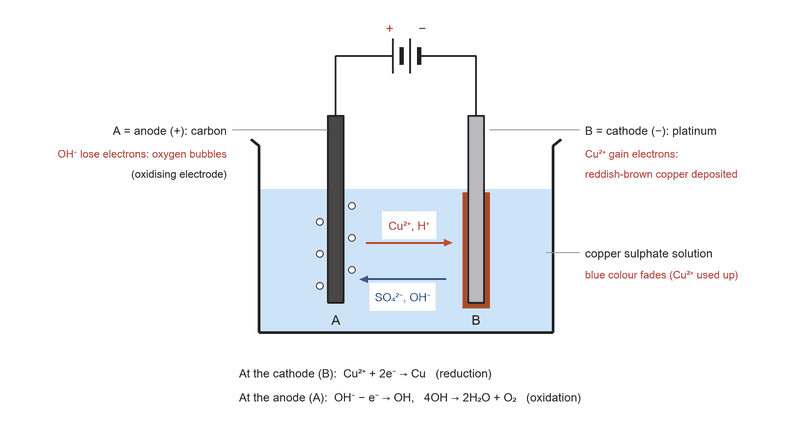
Copper sulphate solution is electrolysed using a platinum cathode and carbon anode. Study the diagram given alongside and answer the following questions :

(a) Give the names of the electrodes A and B.
(b) Which electrode is the oxidizing electrode ?
Solve with AIWritten solution
Solution:
Concept: In the cell symbol the long thin plate is the positive (+) terminal and the short thick plate is the negative (−) terminal. The anode is joined to + and the cathode to −. Oxidation (loss of electrons) takes place at the anode.
Step 1 — Trace the wires.
Electrode A is joined, through the key, to the long thin plate of the cell, the positive terminal. Electrode B is joined, through the rheostat, to the short thick plate, the negative terminal.
Step 2 — (a) Name the electrodes.
So A is the anode, and since the stem says the anode is carbon, A is the carbon electrode. B is the cathode, the platinum electrode.
Step 3 — (b) The oxidising electrode.
At the anode A, ions are discharged in preference to . They lose electrons (are oxidised) and oxygen is given off:
At B the copper ions gain electrons and copper is deposited:
Watch out: The anode is decided by which terminal it is joined to, not by its position on the left or right.
Therefore, (a) A is the anode (carbon) and B is the cathode (platinum); (b) A, the anode, is the oxidising electrode.
- 212 marks
Question 21
To carry out the so-called "electrolysis of water", sulphuric acid is added to water. How does the addition of sulphuric acid produce a conducting solution ?
Solve with AIWritten solution
Solution:
Concept: Pure water is almost entirely molecules; an acid supplies plenty of free ions.
Step 1 — Look at pure water.
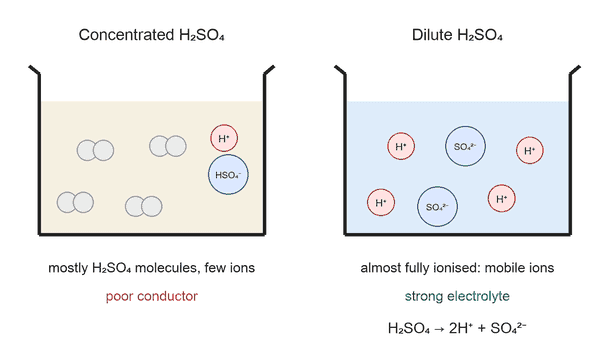
Water is a polar covalent compound and is only very slightly ionised, so it is a very poor conductor.
Step 2 — Add dilute sulphuric acid.
Sulphuric acid is a strong electrolyte and dissociates almost completely:
It also increases the ionisation of the water itself:
Step 3 — See the result.
These free, mobile ions carry the current, so the acidified water becomes a good conductor and the water can be electrolysed.
Watch out: The acid is not decomposed in the process; hydrogen and oxygen come from the water, and the acid is left behind.
Therefore, sulphuric acid dissociates into free H⁺ and SO₄²⁻ ions (and helps water to ionise), and these mobile ions make the solution conduct.
- 225 marks
Question 22
(a) Choosing only words from the following list, write down the appropriate words to fill in the blanks (i) to (v) below: anions, anode, cathode, cations, electrode, electrolyte, nickel, voltameter.
The electroplating of an article with nickel requires an (i) ............ which must be a solution containing (ii) ............ ions. The article to be plated is placed as the (iii) ............ of the cell in which the plating is carried out. The (iv) ............ of the cell is made from pure nickel. The ions that are attracted to the negative electrode and discharged are called (v) ............ .
(b) When a molten ionic compound is electrolysed, the metal is always formed at ................ and the non-metal is formed at ................ .
(c) Electrolysis of acidulated water is an example of ................ (Reduction/oxidation/redox reaction/ synthesis). (2018)
Solve with AIWritten solution
Solution:
Concept: In electroplating the article is the cathode, the plating metal is the anode, and the electrolyte contains ions of the plating metal.
Step 1 — (a) Fill in the nickel-plating blanks.
The plating is done in an electrolyte (i), which must contain nickel (ii) ions. The article is the cathode (iii), the anode (iv) is pure nickel, and the positive ions attracted to the negative electrode and discharged are cations (v).
At the article the cations gain electrons and are deposited as nickel:
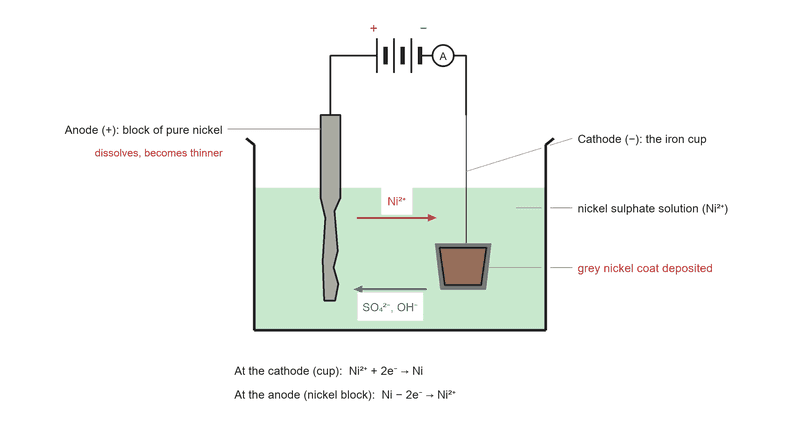
Step 2 — (b) Molten ionic compound.
The metal ion is a cation, so it gains electrons at the cathode; the non-metal ion is an anion, so it loses electrons at the anode. For example, molten lead bromide gives lead at the cathode and bromine at the anode.
Step 3 — (c) Acidulated water.
At the cathode ions gain electrons (reduction), and at the anode ions lose electrons (oxidation). Both happen at the same time, so the electrolysis is a redox reaction.
Watch out: The plating metal is the ANODE (it dissolves); the article being plated is the CATHODE.
Therefore, (a) (i) electrolyte, (ii) nickel, (iii) cathode, (iv) anode, (v) cations; (b) cathode, anode; (c) redox reaction.
- 235 marks
Question 23
Explain the following :
(a) A solution of cane sugar does not conduct electricity, but a solution of sodium chloride is a good conductor,
(b) Hydrochloric acid is a good conductor of electricity,
(c) During the electrolysis of an aqueous solution of NaCl, hydrogen ion is reduced at the cathode and not the sodium ion though both and ions are present in the solution.
(d) On electrolysis of dilute copper (II) sulphate solution, copper is deposited at the cathode but no hydrogen gas evolves there. Explain why ?
(e) When a dilute aqueous solution of sodium chloride is electrolysed between platinum electrodes, hydrogen gas is evolved at the cathode but metallic sodium is not deposited. Why ?
(f) Zinc can produce hydrogen on reacting with acids but copper cannot. Explain.
Solve with AIWritten solution
Solution:
Concept: A solution conducts only if it has free ions. At an electrode the ion lower in the electrochemical series is discharged first, and a metal displaces hydrogen from acids only if it lies above hydrogen.
Step 1 — (a) Cane sugar and sodium chloride.
Cane sugar is a covalent compound that does not dissociate in water; its solution has only molecules, so it does not conduct.
Sodium chloride is an ionic compound; in water it dissociates completely into free and ions, which carry the current.

Step 2 — (b) Hydrochloric acid.
Hydrogen chloride is a polar covalent compound that ionises almost completely in water:
The large number of free ions makes hydrochloric acid a strong electrolyte and a good conductor.
Step 3 — (c) Hydrogen, not sodium, at the cathode.
lies below in the electrochemical series, so it accepts electrons more readily and is discharged in preference, even though ions are more numerous:
Sodium, being far more reactive, stays in the solution as .
Step 4 — (d) Copper, not hydrogen, from copper sulphate.
Both and reach the cathode, but is lower in the series, so the copper ions are discharged first:
The ions stay in solution, so no hydrogen is given off.

Step 5 — (e) Dilute sodium chloride with platinum electrodes.
The reason is the same as in (c): from water lies below and is discharged in preference, giving hydrogen gas, while is not discharged. Even if a little sodium were formed, it would react at once with the water.
Step 6 — (f) Zinc and copper with acids.
Zinc lies above hydrogen in the series, so it loses electrons more readily than hydrogen and displaces hydrogen from acids:
Copper lies below hydrogen, so it cannot displace hydrogen from acids.
Watch out: More Na⁺ ions than H⁺ ions does not decide the matter; the position in the series does.
Therefore, each observation follows from free ions (a, b) and from the order of the electrochemical series (c to f): H⁺ is discharged before Na⁺, Cu²⁺ before H⁺, and only metals above hydrogen displace it from acids.
- 241 mark
Question 24
During the electrolysis of molten lead bromide, which of the following takes place?
Solve with AIAnswer
(A) Bromine is released at the cathode,
(B) Lead is deposited at the anode,
(C) Bromine ions gain electrons,
- Correct
(D) Lead is deposited at the cathode.
Answer: (D) Lead is deposited at the cathode.
Concept: Molten lead bromide contains and ions. Cations go to the cathode and gain electrons; anions go to the anode and lose electrons.
Step 1 — Follow the lead ions.
The lead ions move to the cathode, gain electrons and silvery grey lead is deposited there:
Step 2 — Follow the bromide ions.
The bromide ions move to the anode, lose electrons and bromine is formed:
Watch out: The metal always comes out at the cathode and the non-metal at the anode.
Why the other options are wrong:
- (A) Bromine is released at the cathode,: Bromine is released at the anode, not the cathode.
- (B) Lead is deposited at the anode,: Lead is deposited at the cathode, not the anode.
- (C) Bromine ions gain electrons,: Bromide ions lose electrons at the anode; they do not gain them.
Therefore, lead is deposited at the cathode, option (D).
- 251 mark
Question 25
The aqueous solution of the compound which contains both ions and molecules is :
Solve with AIAnswer
(A)
(B) HCl
(C)
- Correct
(D)
Answer: (D)
Concept: A solution that contains both ions and molecules of the solute is that of a weak electrolyte, one that ionises only partly.
Step 1 — Find the weak acid.
Acetic acid is a weak acid; only a small fraction of its molecules ionise:
Step 2 — Check the particles.
So its solution holds and ions and many un-ionised molecules.
Watch out: All four are acids; only the weak acid leaves molecules un-ionised.
Why the other options are wrong:
- (A) : Sulphuric acid is a strong acid, almost fully ionised; apart from water its solution holds only ions.
- (B) HCl: Hydrochloric acid is a strong acid, almost fully ionised, so no HCl molecules remain.
- (C) : Nitric acid is a strong acid, almost fully ionised, so no HNO₃ molecules remain.
Therefore, the aqueous solution of acetic acid contains both ions and molecules, option (D).
- 261 mark
Question 26
A compound which during electrolysis in its molten state, liberates a reddish brown gas at the anode is :
Solve with AIAnswer
(A) Sodium chloride
(B) Copper [II] oxide
(C) Copper [II] sulphate
- Correct
(D) Lead [II] bromide
Answer: (D) Lead [II] bromide
Concept: A reddish-brown gas at the anode is bromine, so the compound must contain bromide ions.
Step 1 — Find the bromide.
Of the four compounds only lead (II) bromide contains bromide ions. In the melt the ions move to the anode and lose electrons:
Step 2 — Describe what is seen.
Bromine escapes as dark reddish-brown fumes, while lead collects at the cathode.
Why the other options are wrong:
- (A) Sodium chloride: Molten sodium chloride gives greenish-yellow chlorine at the anode, not a reddish-brown gas.
- (B) Copper [II] oxide: Copper (II) oxide has oxide ions, not bromide ions, so it cannot give bromine.
- (C) Copper [II] sulphate: Copper (II) sulphate has no bromide ions either, so it cannot give bromine.
Therefore, the compound is lead (II) bromide, option (D).
- 271 mark
Question 27
Identify the weak electrolyte from the following :
Solve with AIAnswer
(A) Sodium chloride solution,
(B) Dilute hydrochloric acid,
(C) Dilute sulphuric acid,
- Correct
(D) Aq. acetic acid
Answer: (D) Aq. acetic acid
Concept: A weak electrolyte ionises only partly, so its solution has few ions and conducts poorly.
Step 1 — Pick the weak acid.
Acetic acid is an organic acid that is only partly ionised; most of its molecules stay un-ionised:
Step 2 — Check with a bulb.
With only a few ions, a bulb in the circuit glows only dimly.
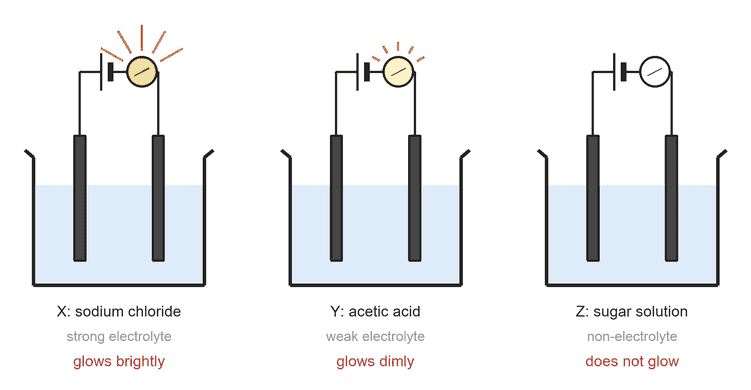
Why the other options are wrong:
- (A) Sodium chloride solution,: Sodium chloride solution is fully dissociated into ions, so it is a strong electrolyte.
- (B) Dilute hydrochloric acid,: Dilute hydrochloric acid is a strong acid, fully ionised, so it is a strong electrolyte.
- (C) Dilute sulphuric acid,: Dilute sulphuric acid is a strong acid, fully ionised, so it is a strong electrolyte.
Therefore, the weak electrolyte is aqueous acetic acid, option (D).
- 281 mark
Question 28
An aqueous electrolyte consists of the following ions. The ion which could be discharged most readily during electrolysis is :
Solve with AIAnswer
(A)
- Correct
(B)
(C)
(D)
Answer: (B)
Concept: Among cations, the one lowest in the electrochemical series gains electrons most easily and is discharged first at the cathode.
Step 1 — Place the ions in the series.
The cation series runs K, Ca, Na, Mg, Al, Zn, Fe, Ni, Sn, Pb, H, Cu, Hg, Ag, Au, so the order of the four ions is Al above Fe, Fe above H, and H above Cu.
Step 2 — Pick the lowest.
is the lowest of the four, so it is discharged first:
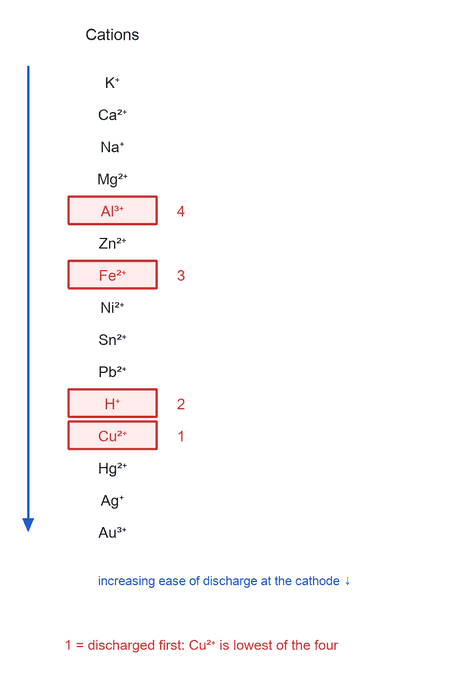
Watch out: The ion discharged most readily is the LOWEST one in the series.
Why the other options are wrong:
- (A) : Iron lies above hydrogen and copper, so Fe²⁺ is harder to discharge.
- (C) : H⁺ lies above Cu²⁺, so it is discharged only after the copper ions.
- (D) : Aluminium is very high in the series; Al³⁺ is not discharged from an aqueous solution at all.
Therefore, Cu²⁺ is discharged most readily, option (B).
- 291 mark
Question 29
During silver plating of an article using potassium argentocyanide as an electrolyte, the anode material should be :
Solve with AIAnswer
(A) Cu
- Correct
(B) Ag
(C) Pt
(D) Fe
Answer: (B) Ag
Concept: In electroplating the anode is a block of the pure plating metal. It dissolves and replaces the metal ions that are deposited on the article.
Step 1 — Follow the anode.
At a silver anode the silver atoms lose electrons and pass into the solution:
Step 2 — Follow the cathode.
At the article (the cathode) the same number of silver ions gain electrons and coat it:
So the silver-ion content of the potassium argentocyanide bath stays constant.
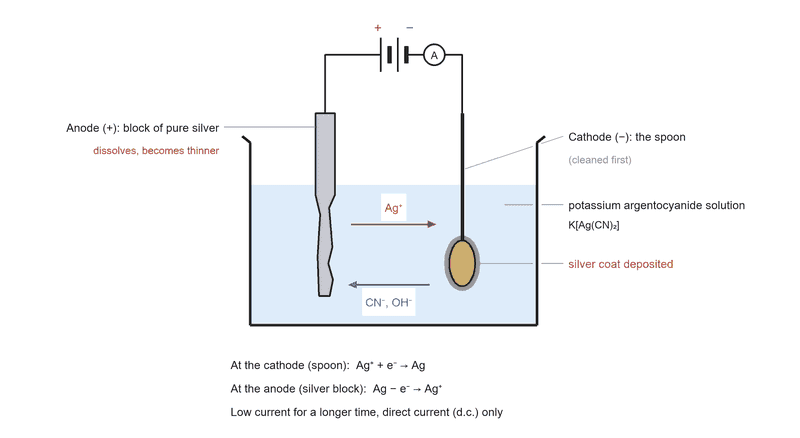
Watch out: The article to be plated is the cathode; the plating metal (silver) is the anode.
Why the other options are wrong:
- (A) Cu: A copper anode would put Cu²⁺ ions into the bath, not silver ions.
- (C) Pt: Platinum is inert; the bath would slowly run out of silver ions.
- (D) Fe: An iron anode would put iron ions into the bath, not silver ions.
Therefore, the anode should be silver, option (B).
- 301 mark
Question 30
State which of these will act as a non-electrolyte :
Solve with AIAnswer
- Correct
(A) Liquid carbon tetrachloride
(B) Acetic acid
(C) Sodium hydroxide aqueous solution
(D) Potassium chloride aqueous solution
Answer: (A) Liquid carbon tetrachloride
Concept: A non-electrolyte contains only molecules, and no ions, in the liquid or dissolved state.
Step 1 — Look at carbon tetrachloride.
is a non-polar covalent liquid; it neither dissociates nor ionises.
Step 2 — Decide.
With no ions to carry charge it does not conduct, so it is a non-electrolyte.
Why the other options are wrong:
- (B) Acetic acid: Acetic acid is a weak electrolyte; it is partly ionised in water.
- (C) Sodium hydroxide aqueous solution: Sodium hydroxide solution is fully dissociated into Na⁺ and OH⁻, so it is a strong electrolyte.
- (D) Potassium chloride aqueous solution: Potassium chloride solution is fully dissociated into K⁺ and Cl⁻, so it is a strong electrolyte.
Therefore, liquid carbon tetrachloride is a non-electrolyte, option (A).
- 311 mark
Question 31
The observation seen when fused lead bromide is electrolysed is :
Solve with AIAnswer
(A) A silver grey deposit at anode and a reddish brown deposit at cathode.
(B) A silver grey deposit at cathode and a reddish brown deposit at anode.
- Correct
(C) A silver grey deposit at cathode and reddish brown fumes at anode.
(D) Silver grey fumes at anode and reddish brown fumes at cathode.
Answer: (C) A silver grey deposit at cathode and reddish brown fumes at anode.
Concept: Lead, a metal, is formed at the cathode; bromine, a non-metal, is formed at the anode.
Step 1 — Look at the cathode.
Lead ions gain electrons and a silvery grey metal (lead) collects:
Step 2 — Look at the anode.
Bromide ions lose electrons. Bromine is volatile at the temperature of the melt, so it escapes as dark reddish-brown fumes:
Watch out: Bromine is not a deposit; it leaves the anode as fumes.
Why the other options are wrong:
- (A) A silver grey deposit at anode and a reddish brown deposit at cathode: It swaps the electrodes, and it calls bromine a deposit.
- (B) A silver grey deposit at cathode and a reddish brown deposit at anode: Bromine escapes as fumes; it does not form a deposit at the anode.
- (D) Silver grey fumes at anode and reddish brown fumes at cathode: Lead does not form fumes, and the electrodes are swapped.
Therefore, a silver grey deposit forms at the cathode and reddish brown fumes at the anode, option (C).
- 321 mark
Question 32
During electroplating an article with silver, the electrolyte used is :
Solve with AIAnswer
(A) Silver nitrate solultion
(B) Silver cyanide solution
- Correct
(C) Sodium argentocyanide solution
(D) Nickel sulphate solution.
Answer: (C) Sodium argentocyanide solution
Concept: For a smooth, firm and lasting coat, silver must be deposited slowly and evenly, so the electrolyte must supply ions slowly.
Step 1 — See how the complex salt behaves.
Sodium argentocyanide, , gives the complex ion, which releases silver ions only slowly:
Step 2 — Follow the silver ions.
At the article (the cathode) the silver ions are discharged steadily:

Watch out: Silver nitrate does give silver ions, but too fast; the deposit then is rough and peels off.
Why the other options are wrong:
- (A) Silver nitrate solultion: With silver nitrate the silver is deposited very fast, so the coat is not smooth and uniform.
- (B) Silver cyanide solution: Silver cyanide on its own is insoluble in water, so it cannot be the electrolyte.
- (D) Nickel sulphate solution: Nickel sulphate supplies nickel ions; it is used for nickel plating, not silver plating.
Therefore, the electrolyte used is sodium argentocyanide solution, option (C).
- 331 mark
Question 33
The metallic electrode which does not take part in an electrolytic reaction is :
Solve with AIAnswer
(A) Cu
(B) Ag,
- Correct
(C) Pt
(D) Ni
Answer: (C) Pt
Concept: An inert electrode only passes electrons to and from the ions; it does not dissolve or react. Platinum (and graphite) are inert.
Step 1 — Use platinum electrodes.
With platinum electrodes in copper sulphate solution, ions are discharged at the anode and oxygen is given off; the platinum itself is unchanged.
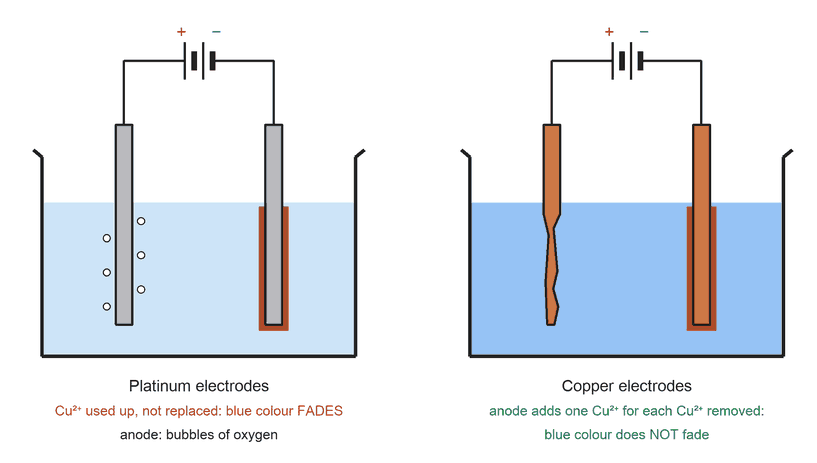
Step 2 — Compare an active anode.
With a copper anode the anode itself dissolves, so copper takes part in the reaction:
Why the other options are wrong:
- (A) Cu: Copper is an active electrode; as an anode it dissolves.
- (B) Ag,: Silver is an active electrode; as an anode it dissolves.
- (D) Ni: Nickel is an active electrode; as an anode it dissolves.
Therefore, the electrode that does not take part is platinum, option (C).
- 341 mark
Question 34
The ion which is discharged at the anode during the electrolysis of copper sulphate solution using platinum electrodes as anode and cathode is :
Solve with AIAnswer
(A)
- Correct
(B)
(C)
(D)
Answer: (B)
Concept: At an inert (platinum) anode the anion lowest in the series is discharged; lies below .
Step 1 — List the ions at the anode.
Both (from the salt) and (from water) move to the anode.
Step 2 — Pick the one discharged.
is discharged and oxygen is given off:
Watch out: The sulphate ion reaches the anode but stays in solution.
Why the other options are wrong:
- (A) : Cu²⁺ is a cation; it moves to the cathode, not the anode.
- (C) : SO₄²⁻ reaches the anode but is not discharged; it is highest in the anion series.
- (D) : H⁺ is a cation; it moves to the cathode, not the anode.
Therefore, the ion discharged at the anode is OH⁻, option (B).
- 351 mark
Question 35
When dilute sodium chloride is electrolysed using graphite electrodes, the cation which is discharged at the cathode most readily is :
Solve with AIAnswer
(A)
(B)
- Correct
(C)
(D)
Answer: (C)
Concept: At the cathode the cation lower in the electrochemical series is discharged first; lies below .
Step 1 — List the cations.
Dilute sodium chloride solution has two cations, from the salt and from water.
Step 2 — Pick the one discharged.
gains electrons more easily, so hydrogen gas is given off:
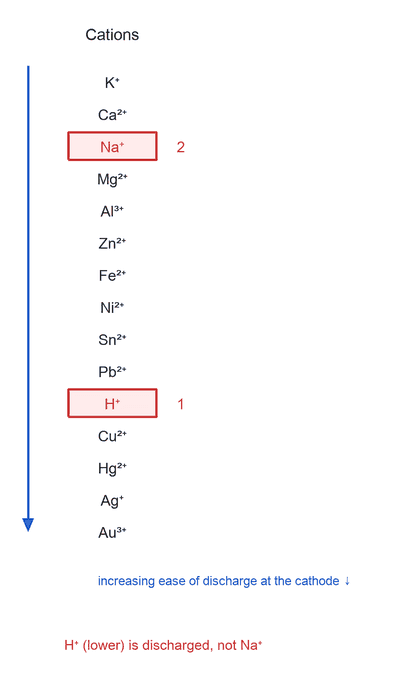
Watch out: There are many more Na⁺ ions than H⁺ ions, but the position in the series decides.
Why the other options are wrong:
- (A) : Na⁺ lies high in the series and stays in the solution.
- (B) : OH⁻ is an anion, not a cation; it goes to the anode.
- (D) : Cl⁻ is an anion, not a cation; it goes to the anode.
Therefore, the cation discharged most readily is H⁺, option (C).
- 361 mark
Question 36
Cathode is a reducing electrode because :
Solve with AIAnswer
(A) it has less number of electrons
(B) it has deficiency of electrons
- Correct
(C) cations gain electrons from cathode
(D) anions lose electrons to cathode
Answer: (C) cations gain electrons from cathode
Concept: Reduction is gain of electrons. The cathode, joined to the negative terminal, has a supply of electrons and hands them to the cations.
Step 1 — Follow a cation.
Cations such as reach the cathode and take electrons from it:
Step 2 — Name the electrode.
Because the cathode makes the cations gain electrons, it is the reducing electrode.
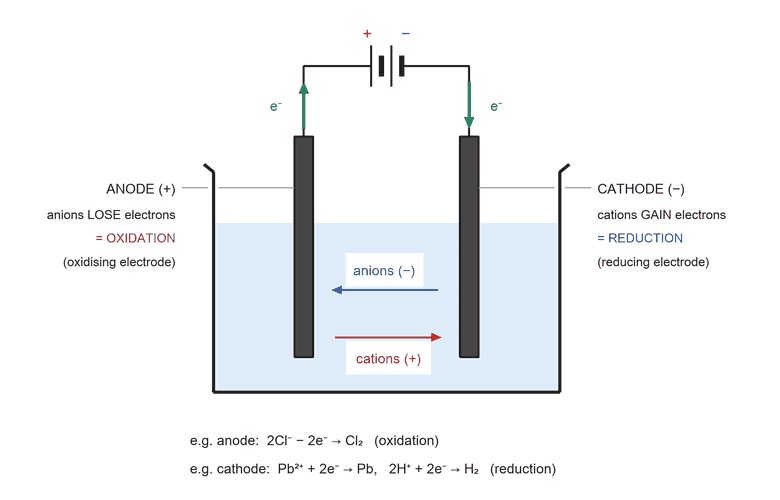
Watch out: The cathode has an EXCESS of electrons; the anode is the electrode that takes electrons away.
Why the other options are wrong:
- (A) it has less number of electrons: The cathode has more electrons, not fewer.
- (B) it has deficiency of electrons: The cathode has no deficiency of electrons; the anode is the electrode that takes electrons away.
- (D) anions lose electrons to cathode: Anions go to the anode and lose electrons there, which is oxidation, not reduction.
Therefore, the cathode is a reducing electrode because cations gain electrons from it, option (C).
- 371 mark
Question 37
Which statement about conduction of electricity is correct ?
Solve with AIAnswer
(A) Electricity is conducted in an aqueous solution by electrons.
(B) Electricity is conducted in a metal wire by ions.
(C) Electricity is conducted in a molten electrolyte by electrons.
- Correct
(D) Electricity is conducted in an acidic solution by ions.
Answer: (D) Electricity is conducted in an acidic solution by ions.
Concept: Electrolytes (solutions and melts) conduct by moving ions; metals conduct by moving free electrons.
Step 1 — Look at an acidic solution.
An acidic solution contains free ions, for example and in dilute hydrochloric acid.
Step 2 — Decide.
These ions move to the electrodes and carry the current, so statement (D) is correct.
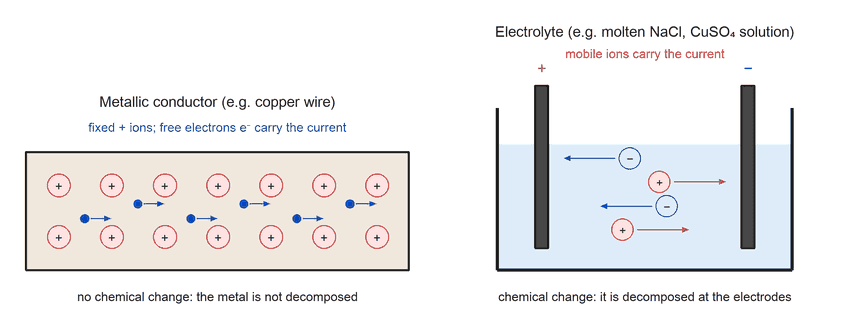
Why the other options are wrong:
- (A) Electricity is conducted in an aqueous solution by electrons: An aqueous solution conducts by ions, not by electrons.
- (B) Electricity is conducted in a metal wire by ions: A metal wire conducts by free electrons, not by ions.
- (C) Electricity is conducted in a molten electrolyte by electrons: A molten electrolyte conducts by ions, not by electrons.
Therefore, electricity is conducted in an acidic solution by ions, option (D).
- 381 mark
Question 38
The oxidation reaction among the following is :
Solve with AIAnswer
(A)
- Correct
(B)
(C)
(D)
Answer: (B)
Concept: Oxidation is loss of electrons. Look for the change in which electrons are removed and the positive charge goes up.
Step 1 — Read option (B).
In (B) the iron (II) ion gives up one electron:
Step 2 — Decide.
Its charge rises from +2 to +3, so this is oxidation.
Watch out: In the other three, electrons are ADDED (+ ne⁻ on the left), which is reduction.
Why the other options are wrong:
- (A) : Fe³⁺ gains three electrons and becomes Fe, which is reduction.
- (C) : Chlorine gains two electrons and becomes chloride ions, which is reduction.
- (D) : Cu²⁺ gains two electrons and becomes Cu, which is reduction.
Therefore, the oxidation reaction is Fe²⁺ − e⁻ → Fe³⁺, option (B).
- 391 mark
Question 39
During electrolysis, what happens to metallic ions and at which electrode do they get discharged ?
P Reduction of metallic ions, cathode
Q Oxidation of metallic ions, anode
R Oxidation of metallic ions, cathode
Solve with AIAnswer
- Correct
(A) Only P
(B) Only Q
(C) both P and Q
(D) Both Q and R
Answer: (A) Only P
Concept: Metal ions are cations. They move to the cathode and gain electrons there, which is reduction.
Step 1 — Judge statement P.
Statement P says 'reduction of metallic ions, cathode'. This matches what happens, for example:
So P is true.
Step 2 — Judge statements Q and R.
Statements Q and R both speak of oxidation of metallic ions. Metal ions gain electrons during electrolysis; they are not oxidised, so Q and R are false.
Why the other options are wrong:
- (B) Only Q: Q is false: metal ions are not discharged at the anode, and they are reduced, not oxidised.
- (C) both P and Q: It includes the false statement Q.
- (D) Both Q and R: Both Q and R describe oxidation of metal ions, so both are false.
Therefore, only P is correct, option (A).
- 401 mark
Question 40
The following questions are Assertion-Reason based questions. Choose the answer based on the codes given below.
(1) Both A and R are true and R is the correct explanation of A.
(2) Both A and R are true but R is not the correct explanation of A.
(3) A is true but R is false.
(4) A is false but R is true.
Assertion (A) : Electrolysis establishes a relationship between electrical energy and chemical energy.
Reason (R) : Substances like metals, carbon (graphite) are conductors while salts like NaCl, KCl are electrolytes.
Solve with AIAnswer
(A) (1) Both A and R are true and R is the correct explanation of A.
- Correct
(B) (2) Both A and R are true but R is not the correct explanation of A.
(C) (3) A is true but R is false.
(D) (4) A is false but R is true.
Answer: (B) (2) Both A and R are true but R is not the correct explanation of A.
Concept: In an Assertion–Reason item, first judge the Assertion (A) true or false, then the Reason (R), and only if both are true ask whether R tells why A is true.
Step 1 — Judge the Assertion.
Electrolysis uses electrical energy to bring about a chemical change (decomposition), so it links electrical and chemical energy. A is true.
Step 2 — Judge the Reason.
Metals and graphite are conductors, and salts such as NaCl and KCl are electrolytes. R is true.
Step 3 — Check the link.
R only classifies substances; it says nothing about how electrical energy is turned into chemical energy. So R does not explain A.
Watch out: Two true statements are not enough for code (1); R must give the reason for A.
Why the other options are wrong:
- (A) (1) Both A and R are true and R is the correct explanation of A: R does not explain A.
- (C) (3) A is true but R is false: R is a true statement.
- (D) (4) A is false but R is true: A is a true statement.
Therefore, both A and R are true but R is not the correct explanation of A, option (B).
- 411 mark
Question 41
The following questions are Assertion-Reason based questions. Choose the answer based on the codes given below.
(1) Both A and R are true and R is the correct explanation of A.
(2) Both A and R are true but R is not the correct explanation of A.
(3) A is true but R is false.
(4) A is false but R is true.
Assertion (A) : Benzene acts as non-electrolyte.
Reason (R) : Benzene does not have free ions.
Solve with AIAnswer
- Correct
(A) (1) Both A and R are true and R is the correct explanation of A.
(B) (2) Both A and R are true but R is not the correct explanation of A.
(C) (3) A is true but R is false.
(D) (4) A is false but R is true.
Answer: (A) (1) Both A and R are true and R is the correct explanation of A.
Concept: In an Assertion–Reason item, first judge the Assertion (A) true or false, then the Reason (R), and only if both are true ask whether R tells why A is true.
Step 1 — Judge the Assertion.
Benzene is a covalent liquid and does not conduct electricity, so it is a non-electrolyte. A is true.
Step 2 — Judge the Reason.
Benzene is made only of molecules and has no free ions. R is true.
Step 3 — Check the link.
Having no free ions is exactly why benzene does not conduct, so R explains A.
Why the other options are wrong:
- (B) (2) Both A and R are true but R is not the correct explanation of A: R does explain A.
- (C) (3) A is true but R is false: R is true.
- (D) (4) A is false but R is true: A is true.
Therefore, both A and R are true and R is the correct explanation of A, option (A).
- 421 mark
Question 42
The following questions are Assertion-Reason based questions. Choose the answer based on the codes given below.
(1) Both A and R are true and R is the correct explanation of A.
(2) Both A and R are true but R is not the correct explanation of A.
(3) A is true but R is false.
(4) A is false but R is true.
Assertion (A) : Metals and alloys conduct electricity with the help of electrons.
Reason (R) : Non-metals do not have free electrons.
Solve with AIAnswer
(A) (1) Both A and R are true and R is the correct explanation of A.
- Correct
(B) (2) Both A and R are true but R is not the correct explanation of A.
(C) (3) A is true but R is false.
(D) (4) A is false but R is true.
Answer: (B) (2) Both A and R are true but R is not the correct explanation of A.
Concept: In an Assertion–Reason item, first judge the Assertion (A) true or false, then the Reason (R), and only if both are true ask whether R tells why A is true.
Step 1 — Judge the Assertion.
Metals and alloys conduct by the movement of their free electrons. A is true.
Step 2 — Judge the Reason.
Non-metals generally have no free electrons (graphite is the well-known exception). Taken as the general rule, R is true.
Step 3 — Check the link.
A fact about non-metals cannot explain how metals conduct, so R is not the explanation of A.
Watch out: Two true statements are not enough for code (1); R must give the reason for A.
Why the other options are wrong:
- (A) (1) Both A and R are true and R is the correct explanation of A: R does not explain A.
- (C) (3) A is true but R is false: R holds as a general statement about non-metals.
- (D) (4) A is false but R is true: A is true.
Therefore, both A and R are true but R is not the correct explanation of A, option (B).
- 431 mark
Question 43
The following questions are Assertion-Reason based questions. Choose the answer based on the codes given below.
(1) Both A and R are true and R is the correct explanation of A.
(2) Both A and R are true but R is not the correct explanation of A.
(3) A is true but R is false.
(4) A is false but R is true.
Assertion (A) : Weak electrolytes do not allow any electricity to flow through them.
Reason (R) : Substances which are composed of only molecules do not allow any current to flow through them.
Solve with AIAnswer
(A) (1) Both A and R are true and R is the correct explanation of A.
(B) (2) Both A and R are true but R is not the correct explanation of A.
(C) (3) A is true but R is false.
- Correct
(D) (4) A is false but R is true.
Answer: (D) (4) A is false but R is true.
Concept: In an Assertion–Reason item, first judge the Assertion (A) true or false, then the Reason (R), and only if both are true ask whether R tells why A is true.
Step 1 — Judge the Assertion.
A weak electrolyte is partly ionised, so it has some ions and allows a small current; a bulb in a circuit with acetic acid glows dimly. The statement 'weak electrolytes do not allow any electricity to flow' is therefore false.
Step 2 — Judge the Reason.
Substances made only of molecules (non-electrolytes, such as sugar solution) do not allow current to flow. R is true.
Watch out: 'weak' means a small current, not no current.
Why the other options are wrong:
- (A) (1) Both A and R are true and R is the correct explanation of A: It treats A as true, but A is false.
- (B) (2) Both A and R are true but R is not the correct explanation of A: It treats A as true, but A is false.
- (C) (3) A is true but R is false: It treats A as true and R as false, the wrong way round.
Therefore, A is false but R is true, option (D).
- 441 mark
Question 44
The following questions are Assertion-Reason based questions. Choose the answer based on the codes given below.
(1) Both A and R are true and R is the correct explanation of A.
(2) Both A and R are true but R is not the correct explanation of A.
(3) A is true but R is false.
(4) A is false but R is true.
Assertion (A) : NaCl is an example of an electrolyte.
Reason (R) : NaCl conducts electricity in aqueous or molten state.
Solve with AIAnswer
- Correct
(A) (1) Both A and R are true and R is the correct explanation of A.
(B) (2) Both A and R are true but R is not the correct explanation of A.
(C) (3) A is true but R is false.
(D) (4) A is false but R is true.
Answer: (A) (1) Both A and R are true and R is the correct explanation of A.
Concept: In an Assertion–Reason item, first judge the Assertion (A) true or false, then the Reason (R), and only if both are true ask whether R tells why A is true.
Step 1 — Judge the Assertion.
Sodium chloride is an electrolyte. A is true.
Step 2 — Judge the Reason.
Sodium chloride conducts when dissolved or melted, because its and ions are then free to move. R is true.
Step 3 — Check the link.
Conducting (and being decomposed) in these states is exactly what makes a compound an electrolyte, so R explains A.
Why the other options are wrong:
- (B) (2) Both A and R are true but R is not the correct explanation of A: R does explain A.
- (C) (3) A is true but R is false: R is true.
- (D) (4) A is false but R is true: A is true.
Therefore, both A and R are true and R is the correct explanation of A, option (A).
- 451 mark
Question 45
The following questions are Assertion-Reason based questions. Choose the answer based on the codes given below.
(1) Both A and R are true and R is the correct explanation of A.
(2) Both A and R are true but R is not the correct explanation of A.
(3) A is true but R is false.
(4) A is false but R is true.
Assertion (A) : An electrolyte can be acid, base or salt.
Reason (R) : An electrolyte is a substance which can conduct electricity in aqueous or molten state.
Solve with AIAnswer
(A) (1) Both A and R are true and R is the correct explanation of A.
- Correct
(B) (2) Both A and R are true but R is not the correct explanation of A.
(C) (3) A is true but R is false.
(D) (4) A is false but R is true.
Answer: (B) (2) Both A and R are true but R is not the correct explanation of A.
Concept: In an Assertion–Reason item, first judge the Assertion (A) true or false, then the Reason (R), and only if both are true ask whether R tells why A is true.
Step 1 — Judge the Assertion.
Acids (e.g. HCl), bases (e.g. NaOH) and salts (e.g. NaCl) can all be electrolytes. A is true.
Step 2 — Judge the Reason.
R is the definition of an electrolyte: a substance that conducts in the aqueous or molten state. R is true.
Step 3 — Check the link.
A definition does not say why these three classes behave so. The real reason is that acids, bases and salts ionise or dissociate into ions in water. So R does not explain A.
Watch out: Two true statements are not enough for code (1); R must give the reason for A.
Note: Some readers take the definition in R as the explanation; the printed key (both true, R not the explanation) is kept, because R does not say why acids, bases and salts give ions.
Why the other options are wrong:
- (A) (1) Both A and R are true and R is the correct explanation of A: R is only the definition; it does not account for why acids, bases and salts in particular are electrolytes.
- (C) (3) A is true but R is false: R is true.
- (D) (4) A is false but R is true: A is true.
Therefore, both A and R are true but R is not the correct explanation of A, option (B).
- 461 mark
Question 46
The following questions are Assertion-Reason based questions. Choose the answer based on the codes given below.
(1) Both A and R are true and R is the correct explanation of A.
(2) Both A and R are true but R is not the correct explanation of A.
(3) A is true but R is false.
(4) A is false but R is true.
Assertion (A) : Oxidation occurs at the anode.
Reason (R) : Electrons are gained at the anode.
Solve with AIAnswer
(A) (1) Both A and R are true and R is the correct explanation of A.
(B) (2) Both A and R are true but R is not the correct explanation of A.
- Correct
(C) (3) A is true but R is false.
(D) (4) A is false but R is true.
Answer: (C) (3) A is true but R is false.
Concept: In an Assertion–Reason item, first judge the Assertion (A) true or false, then the Reason (R), and only if both are true ask whether R tells why A is true.
Step 1 — Judge the Assertion.
At the anode the anions lose electrons, which is oxidation, for example:
A is true.
Step 2 — Judge the Reason.
Electrons are gained at the cathode (reduction) and lost at the anode. 'Electrons are gained at the anode' is therefore false.
Watch out: Gain of electrons happens at the cathode; the anode takes electrons away.
Why the other options are wrong:
- (A) (1) Both A and R are true and R is the correct explanation of A: R is false, so code (1) cannot apply.
- (B) (2) Both A and R are true but R is not the correct explanation of A: R is false, so code (2) cannot apply.
- (D) (4) A is false but R is true: A is true, not false.
Therefore, A is true but R is false, option (C).
- 471 mark
Question 47
The following questions are Assertion-Reason based questions. Choose the answer based on the codes given below.
(1) Both A and R are true and R is the correct explanation of A.
(2) Both A and R are true but R is not the correct explanation of A.
(3) A is true but R is false.
(4) A is false but R is true.
Assertion (A) : Polar covalent compounds can form ions when dissolved in water.
Reason (R) : Electrovalent compounds show dissociation.
Solve with AIAnswer
(A) (1) Both A and R are true and R is the correct explanation of A.
- Correct
(B) (2) Both A and R are true but R is not the correct explanation of A.
(C) (3) A is true but R is false.
(D) (4) A is false but R is true.
Answer: (B) (2) Both A and R are true but R is not the correct explanation of A.
Concept: In an Assertion–Reason item, first judge the Assertion (A) true or false, then the Reason (R), and only if both are true ask whether R tells why A is true.
Step 1 — Judge the Assertion.
A polar covalent compound such as HCl forms ions in water:
A is true.
Step 2 — Judge the Reason.
Electrovalent compounds such as KCl show dissociation:
R is true.
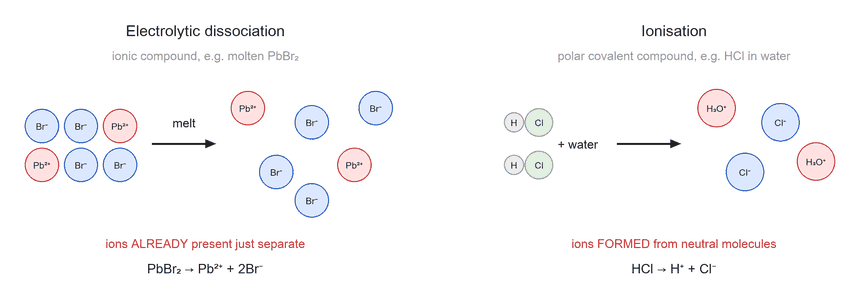
Step 3 — Check the link.
R is about a different class of compounds (ionic ones, which already have ions), so it cannot explain why covalent compounds form ions.
Watch out: Ionisation (covalent compounds) and dissociation (ionic compounds) are two different processes.
Why the other options are wrong:
- (A) (1) Both A and R are true and R is the correct explanation of A: R does not explain A.
- (C) (3) A is true but R is false: R is true.
- (D) (4) A is false but R is true: A is true.
Therefore, both A and R are true but R is not the correct explanation of A, option (B).
- 481 mark
Question 48
The following questions are Assertion-Reason based questions. Choose the answer based on the codes given below.
(1) Both A and R are true and R is the correct explanation of A.
(2) Both A and R are true but R is not the correct explanation of A.
(3) A is true but R is false.
(4) A is false but R is true.
Assertion (A) : A block of pure silver metal is used as anode during silver plating.
Reason (R) : Silver ions are deposited as metal at the anode.
Solve with AIAnswer
(A) (1) Both A and R are true and R is the correct explanation of A.
(B) (2) Both A and R are true but R is not the correct explanation of A.
- Correct
(C) (3) A is true but R is false.
(D) (4) A is false but R is true.
Answer: (C) (3) A is true but R is false.
Concept: In an Assertion–Reason item, first judge the Assertion (A) true or false, then the Reason (R), and only if both are true ask whether R tells why A is true.
Step 1 — Judge the Assertion.
In silver plating a block of pure silver is the anode; it dissolves and keeps up the supply of silver ions:
A is true.
Step 2 — Judge the Reason.
Silver ions are deposited as metal at the cathode (the article), not at the anode:
So R is false.
Watch out: The anode loses metal; deposition happens on the cathode.
Why the other options are wrong:
- (A) (1) Both A and R are true and R is the correct explanation of A: R is false, so code (1) cannot apply.
- (B) (2) Both A and R are true but R is not the correct explanation of A: R is false, so code (2) cannot apply.
- (D) (4) A is false but R is true: A is true, not false.
Therefore, A is true but R is false, option (C).
- 491 mark
Question 49
(Choose the correct word to fill in the blanks).
Cations are formed by .......... (loss/gain) of electrons and anions are formed by .............. (loss/gain) of electrons.
Solve with AIWritten solution
Solution:
Concept: Electrons carry a negative charge. Losing them leaves an atom with extra positive charge; gaining them gives it extra negative charge.
Step 1 — Form a cation.
When a sodium atom loses one electron it becomes a positive ion, a cation:
Step 2 — Form an anion.
When a chlorine atom gains one electron it becomes a negative ion, an anion:
Watch out: Losing a negative electron makes the particle MORE positive, not more negative.
Therefore, cations are formed by loss of electrons and anions are formed by gain of electrons.
- 503 marks
Question 50
Match the following in column A with the correct answer from the choices given in column B :
Column A Column B 1. Ammonium hydroxide soln. (i) Contains only ions 2. Dilute hydrochloric acid (ii) Contains only molecules 3. Carbon tetrachloride (iii) Contains ions and molecules Solve with AIWritten solution
Solution:
Concept: A weak electrolyte gives ions and molecules; a strong electrolyte gives only ions; a non-electrolyte gives only molecules (water molecules of the solvent are left aside).
Step 1 — Ammonium hydroxide solution.
Ammonium hydroxide is a weak base and is only partly ionised, so its solution contains ions and molecules, item (iii):
Step 2 — Dilute hydrochloric acid.
Hydrochloric acid is a strong acid and is almost fully ionised, so it contains only ions, item (i):
Step 3 — Carbon tetrachloride.
Carbon tetrachloride is a covalent liquid and a non-electrolyte, so it contains only molecules, item (ii).
Therefore, 1 – (iii), 2 – (i), 3 – (ii).
- 513 marks
Question 51
Name the kind of particles present in :
(a) Sodium hydroxide solution, (b) Carbonic acid
(c) Sugar solution
Solve with AIWritten solution
Solution:
Concept: Sodium hydroxide is a strong electrolyte, carbonic acid a weak electrolyte and sugar a non-electrolyte (water molecules of the solvent are left aside).
Step 1 — (a) Sodium hydroxide solution.
Sodium hydroxide dissociates fully, so the solution has only ions, and :
Step 2 — (b) Carbonic acid.
Carbonic acid is a weak acid and is only partly ionised, so un-ionised molecules remain along with the ions — ions and molecules:
Step 3 — (c) Sugar solution.
Sugar does not ionise, so the solution has only molecules (sugar molecules and water molecules).
Therefore, (a) only ions, (b) ions and molecules, (c) only molecules.
- 523 marks
Question 52
(a) What kind of particles will be found in a liquid compound which is a non- electrolyte?
(b) If HX is a weak acid, what particles will be present in its dilute solution apart from those of water ?
(c) What ions must be present in a solution used for electroplating a particular metal ?
Solve with AIWritten solution
Solution:
Concept: The particles present depend on how far the substance ionises, and a plating bath must supply ions of the metal being deposited.
Step 1 — (a) A liquid non-electrolyte.
A non-electrolyte does not ionise at all, so it contains only molecules and has no ions to carry a current.
Step 2 — (b) A weak acid HX.
A weak acid ionises only partly, so its solution contains ions, ions and un-ionised HX molecules:
Step 3 — (c) A plating bath.
The solution must contain ions of the metal to be plated, for example ions for nickel plating or ions for silver plating. These cations move to the article (the cathode) and are deposited on it:
Therefore, (a) only molecules; (b) H⁺ ions, X⁻ ions and HX molecules; (c) ions of the metal to be plated.
- 531 mark
Question 53
A strip of copper is placed in four different colourless salt solutions. They are , , , . Which one of the solutions will finally turn blue ?
Solve with AIWritten solution
Solution:
Concept: A metal displaces from solution only a metal that lies below it in the electrochemical series. Copper (II) ions in solution are blue.
Step 1 — Compare copper with each metal.
In the series, potassium, calcium and zinc lie above copper, while silver lies below copper.
Step 2 — Find the reaction.
So copper can displace only silver. It does so from silver nitrate and forms blue copper nitrate:
Step 3 — Check the others.
Copper cannot displace potassium, zinc or calcium, so the other three solutions stay colourless.
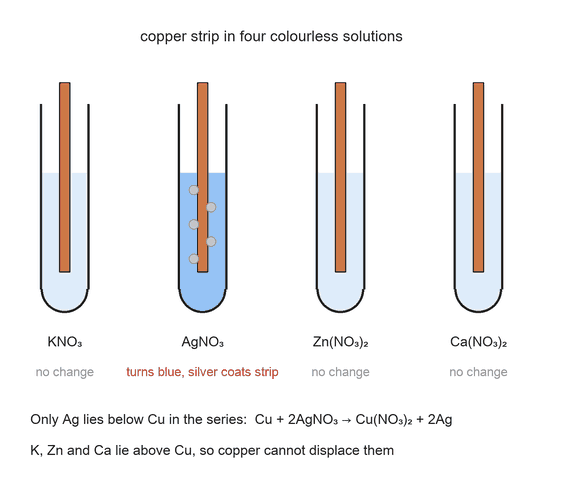
Watch out: The blue colour comes from the copper ions that go INTO the solution, not from the silver.
Therefore, the silver nitrate (AgNO₃) solution finally turns blue.
- 541 mark
Question 54
Here is an electrode reaction :
.
At which electrode (anode or cathode) would such a reaction takes place? Is this an example of oxidation or reduction ?
Solve with AIWritten solution
Solution:
Concept: Loss of electrons is oxidation, and oxidation always takes place at the anode.
Step 1 — Read the equation.
In the reaction each copper atom gives up two electrons and becomes a copper ion:
Step 2 — Name the change and the electrode.
Losing electrons is oxidation, and in electrolysis this happens at the anode; here a copper anode is dissolving.
Therefore, the reaction takes place at the anode, and it is an example of oxidation.
- 552 marks
Question 55
Aqueous solution of nickel sulphate contains and ions.
(a) Which ion moves towards the cathode ?
(b) What is the product at the anode ?
Solve with AIWritten solution
Solution:
Concept: Cations move to the cathode. At the anode the product depends on whether the anode is active (nickel, as in nickel plating) or inert (platinum).
Step 1 — (a) Ion moving to the cathode.
The ions are the cations, so they move towards the cathode, where they are deposited as nickel:
Step 2 — (b) Product at a nickel anode.
With a nickel anode, as used in nickel plating, neither nor is discharged. The anode itself dissolves, giving ions:

Step 3 — (b) Product at an inert anode.
With an inert platinum anode, would be discharged instead and oxygen would be the product:
Watch out: The stem does not name the anode; say which anode you mean.
Therefore, (a) Ni²⁺ ions move to the cathode; (b) with a nickel anode the product is Ni²⁺ ions (the anode dissolves); with an inert anode it would be oxygen.
- 561 mark
Question 56
Identify : A gas which does not conduct electricity in the liquid state but conducts electricity when dissolved in water.
Solve with AIWritten solution
Solution:
Concept: A polar covalent gas has no ions of its own, but it ionises when it dissolves in water.
Step 1 — Look at liquid hydrogen chloride.
Liquid hydrogen chloride is made only of HCl molecules, so it does not conduct.
Step 2 — Dissolve it in water.
In water the polar water molecules pull the away from the chlorine, and ions are formed:
These free ions carry the current, so the solution conducts.
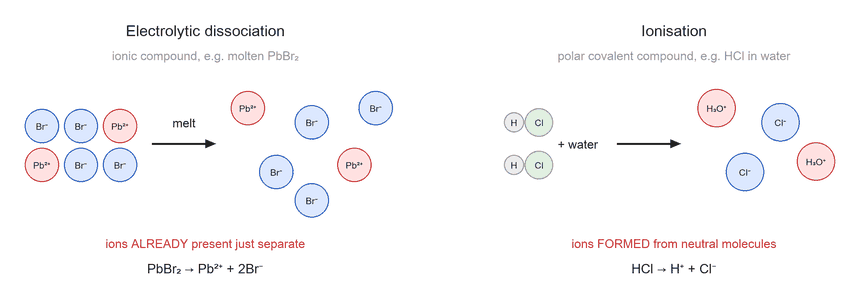
Therefore, the gas is hydrogen chloride (HCl).
- 571 mark
Question 57
Give one word or phrase for :
Electrolytic deposition of a superior metal on a baser metal.
Solve with AIWritten solution
Solution:
Concept: Depositing a thin coat of one metal on another by passing an electric current through a solution of its salt is called electroplating.
Step 1 — Picture the process.
The article of baser metal (e.g. iron or brass) is made the cathode, and ions of the superior metal (e.g. silver) are deposited on it:
Step 2 — Name it.
This electrolytic deposition of a superior metal on a baser metal is electroplating.
Therefore, the term is electroplating.
- 585 marks
Question 58
Give reasons for the following :
(a) The blue colour of aqueous copper sulphate fades when it is electrolysed using platinum electrodes.
(b) Lead bromide undergoes electrolytic dissociation in the molten state but is a non-electrolyte in the solid state.
(c) Aluminium is extracted from its oxide by electrolytic reduction and not by conventional reducing agents.
(d) The ratio of hydrogen and oxygen formed at the cathode and anode is 2 :1 by volume.
(e) In the electrolysis of acidified water, dilute sulphuric acid is preferred to dilute nitric acid for acidification.
(f) Ammonia is unionised in the gaseous state but in the aqueous solution, it is a weak electrolyte.
(g) A direct current instead of alternating current should be used in electrolysis.
(h) Carbon tetrachloride is a liquid but is a non-electrolyte which does not conduct electricity.
(i) Potassium is not extracted by electrolysis of its aqueous salt solution.
(j) The electrolysis of acidulated water is considered to be an example of catalysis.
(k) During electrolysis of molten lead bromide, graphite anode is preferred to other electrodes.
(l) Electrolysis of molten lead bromide is considered to be a redox reaction.
Solve with AIWritten solution
Solution:
Concept: Every reason here comes back to three things: whether there are free ions, which ion is discharged (its place in the electrochemical series), and whether the electrode is inert or active.
Step 1 — (a) Blue colour fades with platinum electrodes.
The blue colour is due to ions. They are discharged at the cathode as copper:
The platinum anode is inert, so it does not dissolve to replace them; ions are discharged there and oxygen is given off. The number of ions keeps falling and the blue colour fades.

Step 2 — (b) Lead bromide, molten and solid.
In solid lead bromide the and ions are held in fixed positions by strong electrostatic forces and cannot move, so it does not conduct.
On melting, these forces are overcome and the ions become free to move:
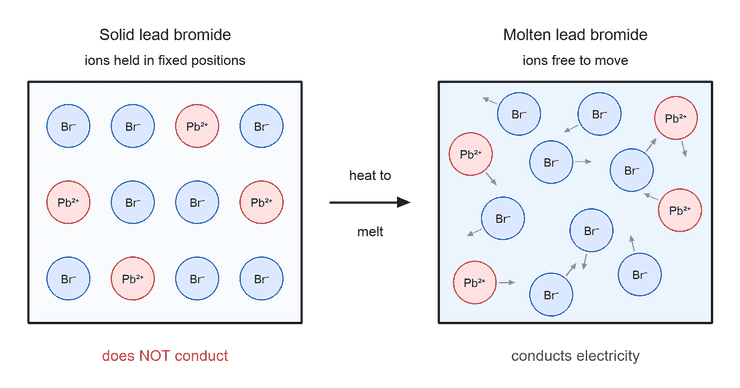
Step 3 — (c) Aluminium needs electrolysis.
Aluminium is high in the electrochemical series and has a strong affinity for oxygen, so its oxide is very stable. Common reducing agents such as carbon monoxide or hydrogen cannot remove the oxygen from alumina.
Electrolysis supplies electrons directly at the cathode, so it can reduce the aluminium ions:
Step 4 — (d) Hydrogen and oxygen in the ratio 2 : 1.
For every 4 electrons that pass, the cathode gives 2 molecules of hydrogen and the anode 1 molecule of oxygen:
By Avogadro's law, equal numbers of gas molecules occupy equal volumes at the same temperature and pressure, so hydrogen and oxygen form in the ratio 2 : 1 by volume.
Step 5 — (e) Sulphuric acid rather than nitric acid.
Dilute sulphuric acid is non-volatile, while dilute nitric acid is volatile; its vapour would escape and mix with the gases collected. Nitric acid is also an oxidising agent and could react with the products.
Step 6 — (f) Ammonia, gas and solution.
Gaseous ammonia is a covalent compound made only of molecules, so it has no ions. In water it forms ammonium hydroxide, which ionises only partly:
So its solution contains ions and molecules, which makes it a weak electrolyte.
Step 7 — (g) Direct current, not alternating.
With direct current each electrode keeps a fixed charge, so cations keep moving to the cathode and anions to the anode, and the products build up at fixed electrodes.
Alternating current reverses the polarity many times a second, so each electrode would be cathode and anode by turns, and no lasting chemical change (and no proper coat in plating) would take place.
Step 8 — (h) Liquid carbon tetrachloride.
Carbon tetrachloride is a covalent compound. Even as a liquid it consists only of molecules and has no free ions, so it cannot conduct electricity.
Step 9 — (i) Potassium from an aqueous solution.
In an aqueous solution both and (from water) reach the cathode. lies far below in the series, so it is discharged instead, and hydrogen, not potassium, is formed:
Any potassium formed would in any case react violently with the water. Potassium is therefore extracted by electrolysis of a fused salt.
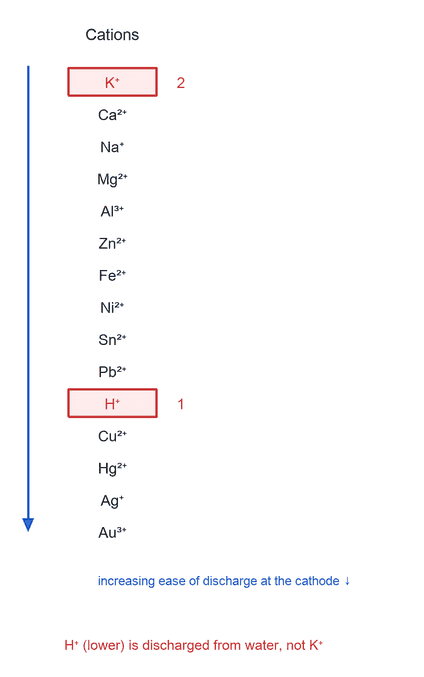
Step 10 — (j) Acidulated water and catalysis.
Pure water is almost entirely molecules. The dilute sulphuric acid increases the ionisation of water, so the water conducts and is decomposed into hydrogen and oxygen. The acid is not used up; the same amount remains at the end, as with a catalyst.
Step 11 — (k) Graphite anode for lead bromide.
The bromine vapour given off at the anode is very reactive. Graphite is not attacked by bromine vapour, whereas many other electrodes would be.
Step 12 — (l) Lead bromide electrolysis is redox.
Reduction takes place at the cathode (gain of electrons) and oxidation at the anode (loss of electrons), at the same time:
So the overall change is a redox reaction:
Watch out: In (a) the colour fades only because the anode is inert; with a copper anode the colour stays (see the second beaker in the first figure).
Therefore, each reason rests on free ions (b, f, h), the order of discharge (a, d, i), the nature of the electrodes (a, k) and the nature of electrolysis itself (c, e, g, j, l), as explained above.
- 595 marks
Question 59
Explain :
(a) Sodium chloride will conduct electricity only in fused or aqueous solution state.
(b) In the electroplating of an article with silver, the electrolyte sodium argento-cyanide solution is preferred over silver nitrate solution.
(c) Although copper is a good conductor of electricity, it is a non-electrolyte.
Solve with AIWritten solution
Solution:
Concept: An electrolyte needs mobile ions; a good plating needs a slow, steady supply of metal ions; a metal conducts by electrons without any chemical change.
Step 1 — (a) Sodium chloride conducts only fused or dissolved.
In solid sodium chloride the and ions are held rigidly in the crystal lattice and cannot move, so the solid does not conduct.
On fusion (melting) or on dissolving in water the ions become free and mobile, and they carry the current:
Step 2 — (b) Sodium argentocyanide rather than silver nitrate.
Sodium argentocyanide, , gives the complex argentocyanide ion, which releases silver ions only slowly:
So silver is deposited slowly and evenly on the article, giving a smooth, firm and long-lasting coat. With silver nitrate the deposition is very fast, so the coat is not smooth and uniform.
Step 3 — (c) Copper is a non-electrolyte.
Copper conducts by the movement of free electrons, not ions, and it undergoes no chemical change when the current passes.
An electrolyte must conduct by ions and be decomposed by the current, so copper is a non-electrolyte (a metallic conductor).
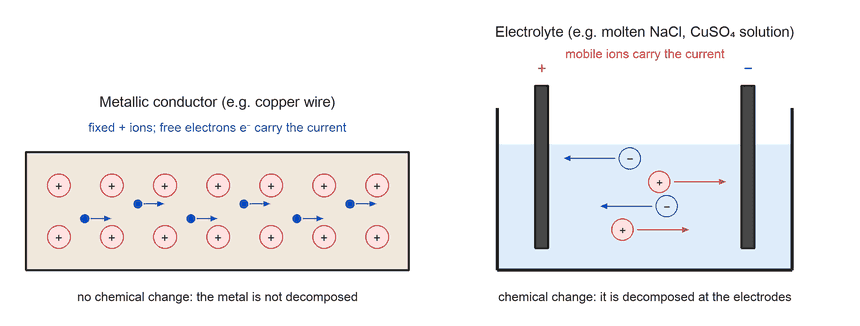
Therefore, (a) NaCl has mobile ions only when fused or dissolved; (b) sodium argentocyanide releases Ag⁺ slowly and gives an even coat; (c) copper conducts by electrons without being decomposed.
- 602 marks
Question 60
Write two applications of electrolysis in which the anode diminishes in mass.
Solve with AIWritten solution
Solution:
Concept: The anode loses mass when it is an active electrode: its atoms lose electrons and pass into the solution as ions.
Step 1 — First application: electroplating.
In nickel plating, for example, the block of pure nickel used as the anode dissolves and becomes thinner:
Step 2 — Second application: electro-refining.
In the refining of copper, the thick block of impure copper used as the anode dissolves, while pure copper builds up on the cathode:
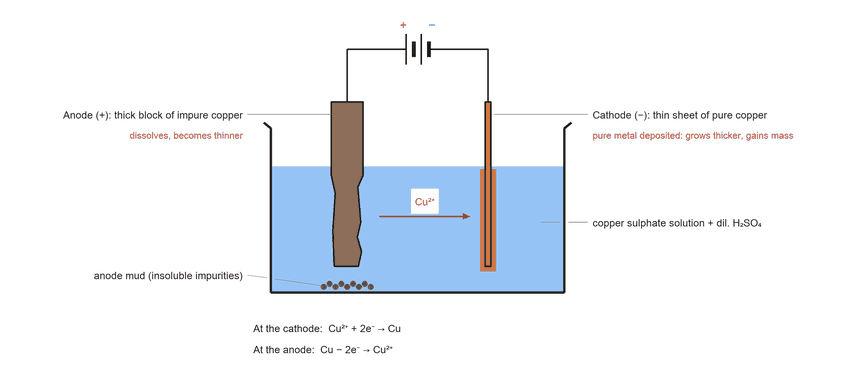
Watch out: An inert anode (platinum, graphite) does not lose mass; only an active anode does.
Therefore, two such applications are electroplating (e.g. nickel plating) and electro-refining of metals (e.g. refining of copper).
- 612 marks
Question 61
A solution contains magnesium ions (), iron (II) ions () and copper ions (). On passing an electric current through this solution, which ions will be the first to be discharged at the cathode? Write the equation for the cathode reaction.
Solve with AIWritten solution
Solution:
Concept: The cation lowest in the electrochemical series gains electrons most easily and is discharged first.
Step 1 — Place the three ions in the series.
Magnesium is high in the series, iron is in the middle, and copper lies below hydrogen, so the order is Mg above Fe above Cu.
Step 2 — Pick the ion discharged first.
The lowest of the three is , so the copper ions are discharged first at the cathode:
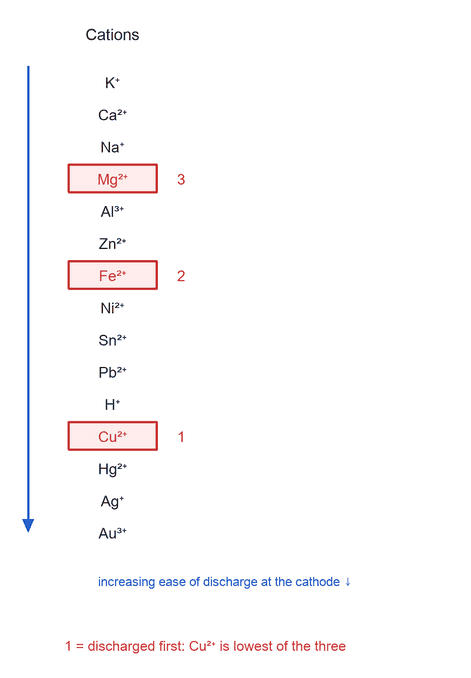
Watch out: The ion discharged first is the LOWEST in the series, not the most reactive metal.
Therefore, the copper ions (Cu²⁺) are discharged first: Cu²⁺ + 2e⁻ → Cu.
- 624 marks
Question 62
During electroplating of an article with nickel —
(a) Name
A. The electrolyte B. The cathode
C. The anode
(ii) Give the reaction of the electrolysis at
A. The cathode B. The anode
Solve with AIWritten solution
Solution:
Concept: In electroplating the article to be plated is the cathode, a block of the pure plating metal is the anode, and the electrolyte is a solution containing ions of the plating metal.
Step 1 — (a) A. The electrolyte.
The electrolyte is aqueous nickel sulphate () solution, with a small amount of dilute sulphuric acid.
Step 2 — (a) B. The cathode.
The cathode is the article to be electroplated, cleaned thoroughly.
Step 3 — (a) C. The anode.
The anode is a block (plate) of pure nickel.
Step 4 — (ii) A. Reaction at the cathode.
Nickel ions gain electrons and are deposited on the article:
Step 5 — (ii) B. Reaction at the anode.
The nickel anode loses electrons and dissolves, replacing the nickel ions used up:
Watch out: The article is never the anode; at the anode it would dissolve instead of being plated.
Therefore, the electrolyte is nickel sulphate solution, the cathode is the article and the anode is pure nickel; at the cathode Ni²⁺ + 2e⁻ → Ni and at the anode Ni − 2e⁻ → Ni²⁺.
- 632 marks
Question 63
A, B and C are three electrolytic cells, connected in different circuits.
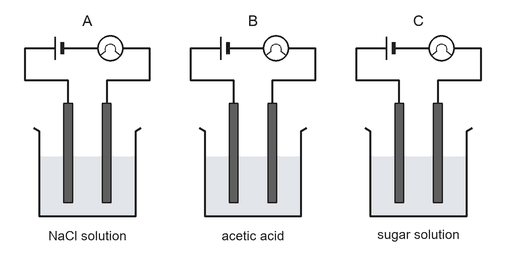
Cell 'A' contains NaCl soluiton, and the bulb in the circuit glows brightly, when the circuit is completed. Cell 'B' contains acetic acid and the bulb glows dimly. Cell 'C' contains sugar soluiton, and the bulb does not glow. Give reason for each observation.
Solve with AIWritten solution
Solution:
Concept: The brightness of the bulb depends on how many free ions the solution contains.
Step 1 — Cell A: bulb glows brightly.
Sodium chloride is a strong electrolyte, completely dissociated into and ions. The large number of ions carries a large current.
Step 2 — Cell B: bulb glows dimly.
Acetic acid is a weak electrolyte, only partly ionised:
Few ions are present, so only a small current flows.
Step 3 — Cell C: bulb does not glow.
Sugar is a non-electrolyte; its solution contains only molecules and no ions, so no current flows.
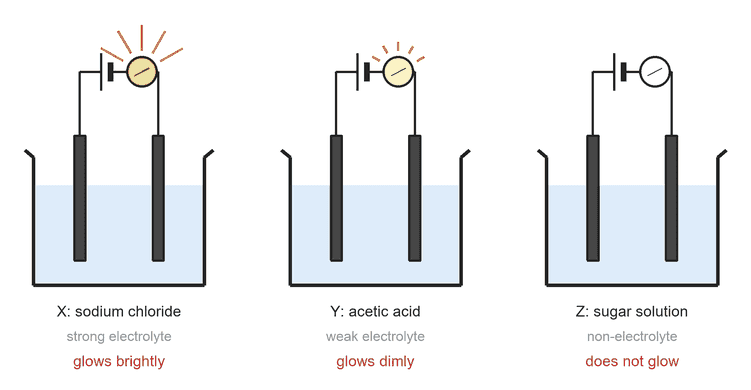
Therefore, A glows brightly (strong electrolyte, many ions), B glows dimly (weak electrolyte, few ions) and C does not glow (non-electrolyte, no ions).
- 642 marks
Question 64
Differentiate between electrical conductivity of – copper sulphate solution and of copper metal.
Solve with AIWritten solution
Solution:
Concept: Electrolytic conduction is by ions with a chemical change; metallic conduction is by electrons without any chemical change.
Step 1 — Compare the two side by side.
The table sets out the three differences.
Copper sulphate solution Copper metal Conducts by the movement of ions (, , , ). Conducts by the movement of free electrons. The solution is decomposed: a chemical change occurs at the electrodes. No chemical change: the copper is unchanged. It is an electrolyte. It is a metallic conductor (non-electrolyte). Step 2 — Show the chemical change.
In copper sulphate solution, for example, copper ions are discharged at the cathode, so new copper appears, which never happens in a copper wire:
Therefore, copper sulphate solution conducts by ions and is decomposed, while copper metal conducts by free electrons and is not changed.
- 652 marks
Question 65
State one appropriate observation for : Electricity is passed through molten lead bromide.
Solve with AIWritten solution
Solution:
Concept: Molten lead bromide gives bromine at the anode and lead at the cathode.
Step 1 — Look at the anode.
Bromide ions lose electrons and bromine escapes as dark reddish-brown fumes:
Step 2 — Look at the cathode.
Lead ions gain electrons and a silvery grey metal, lead, forms:
Therefore, dark reddish-brown fumes of bromine are seen at the anode (and silvery grey lead forms at the cathode).
- 662 marks
Question 66
State your observation : At the cathode when acidified aqueous copper sulphate solution is electrolysed with copper electrodes.
Solve with AIWritten solution
Solution:
Concept: ions lie below in the series, so they are discharged at the cathode in preference to .
Step 1 — Find the ion discharged.
The copper ions move to the cathode and gain electrons:
Step 2 — Describe what is seen.
A pink (reddish-brown) deposit of copper forms on the cathode, which becomes thicker. No hydrogen is given off at the cathode.
Therefore, a reddish-brown (pink) deposit of copper forms on the cathode.
- 672 marks
Question 67
State observation at the anode when aqueous copper sulphate solution is electrolysed using copper electrodes.
Solve with AIWritten solution
Solution:
Concept: A copper anode is active: its own atoms lose electrons more easily than or , so no anion is discharged.
Step 1 — Follow the anode.
The copper atoms of the anode lose electrons and go into the solution as ions:
Step 2 — Describe what is seen.
The copper anode dissolves and becomes thinner (loses mass), and no gas is given off at it. The ions formed replace those deposited at the cathode, so the blue colour of the solution does not fade.
Therefore, the copper anode dissolves and becomes thinner, and no gas is given off at it.
- 682 marks
Question 68
State which electrode : anode or cathode is the oxidising electrode. Give a reason for the same.
- 694 marks
Question 69
is the oxide of a metal 'M' which is above hydrogen in the activity series. when dissolved in water forms the corresponding hydroxide which is a good conductor of electricity.
(a) State the reaction taking place at the cathode
(b) Name the product at the anode.
- 705 marks
Question 70
Element X is a metal with a valency 2. Element Y is a non-metal with a valency 3.
(a) Write equations to show how X and Y form ions ?
(b) If Y is a diatomic gas, write the equation for the direct combination of X and Y to form a compound.
(c) If the compound formed between X and Y is melted and an electric current passed through the molten compound, the element X will be obtained at the .......... and Y at the ................ of the electrolytic cell. (Provide the missing words).
- 715 marks
Question 71
(a) Draw a labelled diagram to show how iron is electroplated with copper.
(b) Which solution is preferred as electrolyte, or ?
(c) Describe what happens to the iron object and the copper rod.
- 725 marks
Question 72
A metal article is to be electroplated with silver. The electrolyte selected is sodium argentocyanide
(a) What kind of salt is sodium argentocyanide ?
(b) Why is it preferred to silver nitrate as an electrolyte?
(c) State one condition to ensure that the deposit is smooth, firm and long lasting.
(d) Write the reaction taking place at the cathode.
(e) Write the reaction taking place at the anode.
- 735 marks
Question 73
During the electrolysis of copper [II] sulphate solution using platinum as cathode and carbon as anode
(a) State what you observe at the cathode and at the anode.
(b) State the change noticed in the electrolyte.
(c) Write the reactions at the cathode and at the anode.
- 745 marks
Question 74
(a) Copy and complete the following table which refers to two practical applications of electrolysis
Anode Electrolyte Cathode (i) Silver plating of a spoon Solution of potassium argentocyanide (ii) Purification of copper (iii) Extraction of sodium (b) Write equations of reactions taking place at anode for Q. 2(a).
- 755 marks
Question 75
The following sketch represents the electroplating of an Iron cup with Nickel metal. Study the diagram and answer the following questions :
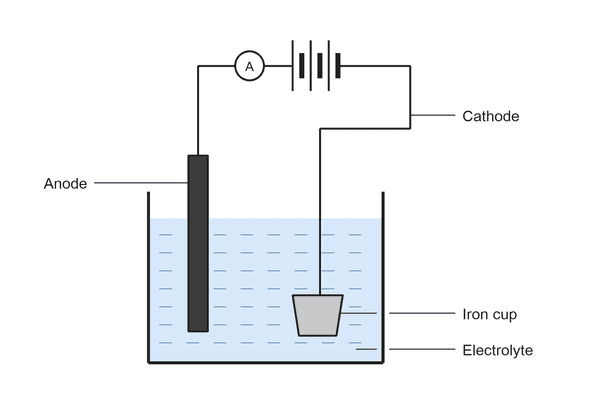
(a) During electroplating the iron cup is placed at the cathode. Why ?
(b) Name the ion that must be present in the electrolyte.
(c) State one condition that is necessary to ensure that the deposit is smooth, firm and even.
(d) Write the reaction taking place at the cathode.
(e) What change would you observe at the anode ?
- 765 marks
Question 76
Copper sulphate soln. is electrolysed using copper electrodes.

(a) Which electrode to your left or right is known as the oxidising electrode and why ?
(b) Write the equation representing the reaction that occurs.
(c) State two appropriate observations for the above electrolysis reaction.
What Class 10 Chemistry Ch 6 covers
The sections of the chapter, in the order the book takes them. Every question above comes from one of these.
- 01Definitions and Examples
- 02Theory of Electrolytic Dissociation
- 03Conduction in Compounds
- 04Characteristics of Electrolysis
- 05Electrochemical Series
- 06Preferential or Selective Discharge of Ions at Electrodes
More ways to study this chapter
The same chapter asked three other ways. Practise it, revise it, and see what the board has set on Ch 6 before.
- Competency-Based Questions (CBQ)Case study questions: a situation, and the part of the chapter that answers it.40questionsOpen
- Previous Year QuestionsQuestions that have actually appeared in board papers, each tagged with its year.60questionsOpen
- Practice QuestionsExtra questions per chapter, for when one attempt at a method is not enough.45questionsOpen
Ch 6 in past ICSE papers
The same chapter as the board has actually asked it. These are worded differently from the textbook exercise, which is the point of reading them.
- 11 mark
Board paper question 1
The particles present in strong electrolytes are:
Solve with AIAnswer
(A) only molecules
- Correct
(B) mainly ions
(C) ions and molecules
(D) only atoms.
Answer: (B) mainly ions
Concept: Electrolytes conduct because they contain mobile ions. A strong electrolyte is almost completely dissociated, so it contains (almost) only ions; a weak electrolyte is only partly dissociated, so it contains ions together with many un-ionised molecules; a non-electrolyte forms no ions and contains only molecules.
Step 1 — Recall what a strong electrolyte is.
A strong electrolyte, such as sodium chloride, sodium hydroxide or hydrochloric acid, breaks up almost completely into ions when it is melted or dissolved in water.
Step 2 — Name the particles.
Since almost every unit has split into ions, the particles of the electrolyte are mainly ions; practically no undissociated molecules are left. These many mobile ions are why a strong electrolyte conducts well.
Watch out: The water molecules of a solution are the solvent, not particles of the electrolyte; do not let them push you to 'ions and molecules', which describes a weak electrolyte.
Why the other options are wrong:
- (A) only molecules: Only molecules (no ions) is the case of a non-electrolyte such as sugar solution, which does not conduct.
- (C) ions and molecules: Ions together with many un-ionised molecules describe a weak electrolyte such as acetic acid.
- (D) only atoms: Electrolytes conduct by ions, not by neutral atoms; free atoms are not the particles of any electrolyte.
Therefore, the particles present in strong electrolytes are mainly ions, option (B).
- 24 marks
Board paper question 2
Write equations for the reactions taking place at the two electrodes (mentioning clearly the name of the electrode) during the electrolysis of:
(i) Acidified copper sulphate solution with copper electrodes.
(ii) Molten lead bromide with inert electrodes.
Solve with AIWritten solution
Solution:
Concept: In an electrolytic cell the anode is the electrode joined to the positive (+) terminal of the battery and the cathode is the electrode joined to the negative (−) terminal. Cations (+) move to the cathode and gain electrons there (reduction); anions (−) move to the anode and lose electrons there (oxidation). An inert electrode (platinum, graphite) only passes electrons and takes no part in the reaction. An active electrode (copper, nickel, silver) takes part: as an anode, its own atoms lose electrons and go into the solution as ions, so the anode dissolves.
(i) Acidified copper sulphate solution, copper electrodes
Step 1 — List the ions.
The solution contains and ions from copper sulphate, ions from the acid and a few and ions from water.
Step 2 — Reaction at the cathode (copper).
Both and move to the cathode. is lower than in the electrochemical series, so it is discharged and copper is deposited:
Step 3 — Reaction at the anode (copper).
The anions and move to the anode, but neither is discharged, because the copper anode is an active electrode. Its own atoms lose electrons more easily and go into the solution as copper ions, so the anode dissolves:
(ii) Molten lead bromide, inert electrodes
Step 4 — List the ions.
Molten lead bromide contains only and ions, now free to move.
Step 5 — Reaction at the cathode (graphite).
The ions move to the cathode and each gains two electrons, forming lead metal:
Step 6 — Reaction at the anode (graphite).
The ions move to the anode and each loses one electron. The bromine atoms formed then join in pairs to give bromine molecules:
Watch out: With copper electrodes the anode reaction is the copper anode dissolving, not the discharge of OH⁻ ions (that happens only with an inert anode).
Therefore, (i) cathode: Cu²⁺ + 2e⁻ → Cu and anode: Cu − 2e⁻ → Cu²⁺; (ii) cathode: Pb²⁺ + 2e⁻ → Pb and anode: Br⁻ − e⁻ → Br, Br + Br → Br₂.
- 32 marks
Board paper question 3
(i) Name the product formed at the anode during the electrolysis of acidified water using platinum electrodes.
(ii) Name the metallic ions that should be present in the electrolyte when an article made of copper is to be electroplated with silver.
Solve with AIWritten solution
Solution:
Concept: When two or more ions of the same sign reach an electrode, the ion lower in the electrochemical series is discharged in preference (selective discharge). The cation series is K⁺, Ca²⁺, Na⁺, Mg²⁺, Al³⁺, Zn²⁺, Fe²⁺, Ni²⁺, Sn²⁺, Pb²⁺, H⁺, Cu²⁺, Hg²⁺, Ag⁺, Au³⁺ and the anion series is SO₄²⁻, NO₃⁻, Cl⁻, Br⁻, I⁻, OH⁻; in both lists the ease of discharge increases downwards. In electroplating, the electrolyte must contain ions of the metal that is to be deposited.
(i) Product at the anode
Step 1 — Find the anions at the anode.
Acidified water contains ions from the sulphuric acid and ions from water. Both move to the platinum anode.
Step 2 — Choose the ion discharged.
The ion is lower than in the anion series, so ions lose electrons:
The OH groups then combine to give water and oxygen gas:
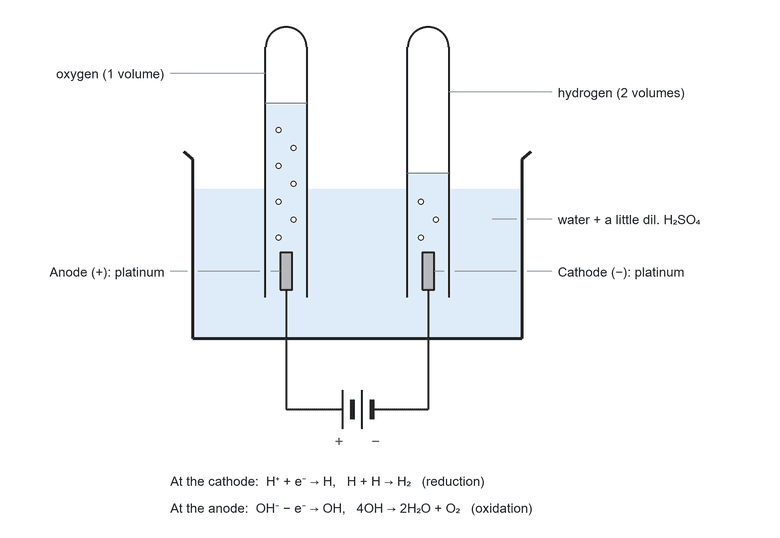
(ii) Metallic ions in the electrolyte
Step 3 — Match the ion to the coat.
The copper article is made the cathode and must receive a coat of silver, so the electrolyte must supply silver ions, . In practice a solution of sodium argentocyanide, , is used, which gives the silver ions slowly.
At the article each silver ion gains one electron:
Watch out: The anode product is a GAS, oxygen; hydrogen is the cathode product.
Therefore, (i) oxygen gas is formed at the anode, and (ii) silver ions (Ag⁺) must be present in the electrolyte.
- 43 marks
Board paper question 4
Give reasons why:
(i) Sodium Chloride will conduct electricity only in fused or aqueous solution state.
(ii) In the electroplating of an article with silver, the electrolyte sodium argento-cyanide solution is preferred over silver nitrate solution.
(iii) Although copper is a good conductor of electricity, it is a non-electrolyte.
Solve with AIWritten solution
Solution:
Concept: An electrolyte conducts by mobile ions and is decomposed by the current; a metal conducts by free electrons and is not decomposed.
(i) Sodium chloride conducts only when fused or dissolved
Step 1 — Look at the solid.
In solid sodium chloride the and ions are held in fixed positions in the crystal by strong electrostatic forces of attraction. They cannot move, so they cannot carry a current.
Step 2 — Look at the melt or the solution.
On fusion (melting) or on dissolving in water these forces are overcome and the ions become free to move. Mobile ions carry the current, so fused or aqueous sodium chloride conducts.
(ii) Sodium argentocyanide is preferred to silver nitrate
Step 3 — Compare the two electrolytes.
Sodium argentocyanide, , is a complex salt that gives ions slowly, so silver is deposited slowly and evenly, giving a smooth, firm and lasting coat. With silver nitrate solution the silver is deposited very fast, so the coat is rough and uneven and does not stick well.
(iii) Copper is a non-electrolyte
Step 4 — See how copper conducts.
Copper conducts by the movement of free electrons, and it undergoes no chemical change when the current passes.
Step 5 — Compare with the definition.
An electrolyte must conduct by ions and be decomposed by the current. Copper does neither, so although it is a good conductor it is a non-electrolyte (a metallic conductor).
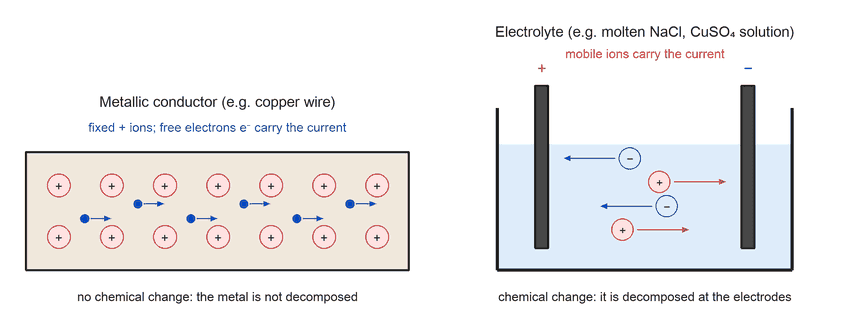
Watch out: 'Good conductor' and 'electrolyte' are not the same thing: an electrolyte must be chemically decomposed by the current.
Therefore, (i) its ions are free to move only when fused or dissolved; (ii) sodium argentocyanide releases Ag⁺ ions slowly, giving a smooth, even, firm coat (silver nitrate deposits silver too fast); (iii) copper conducts by electrons and is not decomposed, so it is not an electrolyte.
- 51 mark
Board paper question 5
Identify the substance underlined, in each of the following cases:
The electrolyte used for electroplating an article with silver.
Solve with AIWritten solution
Solution:
Concept: In electroplating the article to be plated is made the cathode, a block of the pure plating metal is made the anode, and the electrolyte is a solution of a salt of the plating metal. The metal ions are discharged on the article; the anode dissolves and replaces them. For silver the electrolyte must give silver ions slowly and steadily.
Step 1 — Decide what the electrolyte must supply.
To plate an article with silver, the electrolyte must contain silver ions, and it must give them up slowly so that the coat is smooth and even.
Step 2 — Name the electrolyte.
Sodium argentocyanide, , does this. It dissociates to give ions slowly:
(Potassium argentocyanide, , is also used.)
Watch out: Silver nitrate also contains Ag⁺ ions, but it deposits silver too fast and gives an uneven coat, so it is not the electrolyte used.
Therefore, the electrolyte is sodium argentocyanide, Na[Ag(CN)₂].
- 61 mark
Board paper question 6
Identify the substance underlined, in each of the following cases:
The particles present in a liquid such as kerosene, that is a non electrolyte.
Solve with AIWritten solution
Solution:
Concept: Electrolytes conduct because they contain mobile ions. A strong electrolyte is almost completely dissociated, so it contains (almost) only ions; a weak electrolyte is only partly dissociated, so it contains ions together with many un-ionised molecules; a non-electrolyte forms no ions and contains only molecules.
Step 1 — Classify kerosene.
Kerosene is a mixture of covalent hydrocarbons. It forms no ions at all, so it does not conduct electricity; it is a non-electrolyte.
Step 2 — Name its particles.
A substance with no ions is made up only of molecules, so the particles in kerosene are molecules.
Watch out: A non-electrolyte has no ions at all, not even a few.
Therefore, the particles present in kerosene are molecules.
All 60 board paper questions for this chapter, solved the same way.
Class 10 Chemistry Ch 6 questions students ask
How many questions are there in Class 10 Chemistry Ch 6?
76 questions. Every one is solved step by step on this page.
Are these Class 10 Chemistry solutions free?
Yes. Every question and its full working is free to read, with no account needed.
Can I download the Class 10 Chemistry Ch 6 solutions as a PDF?
There is no PDF to download. Every solution is on this page instead, which means it is searchable, always the current syllabus, and readable on a phone. Use your browser's print option if you want it on paper.