Solution:
Concept: With copper electrodes the anode is active: its copper atoms lose electrons and dissolve, so it is eaten away, while copper is deposited on the cathode. In the cell symbol the long thin plate is the positive terminal.
Step 1 — (a) Find the oxidising electrode.
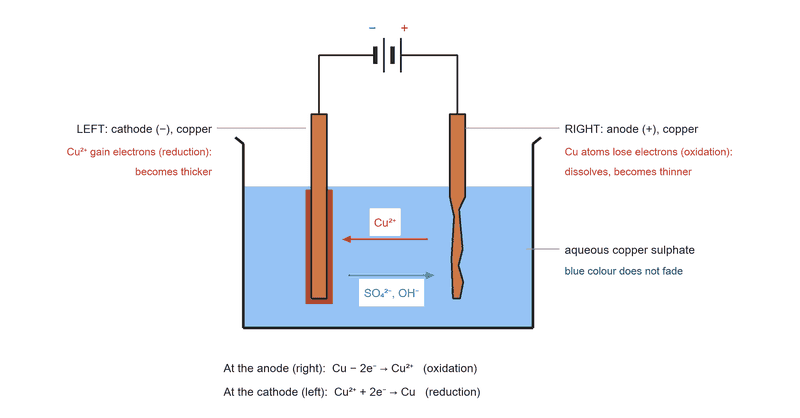
The right-hand electrode is joined to the positive terminal (the long plate of the cell), so it is the anode. There copper atoms lose electrons and go into solution as Cu2+, which is why it is shown eaten away. Loss of electrons is oxidation, so the right electrode is the oxidising electrode.
Step 2 — (b) Write the electrode reactions.
At the anode (right) copper is oxidised:
Cu−2e−⟶Cu2+
At the cathode (left) copper ions are reduced:
Cu2++2e−⟶Cu
Step 3 — (c) Two observations.
First, the anode becomes thinner while the cathode becomes thicker with a reddish-brown deposit of copper.
Second, the blue colour of the solution remains unchanged, because every Cu2+ ion removed at the cathode is replaced by one from the anode.
Therefore, (a) the right electrode (the anode) is the oxidising electrode; (b) Cu − 2e⁻ → Cu²⁺ at the anode and Cu²⁺ + 2e⁻ → Cu at the cathode; (c) the anode thins and the cathode thickens, and the blue colour does not fade.

