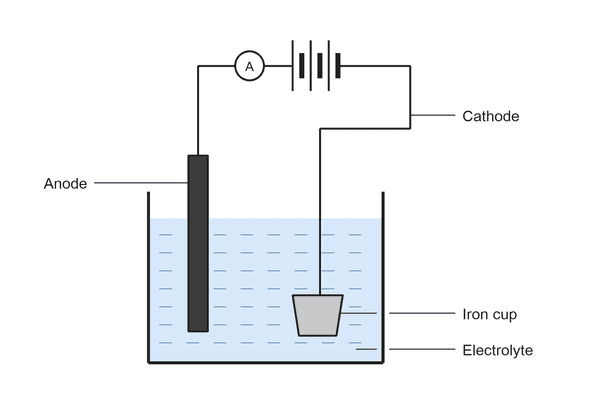
Solution:
Concept: Metal ions are cations; they move to the cathode and are deposited there by gaining electrons. In electroplating the article to be plated is the cathode, a block of the pure plating metal is the anode, and the electrolyte is a solution containing ions of the plating metal.
Step 1 — (a) Why the cup is the cathode.
The Ni2+ ions are positive, so they move to the cathode, where they gain electrons and are deposited as nickel metal. Placing the iron cup at the cathode makes the nickel deposit on the cup.
Step 2 — (b) Ion needed in the electrolyte.
The electrolyte must contain nickel ions, Ni2+, for example from nickel sulphate solution:
NiSO4⟶Ni2++SO42−
Step 3 — (c) A condition for a good deposit.
A low current should be passed for a longer time. The cup must also be thoroughly cleaned before plating, and direct current used.
Step 4 — (d) Reaction at the cathode.
At the iron cup nickel ions gain electrons:
Ni2++2e−⟶Ni
Step 5 — (e) Change at the anode.
The nickel anode dissolves and gradually becomes thinner:
Ni−2e−⟶Ni2+
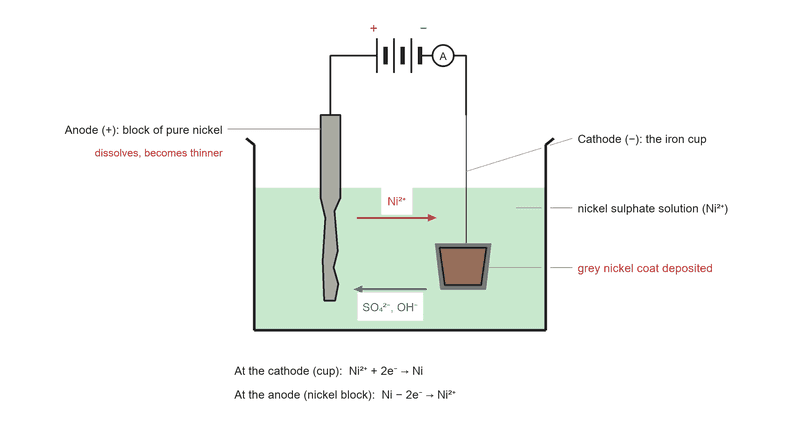
Therefore, (a) Ni²⁺ ions are deposited at the cathode, so the cup must be the cathode; (b) Ni²⁺; (c) low current for a longer time; (d) Ni²⁺ + 2e⁻ → Ni; (e) the nickel anode dissolves and becomes thinner.