Solution:
Concept: In plating and refining the anode is the metal that dissolves, and the cathode is where the pure metal is deposited. In extraction from a fused salt the anode is inert graphite.
Step 1 — (a) Complete the table.
Each row follows the rule above.
| Anode | Electrolyte | Cathode |
|---|
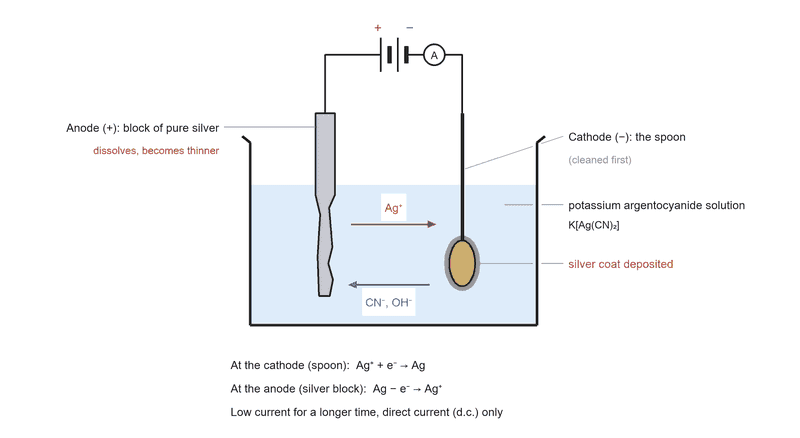
| (i) Silver plating of a spoon | Block of pure silver | Solution of potassium argentocyanide | The spoon |
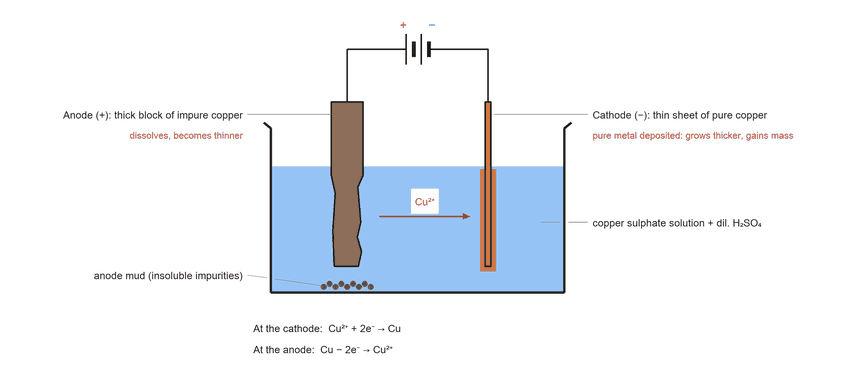
| (ii) Purification of copper | Impure copper (thick slabs) | Aqueous copper sulphate with a little dilute sulphuric acid | Thin strips of pure copper |
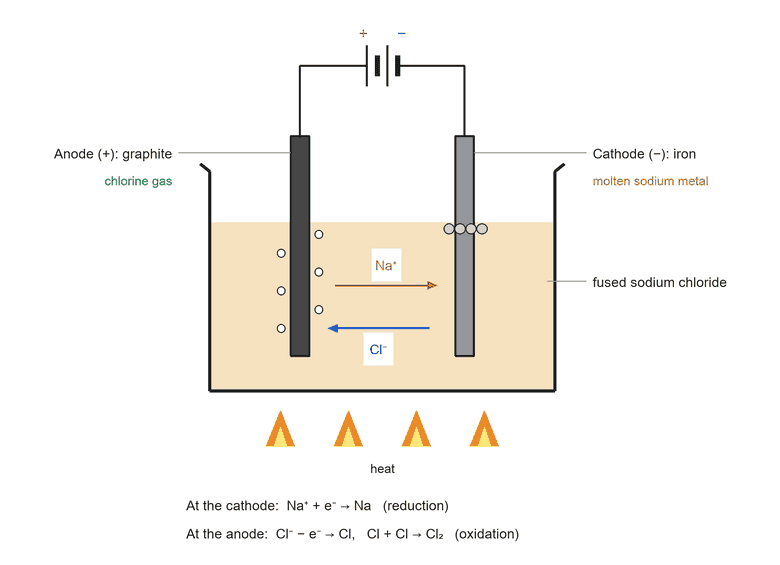
| (iii) Extraction of sodium | Graphite (carbon) | Fused sodium chloride (with a little calcium chloride to lower the melting point) | Iron |
Step 2 — (b) Anode reaction in silver plating.
The silver anode dissolves:
Ag−e−⟶Ag+
Step 3 — (b) Anode reaction in the purification of copper.
The impure copper anode dissolves, and insoluble impurities fall below it as anode mud:
Cu−2e−⟶Cu2+
Step 4 — (b) Anode reaction in the extraction of sodium.
Chloride ions are discharged at the graphite anode and chlorine is given off:
Cl−−e−⟶Cl
Cl+Cl⟶Cl2
Watch out: In refining, the IMPURE metal is the anode and the pure metal grows on the cathode.
Note: Part (b) as printed refers to 'Q. 2(a)'; it is taken to mean the three processes of the table in part (a).
Therefore, the anodes are pure silver, impure copper and graphite; the cathodes are the spoon, pure copper and iron; and the anode reactions are Ag − e⁻ → Ag⁺, Cu − 2e⁻ → Cu²⁺ and 2Cl⁻ − 2e⁻ → Cl₂.
