Solution:
Concept: Both electrodes are inert. So Cu2+ (lower than H+) is discharged at the cathode, OH− (lower than SO42−) at the anode, and nothing replaces the Cu2+ ions used up.
Step 1 — (a) Observations at the electrodes.
At the cathode a pink (reddish-brown) deposit of copper forms on the platinum. At the anode bubbles of a colourless gas, oxygen, are given off at the carbon.
Step 2 — (b) Change in the electrolyte.
The blue colour of the solution fades and finally the solution becomes colourless, because the Cu2+ ions are used up and not replaced. The solution also becomes acidic, because H+ and SO42− ions (sulphuric acid) are left behind.
Step 3 — (c) Reaction at the cathode.
Copper ions gain electrons:
Cu2++2e−⟶Cu
Step 4 — (c) Reaction at the anode.
Hydroxyl ions lose electrons, and the OH groups combine to give oxygen:
OH−−e−⟶OH
4OH⟶2H2O+O2
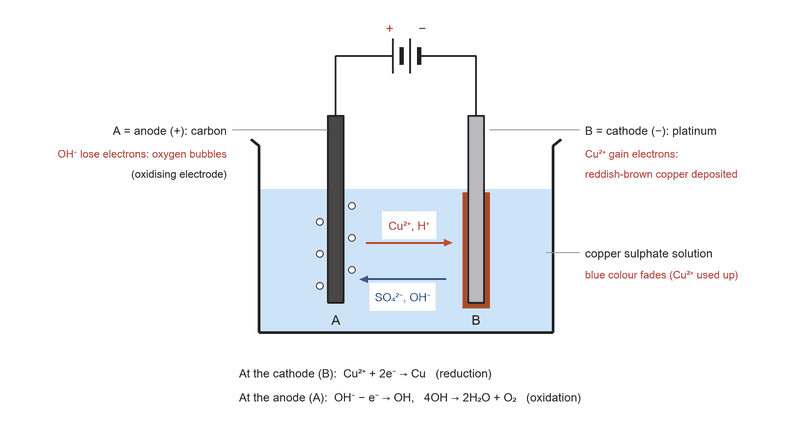
Watch out: With a copper anode the colour would NOT fade; it fades here only because the anode is inert.
Therefore, (a) copper deposits on the cathode and oxygen bubbles at the anode; (b) the blue colour fades and the solution turns acidic; (c) Cu²⁺ + 2e⁻ → Cu at the cathode and 4OH⁻ − 4e⁻ → 2H₂O + O₂ at the anode.
