Solution:
Concept: The oxide dissolves to give the hydroxide, a strong alkali. Since M is above hydrogen in the series, H+ (from water) is discharged at the cathode in preference to M+.
Step 1 — Write the ions present.
The oxide reacts with water to form the hydroxide, which dissociates:
M2O+H2O⟶2MOH
MOH⟶M++OH−
Step 2 — (a) Reaction at the cathode.
H+ ions gain electrons and hydrogen is liberated:
H++e−⟶H
H+H⟶H2
Step 3 — (b) Product at the anode.
OH− ions are discharged and the product is oxygen gas:
4OH−−4e−⟶2H2O+O2
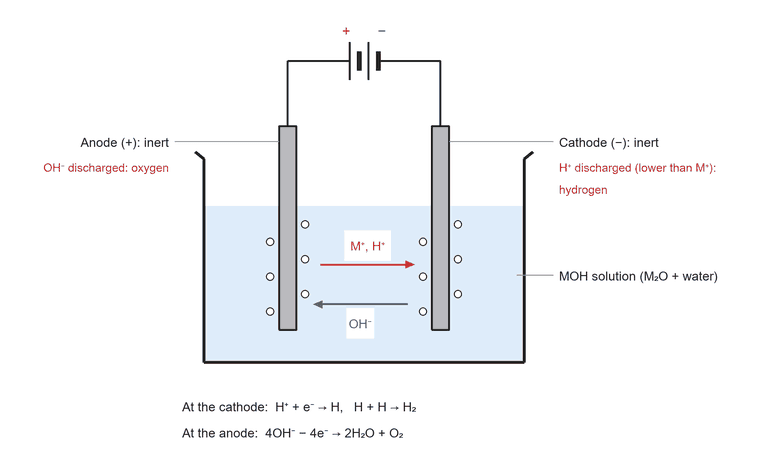
Watch out: M⁺ is not discharged, because M lies above hydrogen in the series.
Therefore, (a) at the cathode H⁺ + e⁻ → H and H + H → H₂ (hydrogen); (b) the product at the anode is oxygen.
