Solution:
Concept: Every reason here comes back to three things: whether there are free ions, which ion is discharged (its place in the electrochemical series), and whether the electrode is inert or active.
Step 1 — (a) Blue colour fades with platinum electrodes.
The blue colour is due to Cu2+ ions. They are discharged at the cathode as copper:
Cu2++2e−⟶Cu
The platinum anode is inert, so it does not dissolve to replace them; OH− ions are discharged there and oxygen is given off. The number of Cu2+ ions keeps falling and the blue colour fades.

Step 2 — (b) Lead bromide, molten and solid.
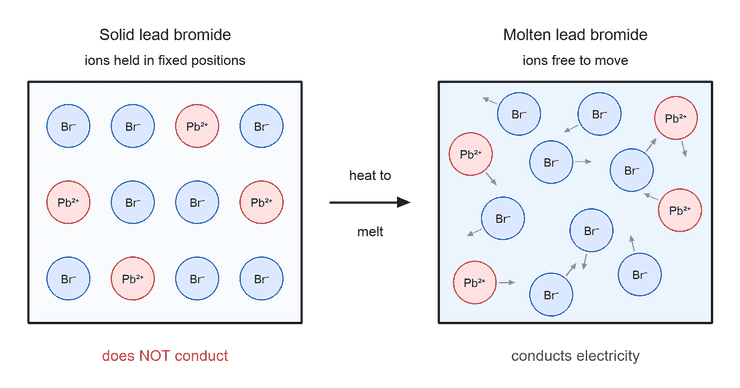
In solid lead bromide the Pb2+ and Br− ions are held in fixed positions by strong electrostatic forces and cannot move, so it does not conduct.
On melting, these forces are overcome and the ions become free to move:
PbBr2⟶Pb2++2Br−
Step 3 — (c) Aluminium needs electrolysis.
Aluminium is high in the electrochemical series and has a strong affinity for oxygen, so its oxide is very stable. Common reducing agents such as carbon monoxide or hydrogen cannot remove the oxygen from alumina.
Electrolysis supplies electrons directly at the cathode, so it can reduce the aluminium ions:
Al3++3e−⟶Al
Step 4 — (d) Hydrogen and oxygen in the ratio 2 : 1.
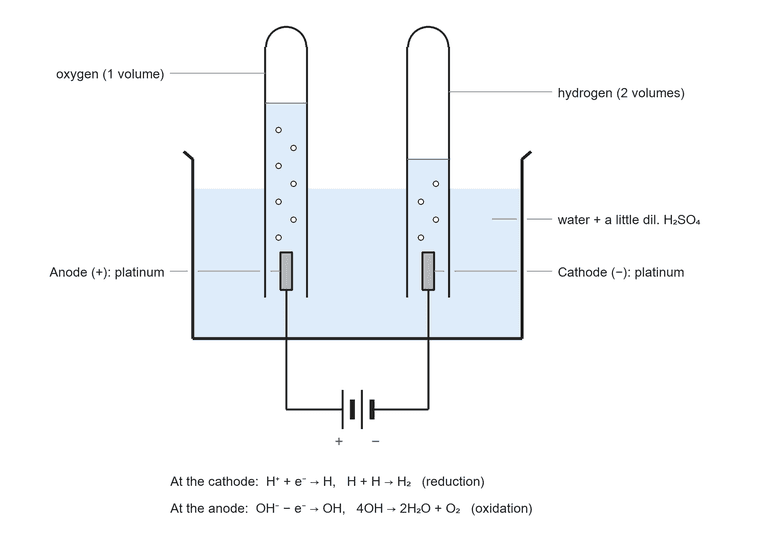
For every 4 electrons that pass, the cathode gives 2 molecules of hydrogen and the anode 1 molecule of oxygen:
4H++4e−⟶2H2
4OH−−4e−⟶2H2O+O2
By Avogadro's law, equal numbers of gas molecules occupy equal volumes at the same temperature and pressure, so hydrogen and oxygen form in the ratio 2 : 1 by volume.
Step 5 — (e) Sulphuric acid rather than nitric acid.
Dilute sulphuric acid is non-volatile, while dilute nitric acid is volatile; its vapour would escape and mix with the gases collected. Nitric acid is also an oxidising agent and could react with the products.
Step 6 — (f) Ammonia, gas and solution.
Gaseous ammonia is a covalent compound made only of NH3 molecules, so it has no ions. In water it forms ammonium hydroxide, which ionises only partly:
NH3+H2O⇌NH4++OH−
So its solution contains ions and molecules, which makes it a weak electrolyte.
Step 7 — (g) Direct current, not alternating.
With direct current each electrode keeps a fixed charge, so cations keep moving to the cathode and anions to the anode, and the products build up at fixed electrodes.
Alternating current reverses the polarity many times a second, so each electrode would be cathode and anode by turns, and no lasting chemical change (and no proper coat in plating) would take place.
Step 8 — (h) Liquid carbon tetrachloride.
Carbon tetrachloride is a covalent compound. Even as a liquid it consists only of molecules and has no free ions, so it cannot conduct electricity.
Step 9 — (i) Potassium from an aqueous solution.
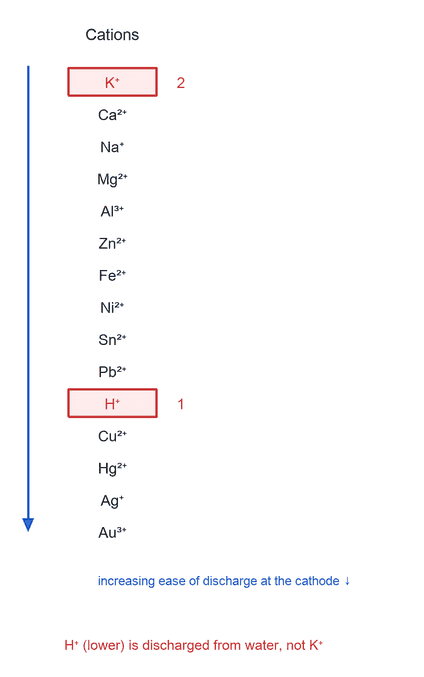
In an aqueous solution both K+ and H+ (from water) reach the cathode. H+ lies far below K+ in the series, so it is discharged instead, and hydrogen, not potassium, is formed:
2H++2e−⟶H2
Any potassium formed would in any case react violently with the water. Potassium is therefore extracted by electrolysis of a fused salt.
Step 10 — (j) Acidulated water and catalysis.
Pure water is almost entirely molecules. The dilute sulphuric acid increases the ionisation of water, so the water conducts and is decomposed into hydrogen and oxygen. The acid is not used up; the same amount remains at the end, as with a catalyst.
Step 11 — (k) Graphite anode for lead bromide.
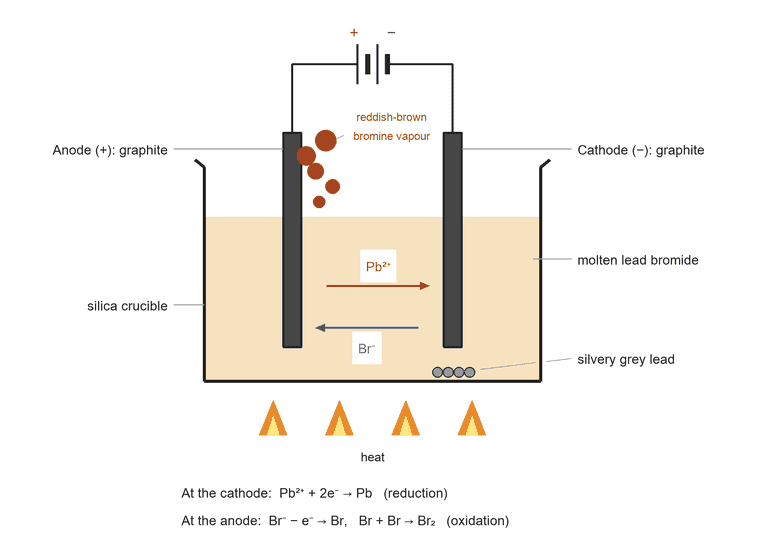
The bromine vapour given off at the anode is very reactive. Graphite is not attacked by bromine vapour, whereas many other electrodes would be.
Step 12 — (l) Lead bromide electrolysis is redox.
Reduction takes place at the cathode (gain of electrons) and oxidation at the anode (loss of electrons), at the same time:
Pb2++2e−⟶Pb
2Br−−2e−⟶Br2
So the overall change is a redox reaction:
PbBr2⟶Pb+Br2
Watch out: In (a) the colour fades only because the anode is inert; with a copper anode the colour stays (see the second beaker in the first figure).
Therefore, each reason rests on free ions (b, f, h), the order of discharge (a, d, i), the nature of the electrodes (a, k) and the nature of electrolysis itself (c, e, g, j, l), as explained above.
