Solution:
Concept: An electrolyte needs mobile ions; a good plating needs a slow, steady supply of metal ions; a metal conducts by electrons without any chemical change.
Step 1 — (a) Sodium chloride conducts only fused or dissolved.
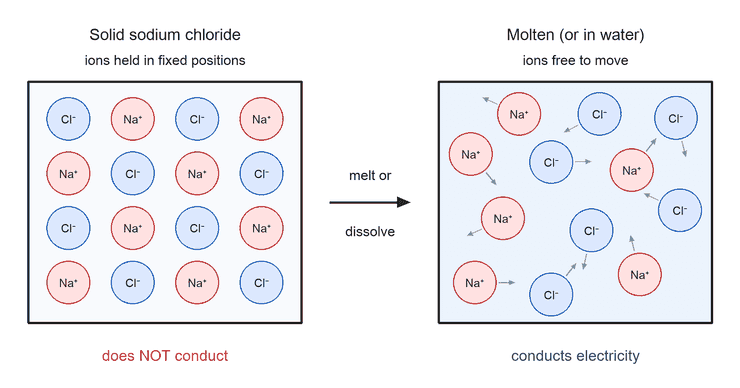
In solid sodium chloride the Na+ and Cl− ions are held rigidly in the crystal lattice and cannot move, so the solid does not conduct.
On fusion (melting) or on dissolving in water the ions become free and mobile, and they carry the current:
NaCl⟶Na++Cl−
Step 2 — (b) Sodium argentocyanide rather than silver nitrate.
Sodium argentocyanide, Na[Ag(CN)2], gives the complex argentocyanide ion, which releases silver ions only slowly:
Na[Ag(CN)2]⟶Na++[Ag(CN)2]−
[Ag(CN)2]−⇌Ag++2CN−
So silver is deposited slowly and evenly on the article, giving a smooth, firm and long-lasting coat. With silver nitrate the deposition is very fast, so the coat is not smooth and uniform.

Step 3 — (c) Copper is a non-electrolyte.
Copper conducts by the movement of free electrons, not ions, and it undergoes no chemical change when the current passes.
An electrolyte must conduct by ions and be decomposed by the current, so copper is a non-electrolyte (a metallic conductor).
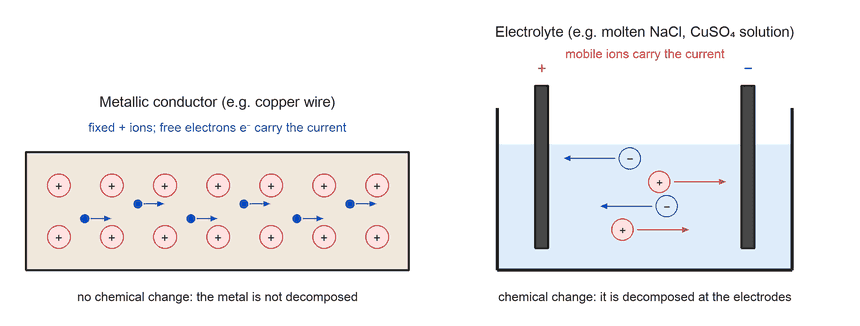
Therefore, (a) NaCl has mobile ions only when fused or dissolved; (b) sodium argentocyanide releases Ag⁺ slowly and gives an even coat; (c) copper conducts by electrons without being decomposed.
